Thomas Goltz - Chechnya Diary
Здесь есть возможность читать онлайн «Thomas Goltz - Chechnya Diary» весь текст электронной книги совершенно бесплатно (целиком полную версию без сокращений). В некоторых случаях можно слушать аудио, скачать через торрент в формате fb2 и присутствует краткое содержание. Город: New York, Год выпуска: 2011, ISBN: 2011, Издательство: Thomas Dunne Books, Жанр: Биографии и Мемуары, military_history, Публицистика, на английском языке. Описание произведения, (предисловие) а так же отзывы посетителей доступны на портале библиотеки ЛибКат.
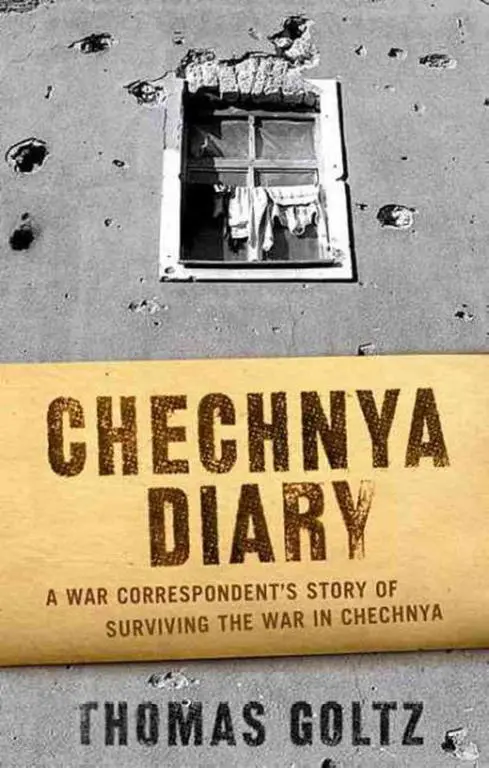
- Название:Chechnya Diary
- Автор:
- Издательство:Thomas Dunne Books
- Жанр:
- Год:2011
- Город:New York
- ISBN:0-312-26874-2
- Рейтинг книги:3 / 5. Голосов: 1
-
Избранное:Добавить в избранное
- Отзывы:
-
Ваша оценка:
Chechnya Diary: краткое содержание, описание и аннотация
Предлагаем к чтению аннотацию, описание, краткое содержание или предисловие (зависит от того, что написал сам автор книги «Chechnya Diary»). Если вы не нашли необходимую информацию о книге — напишите в комментариях, мы постараемся отыскать её.
is part of a larger exploration of the role (and impact) of the media in conflict areas. And at its heart,
is the story of Hussein, the leader of the local resistance in the small town that bears the brunt of the massacre as it is drawn into war.
This is a deeply personal book, a first person narrative that reads like an adventure but addresses larger theoretical issues ranging from the history of ethnic/nationalities in the USSR and the Russian Federation to journalistic responsibility in crisis zones.
is a crossover work that offers both the historical context and a ground-level view of a complex and brutal war.
Chechnya Diary — читать онлайн бесплатно полную книгу (весь текст) целиком
Ниже представлен текст книги, разбитый по страницам. Система сохранения места последней прочитанной страницы, позволяет с удобством читать онлайн бесплатно книгу «Chechnya Diary», без необходимости каждый раз заново искать на чём Вы остановились. Поставьте закладку, и сможете в любой момент перейти на страницу, на которой закончили чтение.
Интервал:
Закладка:
“Prekhadite!” said Viktor, asking me to enter.
The apartment was—what?
Normalna, in the Soviet sense: a couple of dumpy easy chairs and a sofa pushed against the edges of the living room, a cluster of still-life pictures pinned on the flower-pattern wallpaper walls. A piano, out of tune, a stuffed chair or two, and dominating everything else a very large, glass-encased bookshelf filled with encyclopedias and other untouched classics (Tolstoy and Lermontov, as well as Soviet-approved translations of Hemingway, Henry James, and Jack London, all favorite “socialist” authors) churned out by Soviet-era publishing. The kitchen had a tiny fridge and the toilet and bathroom were two different rooms, with no sink in the former, and a rotational spigot in the latter that served, by turns, both for washing hands and taking a shower. All standard Soviet issue.
What was different about the apartment were the bullet-blasted holes in the ceiling and walls. Viktor pulled off his suit coat and rolled up his shirt to show me the shrapnel cuts he had received when the first RPG smacked into the wall of his study where he had been sitting, waiting out the madness on the streets of his hometown.
“I am a Russian, a veteran of the Great War, and a conqueror of Berlin,” he intoned. “I have seen filth and horror—but I never expected my army to do this to me!”
The sound bites comparing Berlin to Grozny were good material and exactly what I wanted. But then Viktor threw me a curveball. Without reference to the fact that I was shooting, he got up and walked to his library and extracted a large folder and plopped it down on the living room table. It was his Book of War, consisting of diary entries and press clips and assorted photographs of the men in his unit, men drawn from across the depth and breadth of the Soviet space, and of every ethnic background one could think of.
“Ah, this is Kasimov, my Azeri friend. We forced the fascists out of bunker twenty-three at Selow with our mortar, and this is Bedrossian, the Armenian who saved my life in the eastern suburbs of the fascist capital when he warned me the woman on the bicycle was carrying a grenade and shot her dead before she could reach my trench.”
The veteran turned page after page, reading every line, finger-scrolling over the text.
“Then on May 2, following our short celebration of International Workers’ Day, we pushed on to Potsdam and the enemy entrenchments there. It was a hard fight.”
Viktor was giving me the closing moments of World War II and the street fighting that ended with the capture of Berlin, but I was not really interested. I wanted his account of the Russian conquest of Grozny, and although he was well placed to do so, his focus remained on the war he had fought exactly fifty years before.
“Then, on May 4, Colonel Tikhamirov announced the 104th would have the honor to advance on the enemy down the Prinzlauer Allee, and into the heart of the fascist beast.”
Viktor was reading, mesmerized by the propaganda prose he was voicing, maybe even chanting, so soaked in memories he was not even aware when I turned off my camera.
“On May 6, following the dispute between captains Bugadov and Trishkin, the order was given to advance, despite the desperate fire of the enemy from the city center; it was then that Corporal Liftinski, who had been with me since Stalingrad and was a fine socialist soldier, sustained a curious wound in his abdomen that neither myself nor the medics were able to abort, and Corporal Liftinski died in my arms at three-thirty-seven that afternoon. After burying him in a garden-he always spoke passionately of his garden in Irbit, where he farmed as part of the First of May Tractor Commune in that district—we continued to advance on the enemy, cogently aware of snipers…”
I snuck out of Victor’s home, leaving the old man alone with his memories, catching the evening plane back to Moscow with little hope that World News Tonight with Peter Jennings would have any room for Viktor and Chechnya and me.
They did not.
“The story has moved on,” said ABC.
I was not surprised or even disappointed. They had been friendly enough to give me a camera and pay me decent money to go down and hang as the emergency ABC video news asset in Chechnya, and that was good enough. But I also had a pretty good idea of another channel that might be interested in my new war archives.
“Let us take a look at what you shot,” asked Yevgenii Kisilov over at NTV’s Itogi. Five minutes later he went into conference with his producers and then came back to me.
“Write me a script. Four or five minutes. We are using this tonight.”
“Script?” I asked. “On what?”
“The front.”
“There is no front.”
“Then call it just that. Gdeje Front? —‘Where’s the Front?’”
And so I did. About fifteen minutes or a half hour later I was in the sound studio voicing a short piece that meditated on the inanity, weirdness, and wickedness of war in the Caucasus, with a series of video images arbitrarily culled from the material I had shot for ABC. It began with Belgian doctors in Shatoi desperately trying to pump the heart of a blood-stained victim back to life following a rocket attack that had officially never happened, a two-meter-tall basketball player in better times strumming a guitar and singing a lament about Chechnya in Russian, a triumphant young guerilla standing on the shattered tail of the crashed fighter-bomber at Vedeno, the negotiations between Asian Maskhadov and General Trochev at Novi Atagi, and the subsequent double cross at the Chiri Yurt cement factory. Then there was the funeral for eight and the dirge circle at Stari Atagi, the collision between the Captain Artur Kinjaliyan’s APC and the rogue T-82 battle tank driven by drunks, the wild night in Grozny celebrating VE Day in Europe by firing AK-47 tracers and RPG grenades against the walls of gutted buildings next to Salman Khadjiev’s administration office, morning coffee with Kiril and his pals cleaning their guns for another day of shooting after a brief break to sun their buns at The Beach atop the shattered central post office, and, finally, the VE-Day parade in Grozny and the slow walk home with a stooped old man named Viktor, hero of the Great War, reading from his personal scrapbook that might be regarded as his Book of the Dead.
In the television trade, throwing images together like this is called “wallpapering,” and is frowned on by Western television (and particularly American-network) stylists.
“It was beautiful,” said Steve Coppen, the ABC bureau boss the next day, as I stopped by to square the circle and say good-bye. “I only wish I could pitch something like that to the desk—but they would never go for it. There is no American involved.”
Where’s The Front?
It was no longer Samashki.
I had not even bothered to stop by there.
PART FOUR
15
THE CONSOLATION PRIZE IS LIFE
For a guy who does not own a television set, it was a little overwhelming.
Everyone who was anyone in international TV was there, coiffed and perfumed and dressed in tuxedo or gown. John Simpson, Michael Ignatieff, Tira Shubart, Sue Inglish of Channel Four, Peter Jouvenal, Mark Foley and the entire ABC London office, Ron McCullough of Insight News, and blocks of producers, reporters, editors, and camera-people from CNN, ITN, WTN, and APTV, to name just a few of the alphabet soup of acronyms standing for the International This and World That agencies and production houses specializing in foreign television news.
The presenter was Nik Gowing, the anchor of the BBC’s Evening News Division, but the focus of the evening was Rory’s widow, Juliette, an iron lady with an aristocrat’s accent and a black patch over one eye.
Читать дальшеИнтервал:
Закладка:
Похожие книги на «Chechnya Diary»
Представляем Вашему вниманию похожие книги на «Chechnya Diary» списком для выбора. Мы отобрали схожую по названию и смыслу литературу в надежде предоставить читателям больше вариантов отыскать новые, интересные, ещё непрочитанные произведения.




Обсуждение, отзывы о книге «Chechnya Diary» и просто собственные мнения читателей. Оставьте ваши комментарии, напишите, что Вы думаете о произведении, его смысле или главных героях. Укажите что конкретно понравилось, а что нет, и почему Вы так считаете.