Thomas Goltz - Chechnya Diary
Здесь есть возможность читать онлайн «Thomas Goltz - Chechnya Diary» весь текст электронной книги совершенно бесплатно (целиком полную версию без сокращений). В некоторых случаях можно слушать аудио, скачать через торрент в формате fb2 и присутствует краткое содержание. Город: New York, Год выпуска: 2011, ISBN: 2011, Издательство: Thomas Dunne Books, Жанр: Биографии и Мемуары, military_history, Публицистика, на английском языке. Описание произведения, (предисловие) а так же отзывы посетителей доступны на портале библиотеки ЛибКат.
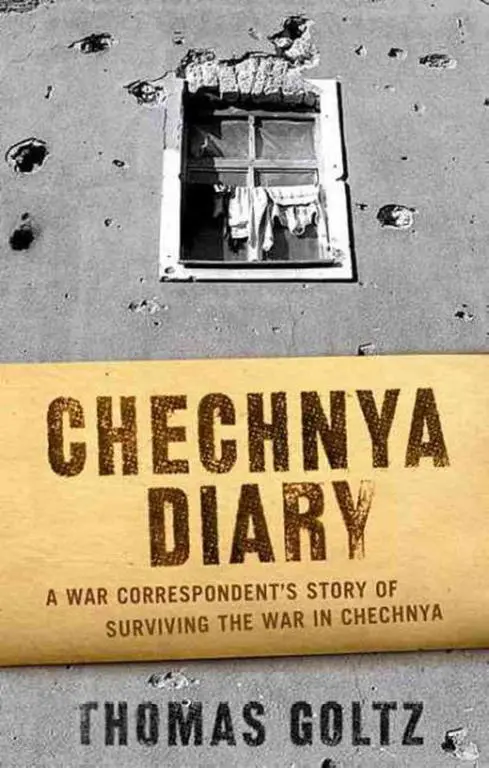
- Название:Chechnya Diary
- Автор:
- Издательство:Thomas Dunne Books
- Жанр:
- Год:2011
- Город:New York
- ISBN:0-312-26874-2
- Рейтинг книги:3 / 5. Голосов: 1
-
Избранное:Добавить в избранное
- Отзывы:
-
Ваша оценка:
Chechnya Diary: краткое содержание, описание и аннотация
Предлагаем к чтению аннотацию, описание, краткое содержание или предисловие (зависит от того, что написал сам автор книги «Chechnya Diary»). Если вы не нашли необходимую информацию о книге — напишите в комментариях, мы постараемся отыскать её.
is part of a larger exploration of the role (and impact) of the media in conflict areas. And at its heart,
is the story of Hussein, the leader of the local resistance in the small town that bears the brunt of the massacre as it is drawn into war.
This is a deeply personal book, a first person narrative that reads like an adventure but addresses larger theoretical issues ranging from the history of ethnic/nationalities in the USSR and the Russian Federation to journalistic responsibility in crisis zones.
is a crossover work that offers both the historical context and a ground-level view of a complex and brutal war.
Chechnya Diary — читать онлайн бесплатно полную книгу (весь текст) целиком
Ниже представлен текст книги, разбитый по страницам. Система сохранения места последней прочитанной страницы, позволяет с удобством читать онлайн бесплатно книгу «Chechnya Diary», без необходимости каждый раз заново искать на чём Вы остановились. Поставьте закладку, и сможете в любой момент перейти на страницу, на которой закончили чтение.
Интервал:
Закладка:
Rory, of course, was the late, great Rory Peck.
A swashbuckling cameraman extraordinaire who had worked every hellhole from Afghanistan to Abkhazia, Rory had given the concept of “freelance” such new and profound meaning in the way of devotion to duty that he had become an icon long before his death. On that awful day of October 3, 1993, in Moscow, when Boris Yeltsin “reestablished” democratic order in the “New Russia” by turning tanks first on the White House, or Russian parliament. Not satisfied with that, he then turned his attention to the Ostankino Television tower, allegedly because discontents were about to seize control of Russian broadcasting and announce a coup, or maybe a revolution against Yeltsin’s revulsions. Rory was there with his camera as soldiers and snipers began shooting into the crowd, and he caught a sniper’s bullet through the brain as he filmed footage for Sonia Mikich and her ARD bureau. We had been together in Tbilisi only two or three days before, laughing and drinking after my escape from Sukhumi. For Rory, the consolation prize for not living longer took the form of an annual award in his name, presented to the freelance cameraman who had shown most gumption in any given year.
The first year, the Rory Peck Prize was awarded posthumously to Farhad Karimov, a cameraman from Azerbaijan. He had worked with Lawrence Sheets in diverse Caucasus conflict zones, such as the siege and fall of Sukhumi in 1993, but most notably during the siege and fall of Grozny in the winter of 1994-1995, when he had established a reputation for himself as someone willing to take the most insane risks imaginable just to capture a particular shot. I had last seen Farhad at the Reuters office at the Raddison-Slavanskaya hotel in Moscow in March of that year, when he was desperately trying to check out reports that another Reuters cameraman, Adil Bunyadov, had just been killed in Baku during the course of a confusing counter-coup melee. I noted that Farhad’s attitude toward frontline camerawork had begun to change.
“All we are doing is risking our lives and those of the people around us for the sake of entertainment,” he had said at the time. He then said he was so sick of war reporting that he had hung up his camera and “returned to the mosque,” meaning he had quit smoking and drinking and had turned to prayer, urging me to do the same.
That is what Farhad had said then. But within a week or two he had changed his mind. Either the compulsion to cover war or the compulsion to cover debt had led him to cast his pacific vows aside and take on a new combat camera job with the Associated Press. Camera in hand, he had come up the same Azerbaijan-Dagestan-Chechnya pipeline that I had traveled scant months before, when he was murdered in the mountains before he could record a moment of his journey.
For his money? His camera? His smile?
Farhad, like Rory, was now lionized as the epitome of selfless news-serving, a legend deserving posthumous awards. Accolades, instead of a longer life.
Ours was the second year of the Rory Peck prize, and a wide field of entries had been culled down to four finalists, whose work, in the words of the chairman of judges, met the Rory Peck criteria of being as human, stylish, and eccentric as the man the prize was named after. We were also, most notably, all still alive.
This could not be said for Rory, Farhad, and a number of other freelancers who appeared within the context of the warmup film shown to kick off the gala affair. The extreme case was an overly aggressive Bosnian who had managed to film his own death, which we all got to see in extended form on the screen in front of us.
The list of dead and missing was extensive, but there was equal focus on the parallel issue of the surviving wives and children of killed cameramen, who, through the lack of combat or danger insurance, had been flung into debt and destitution. The frustration and plight of freelancers collecting bang-bang material that was simply too awful and brutal to be shown in anything other than snuff movies was another theme. Why bother to collect such material at all?
Then Nik Gowing, a face more known and respected in the U.K. and the larger BBC world than Peter Jennings, Tom Brokaw, and Dan Rather combined, appeared behind the lectern to formally introduce each of the four finalists for the 1996 Rory Peck Award, and show a short, representative clip of the work that had brought each candidate to the hall.
The first was a three- or four-minute segment of a feature piece by Canadian producer and camerawoman Jane Kokan that had appeared on Channel Four’s Dispatches program. It was entitled “Sanski Most ,” or “The Bridge at Sanski,” and detailed with humor and brutality the activities of a Bosnian battalion in the final paroxysm of violence of the Bosnia-Serbia war. The next was a news story from Hedley Trigge, a BBC stringer in the Middle East who had been traveling with a UN relief convoy in Lebanon when it was bombed by precision-placed Israeli artillery, an attack designed not so much to kill or maim the Blue Berets as scare the shit out of them. The third candidate was a dark piece on beleaguered journalists in Algeria by Shane Teehan, but it could have been on Colombian drug wars, or Sri Lanka strife for all I cared, because my piece was next, and quite frankly I was not watching anything else by anybody any longer.
“Thomas Goltz, one of the finalists tonight, spent six months among the Chechens with no guarantee that he would make a farthing until his reportage was purchased by ABC,” Gowing solemnly intoned.
This was not exactly correct, but close enough to tickle. I had spent perhaps six weeks in Samashki, and ABC had only really been interested in the sixty seconds of massacre footage broadcast more than a year and a half before, and not in the material that had gone into the ten-minute piece that had brought me to the Peck Awards, but no matter.
The lights dimmed, and on the huge screen in that packed auditorium came images that had me traveling back in time.
Hussein, spinning that waterwheel at the pump station he had previously wanted to buy, when oblivious to the fact that said station had been made out of the tombstones of his ancestors; Hussein, single-loading shells in that front-line gun pit against amazingly overwhelming odds; Hussein, the defender of Samashki against the Russian Bear; the first storming of the town, the mothers and monks march, and then corpses being lowered into graves as Samashki put its dead to rest. “When shall the bloodshed cease in the mountains?” came my recorded voice, quoting a Chechen proverb. “When sugarcane grows in the snow.”
And then the clip was over and Nik Gowing was calling us to mount the stage.
“Good luck,” we said to each other, smiling and lying to each other the way all finalists have done for all time and will continue to do.
We all wanted ourselves to win and hoped the rest were losers.
It had been a long march to the Rory Peck Awards.
Following an assignment from the New York Times to cover the great earthquake on the far eastern Russian island of Sakhalin, I had returned to Montana via Istanbul to lick my wounds of war. A swing band was playing at the Murray Bar, a swimmer was lost in the Yellowstone flood, and Walter and Maggie Kirn had gotten married. I nearly burned down the barn because my hillbilly welfare tenants wouldn’t leave and let me back in my house, and Senate leader Newt Gingrich had launched his Contract With America. I did not quite understand all the excitement and buzz about e-mail and the Internet because I did not yet know what e-mail and the Internet were. I guess I had been out of the technological loop for a spell, with war raging all around me.
Читать дальшеИнтервал:
Закладка:
Похожие книги на «Chechnya Diary»
Представляем Вашему вниманию похожие книги на «Chechnya Diary» списком для выбора. Мы отобрали схожую по названию и смыслу литературу в надежде предоставить читателям больше вариантов отыскать новые, интересные, ещё непрочитанные произведения.



Обсуждение, отзывы о книге «Chechnya Diary» и просто собственные мнения читателей. Оставьте ваши комментарии, напишите, что Вы думаете о произведении, его смысле или главных героях. Укажите что конкретно понравилось, а что нет, и почему Вы так считаете.