Thomas Goltz - Chechnya Diary
Здесь есть возможность читать онлайн «Thomas Goltz - Chechnya Diary» весь текст электронной книги совершенно бесплатно (целиком полную версию без сокращений). В некоторых случаях можно слушать аудио, скачать через торрент в формате fb2 и присутствует краткое содержание. Город: New York, Год выпуска: 2011, ISBN: 2011, Издательство: Thomas Dunne Books, Жанр: Биографии и Мемуары, military_history, Публицистика, на английском языке. Описание произведения, (предисловие) а так же отзывы посетителей доступны на портале библиотеки ЛибКат.
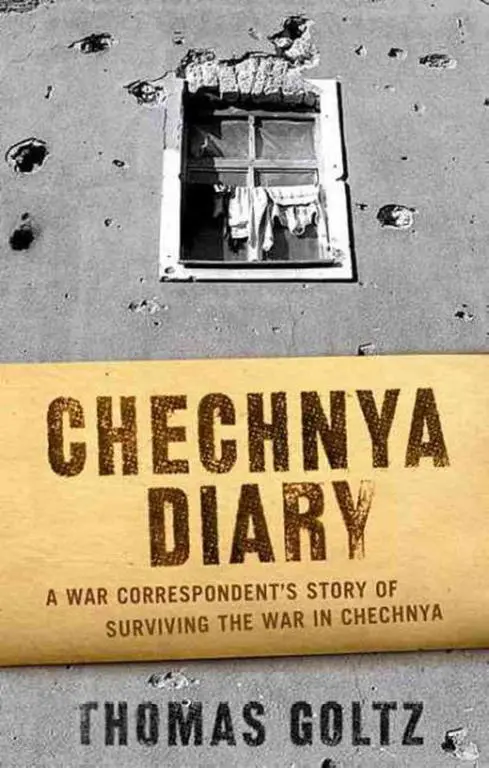
- Название:Chechnya Diary
- Автор:
- Издательство:Thomas Dunne Books
- Жанр:
- Год:2011
- Город:New York
- ISBN:0-312-26874-2
- Рейтинг книги:3 / 5. Голосов: 1
-
Избранное:Добавить в избранное
- Отзывы:
-
Ваша оценка:
Chechnya Diary: краткое содержание, описание и аннотация
Предлагаем к чтению аннотацию, описание, краткое содержание или предисловие (зависит от того, что написал сам автор книги «Chechnya Diary»). Если вы не нашли необходимую информацию о книге — напишите в комментариях, мы постараемся отыскать её.
is part of a larger exploration of the role (and impact) of the media in conflict areas. And at its heart,
is the story of Hussein, the leader of the local resistance in the small town that bears the brunt of the massacre as it is drawn into war.
This is a deeply personal book, a first person narrative that reads like an adventure but addresses larger theoretical issues ranging from the history of ethnic/nationalities in the USSR and the Russian Federation to journalistic responsibility in crisis zones.
is a crossover work that offers both the historical context and a ground-level view of a complex and brutal war.
Chechnya Diary — читать онлайн бесплатно полную книгу (весь текст) целиком
Ниже представлен текст книги, разбитый по страницам. Система сохранения места последней прочитанной страницы, позволяет с удобством читать онлайн бесплатно книгу «Chechnya Diary», без необходимости каждый раз заново искать на чём Вы остановились. Поставьте закладку, и сможете в любой момент перейти на страницу, на которой закончили чтение.
Интервал:
Закладка:
Or without me.
In June 1995, the Chechen field commander Shamil Basayev and a crowd of suicide commandoes had bribed their way across Russian lines and penetrated some two hundred kilometers outside Chechnya’s border to take over a hospital in the Russian town of Budyanovsk, and were using over one hundred patients as human shields.
This was hot! This was news!
But I could not get an assignment to send me back over to my war. The reason for my unemployed state, I was sure, was directly connected to a fax I had received upon my return from Moscow to Montana.
The line quality was bad, but it was still very identifiably a mug shot of me wearing a beard and staring at a camera for a passport photo. Someone had inked in the word “(Un) Wanted!” in bold letters over the portrait, in the spirit of the words Dead or Alive that used to adorn hanging trees throughout the Old West. The more modern symbol of undesirability—a large “X” similar to No Smoking, No Radios , and No Skateboards —crossed out my face. Beneath this image, also written in bold type, were the words “VNI Hall of Heroes,” but with a “Z” written over the “H” of the last word, converting the sentence to “ VNI Hall of Zeroes .”
Video News International, the people who had left me in the lurch in Chechnya, had been having some fun at my expense. But what was written at the bottom of the one-page poster was not very humorous at all. It read:
Tomas Stalinsky Goltzkoi: Leader of Russian forces in the assault on Chechnya, he attempted the ultimate spin-doctor maneuver by trying to pass off badly shot home video of same as a journalist’s account of stubborn Chechen resistance to superior fire power.
The poster.
I had sent dozens of copies of my rough-cut Samashki film to dozens of production houses, but with no result. Thanks, but no thanks, was the nicest reply I received.
True, the war in Chechnya had moved so far off the American news radar that it had literally disappeared from view—but I was increasingly convinced that the reason I could not get an assignment was because my reputation had been ruined.
The poster.
Not only was I a lousy cameraman and journalist, but also a Russian disinformation specialist. Had the poster traveled to those very same New York newsrooms that were now turning down my Samashki film left and right? What about Europe? Turkey? Russia? Chechnya?
No, it did not look like a joke to me.
My erstwhile employers were not only ruining my career—they had just put a potential death warrant on my head.
The poster.
In retrospect, I guess my behavior might be said to be linked to Post-Traumatic Stress Disorder caused by the rusty razor blade of a distant war remembered, and the fact that I was forced to watch it as a distant voyeur. I spit and fought and drank and shrieked and relived Samashki and Chechnya on a daily basis, alienating friends and family, and hating the fireworks on the Fourth of July. There was Crow Fair and Annual All-Indian Rodeo within sight of the Little Big Horn Battlefield, where I joined the Fancy Dancers from the Lakota reservation, performing a zikr in the open sessions while trying to make profound connections between the white man’s conquest of the American West and the Russian conquest of the Caucasus. If this sounds strange—and to this day I do not think the comparison so much unreasonable as just obscure—I was certainly drifting off in still more distant directions and walking the thin line that separates delusion from insight.
Months passed. September, October, and then the holiday season and December, and I had been without a stitch of income for more than six months, save for an article written for Soldier of Fortune and a couple of lectures at scattered venues, where the main income came from charging the organizers the equivalent value of the Sky Miles cash-in tickets that I burned. Friends and family were fronting me small loans, and my diet consisted almost exclusively of deer I had shot during hunting season.
The poster.
The only access to information on Chechnya was a newly created Web site on the newly created Internet. The Web site was run by a Dane named Norbert for a dozen or so obsessed members of a Chechnya-specific discussion group to which I became instantly addicted, logging on for all-night, on-line screed sessions with the other ether personalities who also seemed to have nothing better to do than sit up all night and rant-punch the keyboard. The most frequent contributor, and thus combatant, was an Armenian academic named Artur, who kept changing his name when suspended from the list for violating Netiquette, mainly in the way of hurling personal abuse and invective at a car mechanic who lived somewhere in Massachusetts and who went by the name of Mark, but had been revealed as really being a North Caucasian Muslim named Murat. Other regulars included a Canadian Quaker named Ross, who urged peace for both the real and the electronic Chechnya, and a Washington-based lawyer named Boyd, whose convoluted legal analysis and determination to take Boris Yeltsin to the newly established War Crimes tribunals at the Hague only partially obfuscated the fact that he was either insane or an anarchist or both.
I had no one else to speak to; I knew no one else who cared. It was, altogether, a bleak Montana winter.
Then in February, or maybe March 1996, the telephone rang.
The person on the other end of the line identified himself being one Danny Schechter, and in a thick New York accent he explained that he was the director of a New York City production house called Global Vision. Specifically, he said he was the producer of a program called Right and Wrongs, and that he had finally gotten around to viewing that VHS tape I had sent months before. While the quality of the copy was pretty bad, he was interested if I had the originals, because R & W was thinking of doing a special episode on Chechnya, and that while they did not pay much because they were a not-for-profit organization dedicated to truth and verity, there might be some compensation involved if the original material were up to snuff.
Rights and Wrongs . I had never heard of the show before.
The Global Vision office was located in a building fenced in by kebab stands and basement porno joints on Broadway and the low fifties, and was in a constant state of chaos of interns running in and out of cramped studios working on seventeen shows at once. Framed letters of thanks and praise, including one from Nelson Mandela, had pride of place in the visitor’s waiting area. They described Global Vision in terms such as “radical” and “extraordinary.” One framed newspaper clip described Danny Schechter—usually referred to as the “News Dissector,” it seemed—as being a visionary child of the 1960s antiwar movement who had won a coveted Nieman Fellowship at Harvard in the 1970s, translated that into a full producer’s job at ABC in the 1980s, only to toss it all away in disgust at the dumbing-down practices of the mainstream American media, which was only interested in product for profit.
I heard The Dissector ranting on the phone about something to someone some fifteen minutes before he kicked his office door open and commanded his secretary to allow me to enter the inner sanctum. He greeted my arrival with a torrent of abuse to whomever he was talking to on the other line, while suggesting with hand gestures that I redistribute the mounds of yesterday’s papers scattered on his visitor’s chair and have a seat.
“No, no, no!” he shouted, maligning his invisible audio victim. “I will not accept that bastard’s apology! Remind him that until he comes crawling on his knees to beg forgiveness for his awful journalistic sins, we will continue to ream his ass and refer to him as the fascist that he is!!”
Читать дальшеИнтервал:
Закладка:
Похожие книги на «Chechnya Diary»
Представляем Вашему вниманию похожие книги на «Chechnya Diary» списком для выбора. Мы отобрали схожую по названию и смыслу литературу в надежде предоставить читателям больше вариантов отыскать новые, интересные, ещё непрочитанные произведения.






Обсуждение, отзывы о книге «Chechnya Diary» и просто собственные мнения читателей. Оставьте ваши комментарии, напишите, что Вы думаете о произведении, его смысле или главных героях. Укажите что конкретно понравилось, а что нет, и почему Вы так считаете.