Thomas Goltz - Chechnya Diary
Здесь есть возможность читать онлайн «Thomas Goltz - Chechnya Diary» весь текст электронной книги совершенно бесплатно (целиком полную версию без сокращений). В некоторых случаях можно слушать аудио, скачать через торрент в формате fb2 и присутствует краткое содержание. Город: New York, Год выпуска: 2011, ISBN: 2011, Издательство: Thomas Dunne Books, Жанр: Биографии и Мемуары, military_history, Публицистика, на английском языке. Описание произведения, (предисловие) а так же отзывы посетителей доступны на портале библиотеки ЛибКат.
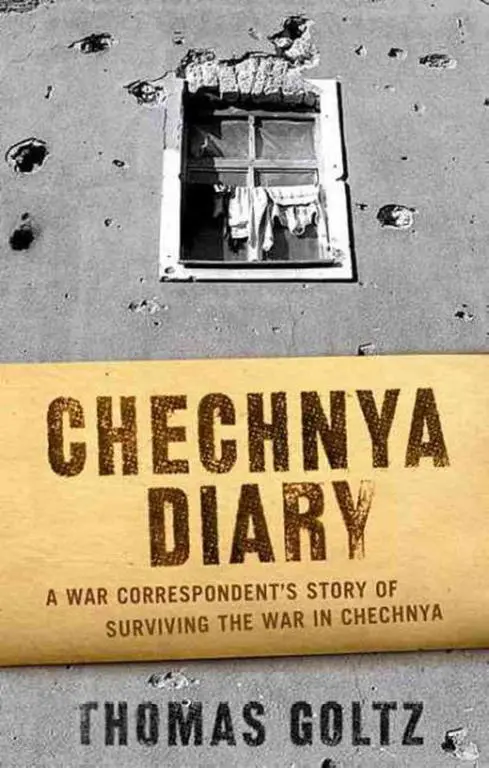
- Название:Chechnya Diary
- Автор:
- Издательство:Thomas Dunne Books
- Жанр:
- Год:2011
- Город:New York
- ISBN:0-312-26874-2
- Рейтинг книги:3 / 5. Голосов: 1
-
Избранное:Добавить в избранное
- Отзывы:
-
Ваша оценка:
Chechnya Diary: краткое содержание, описание и аннотация
Предлагаем к чтению аннотацию, описание, краткое содержание или предисловие (зависит от того, что написал сам автор книги «Chechnya Diary»). Если вы не нашли необходимую информацию о книге — напишите в комментариях, мы постараемся отыскать её.
is part of a larger exploration of the role (and impact) of the media in conflict areas. And at its heart,
is the story of Hussein, the leader of the local resistance in the small town that bears the brunt of the massacre as it is drawn into war.
This is a deeply personal book, a first person narrative that reads like an adventure but addresses larger theoretical issues ranging from the history of ethnic/nationalities in the USSR and the Russian Federation to journalistic responsibility in crisis zones.
is a crossover work that offers both the historical context and a ground-level view of a complex and brutal war.
Chechnya Diary — читать онлайн бесплатно полную книгу (весь текст) целиком
Ниже представлен текст книги, разбитый по страницам. Система сохранения места последней прочитанной страницы, позволяет с удобством читать онлайн бесплатно книгу «Chechnya Diary», без необходимости каждый раз заново искать на чём Вы остановились. Поставьте закладку, и сможете в любой момент перейти на страницу, на которой закончили чтение.
Интервал:
Закладка:
Just at a time when Moscow had declared the operation to “restore constitutional order” in Chechnya to be over, save possibly for afew “terrorist bandits” holed up in the hills, thousands of Chechen commandos materialized from nowhere and overran Grozny in August 1996. Arriving in trucks, buses, railcars, and on foot through sewers, the nonexistent Chechen army quickly infiltrated the city, trapping some six thousand Russian soldiers in their bunkers. Under threat of the Chechens annilihating the soldiers on live television, the humiliated government of Boris Yeltsin capitulated. Russia —Rossiya— the country that put paid to Hitler’s Third Reich, brought to its knees by a handful of Islam-inspired bandits?
The resulting cease-fire and subsequent withdrawal of all Russian military personnel from Chechen territory, negotiated by Chechen Commander-in-Chief Asian Maskhadov and Yeltsin’s National Security advisor General Alexandr Lebed, became known as the Khazavyurt Accords. They all but recognized the Chechen Republic of Ichkeria as an independent state. David had just slain Goliath, and the victorious nationalists moved back to power in the devastated capital. It was immediately renamed Johar Kala in memory of Djohar Dudayev, who had been killed by a Russian missile in April of that year.
But despite celebration, it was not the end of the Chechen crisis.
The first question that needed to be addressed in the de facto independent Chechen Republic of Ichkeria was that of leadership. With the mercurial Dudayev dead, this logically focused on his successor. The Chechen constitution was at least clear on this point. In the event of the death or disappearance of the president, the vice-president was to step in and fulfill presidential duties until the people elected a new leader.
Dudayev’s immediate successor was Vice President Zalimkhan Yandarbiyev, the main nationalist, Islamist ideologue of the Chechen revolution. A Soviet-style intellectual who described himself as “a shepherd and poet,” it was Yandarbiyev who had initially invited Dudayev to come home and lead the secessionist movement.
Yandarbiyev’s tenure as acting president of Chechnya was short, effectively consisting of the period between Dudayev’s death in April 1996 and the presidential elections held in January 1997. During that time he was credited with two accomplishments, both of which might be regarded as related pillars of his foreign policy.
The first was allowing an infusion of foreign Muslim essentialists into Chechnya as volunteers for the cause. Generically known as Wahhabites, or followers of the rigorous version of Islam practiced in Saudi Arabia, the Islamic legion came from all over the Muslim world, and even included a number of volunteers from among European and even American converts. 21While the Kremlin sought to convince the world that these mujahideen numbered in the thousands, most neutral observers put the more likely number in the low hundreds—and this was a number that also included diaspora Chechens from Turkey, Jordan, and Syria, who did not regard themselves as foreigners at all.
But they did represent a distinct outlander group. Their nominal leader—or at least the man who symbolized the foreign and diaspora component in Chechnya—was a handsome Jordanian of Chechen descent (some said he was actually a Bedouin from Saudi Arabia, others that he was a lesser prince from one of the Gulf Emirates) with almost feminine locks cascading down his back. He was known as Commander Khattab, a name whose mention struck fear in the breast of virtually every Russian soldier to serve in Chechnya.
There was no question of his zealotry. Schooled in the ways of holy guerrilla warfare during the Soviet occupation of Afghanistan, and reportedly a close associate of Osama bin Laden, Khattab and his men took credit—indeed, celebrated —their gratuitous, no-quarter killings while at war. A popular video making the rounds showed the commander at work in the mountains, trapping an entire Russian armored column by the old trick of knocking out the first and last vehicles to block escape or retreat, and then slamming rocket-propelled grenades into those stuck in the middle. Then he and his men moved in with small arms and knives. The final frames show a blissful Khattab shouting “God is the Greatest!” while lifting what appeared to be human entrails on his bayonet. Another film that saw wide circulation as an anti-Chechen propaganda piece (and that may or may not have been shot by Khattab’s personal cameraman) was a snuff clip. It portrayed several Russian kontraktni being executed by the tried-and-true manner of slitting their throats like ritually slaughtered animals. This was not the sort of material that endeared the Chechen cause to human rights activists, or to many Chechens, for that matter.
Adding to inter-Chechen tension was Khattab’s effort to proselytize his rigorous brand of Islam. The majority of Soviet Chechens were members of one of two traditional Sufi brotherhoods—the Qaddari and Naxshabendi tariqat, or semisecret religious orders. Much has been made of the difference between the two, the former embracing the “active” and the latter the “passive” forms of zikr, or ritual remembrance of God. The wild, barn-dance stomping I had seen in Samashki was associated with the first—a quieter, meditative reflection about the nature of the universe, and clues to be gleaned by pious communion with the spirit of intervening Muslim saints was more typical of the second.
Both were regarded by the authorities in Moscow, for the duration of the Soviet Union, as fundamentally dangerous expressions of religious-based, anti-Soviet feeling—“antisocialist tendencies” that needed to be extirpated, preferably with a good dose of Marxist-Leninist Listerine, such as a stint in a gulag hard-labor colony. Khattab’s attitude toward the traditional Sufi brotherhoods that had sustained the Chechen spirit during the seventy years of commissar domination was remarkably similar to—well, to that of the commissars. He regarded the practice of zikr in all its forms, and other Sufi practices, such as the visitation of saints’ graves, as nothing short of polytheistic, un-Islamic ignorance that had to be banished from the land. I include the following exegesis from the (Internet) pen of Khattab to give the reader a taste of the man’s theological thinking:
It is regrettable that simple, uneducated Muslims [of the Caucasus] have failed to understand the true meaning of worship. In their ignorance, it is not Allah they worship, and they fall into the sin of polytheism, which places a man outside religion. This occurs when they pray to dead prophets, to the friends of Allah… and when they march in procession around the graves and the tombs of [these worthies], just as they would around the Kaaba…. But if such simple and ignorant people are guilty of polytheism because they are ignorant, and because they could not understand what true worship is, some justification can be found for them. [But]… how can we justify the learned scholars who do understand that these simple people have become bogged down in polytheism, which places a man outside religion, yet at the same time pass down decisions that this polytheism… is the best way to express love for the prophets, the friends of Allah?… Do these learned men have no fear, as they lead the simple people to unbelief?! [22] Umar ibn Al Khattab, “How We Understand Monotheism,” trans. Joan Beecher Eichrodt. The excerpt quoted here is available on-line at http://groups.yahoo.com/group/chechnya-sl/message/147 (accessed July 9, 2003).
The passage might be translated thusly: Traditional Sufi Islam is heresy; traditional leaders are guiltier than their followers for leading the masses into the cardinal sin of shirk , or polytheism.
Читать дальшеИнтервал:
Закладка:
Похожие книги на «Chechnya Diary»
Представляем Вашему вниманию похожие книги на «Chechnya Diary» списком для выбора. Мы отобрали схожую по названию и смыслу литературу в надежде предоставить читателям больше вариантов отыскать новые, интересные, ещё непрочитанные произведения.






Обсуждение, отзывы о книге «Chechnya Diary» и просто собственные мнения читателей. Оставьте ваши комментарии, напишите, что Вы думаете о произведении, его смысле или главных героях. Укажите что конкретно понравилось, а что нет, и почему Вы так считаете.