Thomas Goltz - Chechnya Diary
Здесь есть возможность читать онлайн «Thomas Goltz - Chechnya Diary» весь текст электронной книги совершенно бесплатно (целиком полную версию без сокращений). В некоторых случаях можно слушать аудио, скачать через торрент в формате fb2 и присутствует краткое содержание. Город: New York, Год выпуска: 2011, ISBN: 2011, Издательство: Thomas Dunne Books, Жанр: Биографии и Мемуары, military_history, Публицистика, на английском языке. Описание произведения, (предисловие) а так же отзывы посетителей доступны на портале библиотеки ЛибКат.
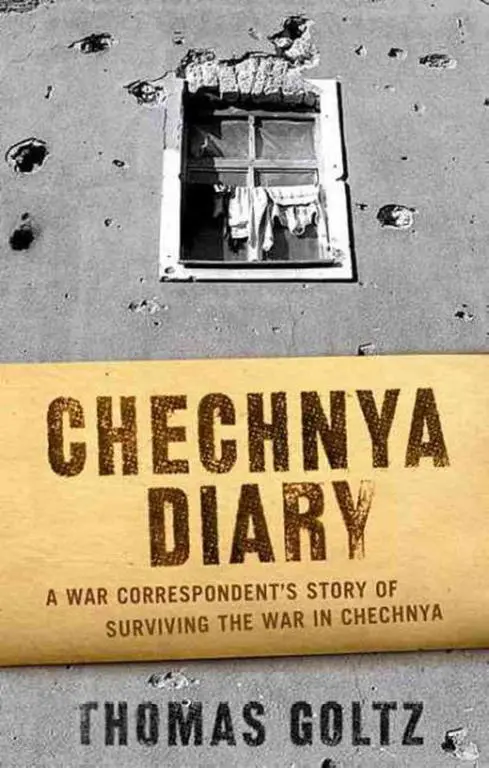
- Название:Chechnya Diary
- Автор:
- Издательство:Thomas Dunne Books
- Жанр:
- Год:2011
- Город:New York
- ISBN:0-312-26874-2
- Рейтинг книги:3 / 5. Голосов: 1
-
Избранное:Добавить в избранное
- Отзывы:
-
Ваша оценка:
Chechnya Diary: краткое содержание, описание и аннотация
Предлагаем к чтению аннотацию, описание, краткое содержание или предисловие (зависит от того, что написал сам автор книги «Chechnya Diary»). Если вы не нашли необходимую информацию о книге — напишите в комментариях, мы постараемся отыскать её.
is part of a larger exploration of the role (and impact) of the media in conflict areas. And at its heart,
is the story of Hussein, the leader of the local resistance in the small town that bears the brunt of the massacre as it is drawn into war.
This is a deeply personal book, a first person narrative that reads like an adventure but addresses larger theoretical issues ranging from the history of ethnic/nationalities in the USSR and the Russian Federation to journalistic responsibility in crisis zones.
is a crossover work that offers both the historical context and a ground-level view of a complex and brutal war.
Chechnya Diary — читать онлайн бесплатно полную книгу (весь текст) целиком
Ниже представлен текст книги, разбитый по страницам. Система сохранения места последней прочитанной страницы, позволяет с удобством читать онлайн бесплатно книгу «Chechnya Diary», без необходимости каждый раз заново искать на чём Вы остановились. Поставьте закладку, и сможете в любой момент перейти на страницу, на которой закончили чтение.
Интервал:
Закладка:
A major rift had just opened in Chechen society between the pure and unclean—and between the majority of local Chechens who only wanted to rebuild their shattered lives, and the Wahhabi outlanders who had arrived to cleanse Chechnya first of the godless Russians, and next of apostates, before then maybe exporting their pristine version of Islam and attendant holy war to neighboring territories, such as Dagestan.
While it is not entirely fair to blame Zelimkhan Yandarbiyev exclusively for this development, there is little question that he was the man who left the door ajar, and with dire consequences. Perhaps one might better ask the uncomfortable question of just who else, aside from the Islamic fundamentalist fringe, was interested in aiding the Chechens. Certainly not the West. And as the Turkish saying has it, “a drowning man will clutch a snake swimming on the water.”
Yandarbiyev’s other contribution as acting president was actually quite different and arguably a complete contradiction of his apparent embrace of the Wahhabis. Specifically, it was he who opened a window on the world for Chechnya in the form of a real foreign ministry. Curiously, it was not located in shattered Grozny, but in a luxury suburb of Bebek, along the shores of the Bosphorus in Istanbul. In addition to the new Minister of Foreign Affairs, Rouslan Chimaev, the Minister of Health, Dr. Umar Hambiev, also made Istanbul the seat of his activities, while other ranking officials in the Chechen government came and went with frequency, making the townhouse almost a government in exile.
“To say ‘government abroad’ is more correct,” said my old friend Eduard Khatchoukaev, the former Deputy Director for Foreign Economic Relations of the Chechen Republic of Ichkeria, whom I had met in prewar Grozny. “But ‘government ex-territorio’ is better.”
Good old “Edik.” Always depend on him for a colorful quote. His new title described him as being Chief of Department of Foreign Credit and Investment in the Chechen Republic. The last time I had seen him he had been nothing more than a man on the run, hiding out in a Baku basement during a new Ramadan, fasting and predicting that not only would Djohar Dudayev emerge as a “serious personality” in any post-Yeltsin government in Russia, but that the real winner of the Russo-Chechen war would be Germany. He did not bother to explain.
“Mark my words,” Edik had said before sort of drifting back into a coma induced by his fast.
The next quote he gave me in Istanbul that autumn of 1996 was a little more chilling, and verged on being a threat. It concerned the question of who had killed Djohar Dudayev six months before, and what the Chechens aimed to do about it.
“We will make the murderers pay,” said Edik, handing me a printed photograph published in a Moscow newspaper. It showed the Chechen president standing next to his jeep with his hand on a telephone receiver and literally staring up at the cross-hair target reader of the missile nose cone that was about to blow him to bits. Edik informed me that it was actually an American projectile, as evidenced by some technical information written in English pertaining to the guidance system. For me, the photograph was such an obvious hoax that it was almost laughable. But Edik seemed to believe it, as did others. It was not Russia, but the United States that had assassinated the Chechen president as part of some larger, imperialist plot designed to… what?
“Rule the world,” said Edik cryptically.
At least this time he did not accuse me of asking him black-and-white questions about multicolor subjects that his grandfather could not understand.
Then he set me up to interview Dudayev’s widow, Alla Dudayeva, who just happened to be in town and, indeed, in the next room.
A small ethnic Russian woman (and a Soviet officer’s daughter) from Estonia who fancied herself an artist, Alla Dudayeva had been present at the time of the killing of her husband near the village of Gekhi-Chu, and gave me a completely different account of how it happened. Her description of the sudden ‘ woosh ’ suggested that the projectile that killed Dudayev was actually a laser-guided artillery shell called in by hidden spotters—adding yet another version to the growing conspiracy list. This now included everything from Edik’s American missile theory to a related twist that had an American AWACs airplane feeding the Russians the coordinates of Dudayev’s satellite phone while the Chechen president waited on hold to speak with Bill Clinton. Variations of this theme had Dudayev talking with a trusted interlocutor in Moscow, making a call to a Moroccan intermediary and chatting with the Boston-based academic Diane Roazen. These versions agree that Dudayev was rudely interrupted mid-sentence by a direct projectile hit trained on his telephone signal, and instantly killed. Still another twist has the Russians dropping a concussion bomb that killed Dudayev horribly and slowly by shattering bodily organs from the inside out, and another version that it was all a sham, and that Djohar Dudayev was still alive, but in necessary Occlusion. He would remain in hiding until Grozny was liberated, when he would return in Mahdi-like form to resume his presidency. But that holy day had come and gone, and even Alla Dudayeva dismissed the idea of her husband’s returning from the grave as nonsense.
“My husband was only one of many martyrs who died for Chechen independence,” she said softly. “Our task now is to make sure their deaths were not in vain.”
Then she thoughtfully gave me an autographed poem and showed me a photographic album of her paintings, all of which had been incinerated in Grozny
The man formally responsible for the Chechen Foreign Ministry in Istanbul may have been Acting President Zelimkhan Yandarbiyev, but the man on the ground (and paying the rent) was Khoj Akhmet Noukhayev. Khoj Akhmet (standard variations on his name include Hajj Ahmad Nukaev) was the cool-to-cold former head of Dudayev’s security apparatus, and a man who seemed to tolerate reports in the foreign media that described him as the ultimate Chechen mafioso so long as said reports credited him with being a state-building (or maybe state-supplanting) philosopher. The cash for the Bebek digs, for example, seems to have come not from the exchequer of the Chechen Republic of Ichkeria in Grozny (was there such an office?) but from Adnan Khashoggi (an Arabized form of the word Kashikji, or “Spoon-maker”), the globe-trotting Saudi business tycoon and international weapons dealer. Khoj Akhmet and Khashoggi appeared together at a Crans Montana Forum, an annual economic event held in Switzerland (that clearly attempted to rival the Davos World Economic Affairs forums) designed to bring together leading personalities from the business and political worlds for a little multilateral chitchat and discreet deal making.
It was there that Noukhayev first put on the table the idea of creating a “Caucasus Chamber of Commerce,” an interesting concept, given the convoluted politics of the region, that focused on devolution from state structures to those of the clan. Thus, on a theoretical level, Khoj Akhmet was seeking to destroy, or at least supplant, the state his operation was allegedly put in place to represent, while businessman Khashoggi announced that he had taken such a keen interest in newly independent Chechnya that he was willing to cough up one hundred million dollars to set up a joint investment bank.
Another of Yanderbayev’s men in Istanbul—and indeed, Noukhayev’s right-hand man—was Mansour Maciej Jachimczyk, a Polish Jew who had first converted to Catholicism when studying at Oxford, before then becoming a double apostate by next adopting Islam. Religious concerns or definitions aside, his crowded business card announced him to be not only the Secretary General of the International Roundtable for the Reconstruction of Chechnya, Peace in the Caucasus and Democracy in Russia, but also the Chief Advisor to the Government of the Chechen Republic of Ichkeria on Foreign Affairs and Foreign Economic Relations.
Читать дальшеИнтервал:
Закладка:
Похожие книги на «Chechnya Diary»
Представляем Вашему вниманию похожие книги на «Chechnya Diary» списком для выбора. Мы отобрали схожую по названию и смыслу литературу в надежде предоставить читателям больше вариантов отыскать новые, интересные, ещё непрочитанные произведения.




Обсуждение, отзывы о книге «Chechnya Diary» и просто собственные мнения читателей. Оставьте ваши комментарии, напишите, что Вы думаете о произведении, его смысле или главных героях. Укажите что конкретно понравилось, а что нет, и почему Вы так считаете.