Thomas Goltz - Chechnya Diary
Здесь есть возможность читать онлайн «Thomas Goltz - Chechnya Diary» весь текст электронной книги совершенно бесплатно (целиком полную версию без сокращений). В некоторых случаях можно слушать аудио, скачать через торрент в формате fb2 и присутствует краткое содержание. Город: New York, Год выпуска: 2011, ISBN: 2011, Издательство: Thomas Dunne Books, Жанр: Биографии и Мемуары, military_history, Публицистика, на английском языке. Описание произведения, (предисловие) а так же отзывы посетителей доступны на портале библиотеки ЛибКат.
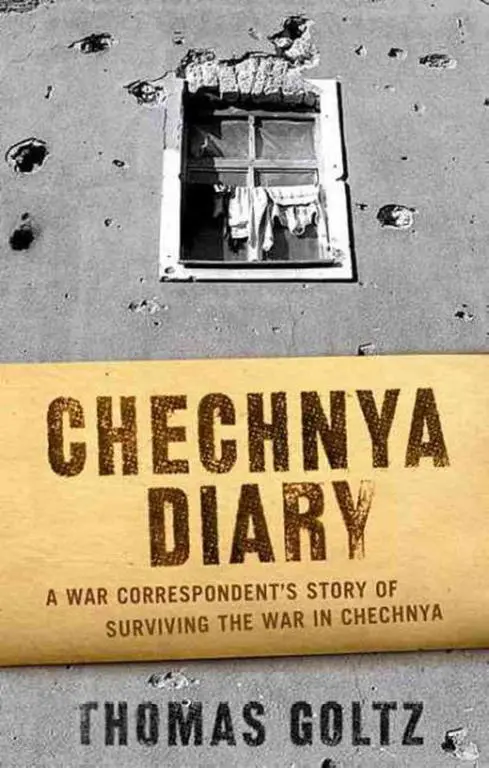
- Название:Chechnya Diary
- Автор:
- Издательство:Thomas Dunne Books
- Жанр:
- Год:2011
- Город:New York
- ISBN:0-312-26874-2
- Рейтинг книги:3 / 5. Голосов: 1
-
Избранное:Добавить в избранное
- Отзывы:
-
Ваша оценка:
Chechnya Diary: краткое содержание, описание и аннотация
Предлагаем к чтению аннотацию, описание, краткое содержание или предисловие (зависит от того, что написал сам автор книги «Chechnya Diary»). Если вы не нашли необходимую информацию о книге — напишите в комментариях, мы постараемся отыскать её.
is part of a larger exploration of the role (and impact) of the media in conflict areas. And at its heart,
is the story of Hussein, the leader of the local resistance in the small town that bears the brunt of the massacre as it is drawn into war.
This is a deeply personal book, a first person narrative that reads like an adventure but addresses larger theoretical issues ranging from the history of ethnic/nationalities in the USSR and the Russian Federation to journalistic responsibility in crisis zones.
is a crossover work that offers both the historical context and a ground-level view of a complex and brutal war.
Chechnya Diary — читать онлайн бесплатно полную книгу (весь текст) целиком
Ниже представлен текст книги, разбитый по страницам. Система сохранения места последней прочитанной страницы, позволяет с удобством читать онлайн бесплатно книгу «Chechnya Diary», без необходимости каждый раз заново искать на чём Вы остановились. Поставьте закладку, и сможете в любой момент перейти на страницу, на которой закончили чтение.
Интервал:
Закладка:
Not so with the media. Every news agency and newspaper and television station with reporters based in Russia, both local and foreign, seemed to have descended on Grozny. Lawrence Sheets had even brought up his cook from Tbilisi to break the monotony of the standard Chechen chow of boiled beef with fried green garlic with some Georgian-style home cookin’, and the so-called “Reuters House” near the bazaar soon became a veritable soup kitchen for the small army of reporters, cameramen, photographers, translators, drivers, and guards, whether they were working for Reuters or not. The most curious addition to the table, if not exactly a guest, was a wandering American youth dressed up in Pashtun garb. He burst into the Reuters House one night looking for a companion to go “meet the Muslims” in the mountains. We threw him out. To this day, I wonder if he was not John Walker Lindh, the “American Taliban,” on his way to deepest, darkest Afghanistan, looking for one of Khattab’s training camps.
Unlike the crowd of foreign press, human rights advocates, and election observers from the former Eastern Bloc, I was not in Chechnya to track presidential poll results. My focus was Samashki. And almost without thinking about how easy it would be for anyone to kidnap me—a solo foreigner traveling alone at dusk—I jumped in the first car I found, and began my journey home, unsure of what I would find.
When did it first dawn on me that people were looking at me in a peculiar way?
Was it that first knot of men huddled over a tire fire near the burnt-out shell of the central school building who seemed unpleasantly surprised to see me? Or was it that attenuated greeting, almost sour, delivered by the blacksmith, Alkhazur?
The young man I found “brick farming” in the ruins of a shattered building picked up a piece of rubble and threw it at me.
Something was wrong, very wrong, and I knew it before knocking on the courtyard door, a long-lost son returned.
“As-salam aleikum!” I cried in my best Chechen, as the short, stocky form of Hussein’s father revealed itself in the half-open gate, illuminated by a candle. “Marsh vogil!”
“Barkal,” he muttered gruffly. “Thanks.”
While he had never been exactly gushingly friendly, he now seemed to almost resent my appearance at his door. It opened no wider.
“Hussein is away.”
Away! That meant Hussein was still alive!
“Will he be back soon?” I asked, waiting at the door.
“No,” came the stone-cold reply.
“And Ussam?” I asked, referring to Hussein’s younger brother.
“In Slepsovski, on business.”
It was time to take stock of this situation.
I was back in Samashki. Hussein was alive but gone. His father was cool to cold. Other people were throwing bricks at me when not casting me the evil eye.
Something was wrong.
“Can I wait for him here?”
A moment’s pause.
“Ok,” he said at last, and I entered, having forced myself upon Hussein’s household by evoking the Law of the Mountains pertaining to persistent guests and strangers.
If the house had sustained any damage over the last eighteen months, it was not apparent. But the dwelling, sparsely furnished during the best of times, was completely empty. A single spring bed and mattress were set in the back room.
Hussein’s father stood there and studied me in silence. He did not smile.
What the hell was going on here?
I had a copy of the Rights and Wrongs broadcast tape in my bags, as well as a photocopy of a Soldier of Fortune article I had written entitled “Weapons Bizarre.” It had to do with the Chechens’ ability to create a homemade arsenal during the war, ranging from shoulder-fired surface-to-air missiles culled from downed helicopters, to things like Hussein’s gigantic land mine made from a rocket warhead.
“These are for you,” I said, offering the material to the elder man.
“Hussein, ” he breathed, studying the pictures.
“Please,” I said. “They are yours to keep as a memory of those bad times.”
“Thanks,” he said, and then shuffled out the door. “Those bad times.”
“ Toms.”
It was Hussein’s father, the man whose name I never knew, sitting down on my bed in the dark, candle in his hand. It was a peculiar moment, almost paternal, nearly intimate—and utterly against Chechen tradition. The Law of the Mountains did not allow elders to act in such a casual way.
“You know the situation here is bad,” he said, speaking without looking at me, staring straight ahead to the shadow of his candle dancing on the opposite wall.
“Yes,” I replied, waiting.
“The war has stopped and the Russians are gone…”
“Yes.”
“Please listen,” he said, placing his hand on my knee. “Then, you knew who the enemy was and where he stood. Now , it is much more dangerous. The enemy is all around and you do not know who he is. Do you understand me?”
“Please go on,” I said.
A queer knot was forming in my stomach, in my soul. I knew where this was heading, and did not want it to go there.
“Hussein is in Kazakhstan, and he will not be coming back.”
“Why?”
“They say he was a traitor, and brought war to Samashki.”
“Who?”
“The elders, the ones who surrendered the town when you were here.”
“But we know that…”
“Please listen,” he cut me off. “There is more.”
“I am listening,” I said, the knot in my stomach growing into a twisted lump.
“They say he was not alone in his betrayal,” said Hussein’s father, speaking about his son. “They say a KGB agent worked with him to take pictures of the town’s defenses.”
I did not even need to hear the rest. The twisted lump had turned to burning steel, exploding in my gut and sending singeing pieces of shrapnel to every nerve in my body
I was on fire.
“Toms,” he said, now looking me in the eye and patting my knee with a paternal hand. “It is very dangerous for you to be here at all.”
I was almost giddy with fear and decades away from sleep.
That KGB agent was me.
Ussam returned toward dawn and found me chain-smoking in the kitchen.
“You” he said, in a tone that made me very worried, knowing now what I did.
Then his father entered and spoke just three words.
“I told him,” said the elder man, referring to me. “Now you talk.”
The Law of the Mountains; an elder’s command. Kanun.
Ussam stared at me with malignant eyes for a moment, looked back at his father, back at me, and then sat down on the floor, back propped against the far wall, sighing.
“Talk,” said his father.
“Talk,” I asked, almost pleading.
It took hours to extract, but Ussam filled in the details.
Of course I was filming.
“After the Mothers’ March through Samashki, things got very bad, and the elders wanted to surrender the town,” Ussam related, referring to the period of time bracketed by my escape from Samashki on March 27 and the massacre of April 7. “They demanded that Hussein go with them to negotiate at the Post, and so he went. But in going to meet with the Russians, my brother lost the trust of the militants who wanted to fight no matter what. Still, the people pleaded, and so Hussein managed to convince most of the fighters to leave, because that is what the majority wanted, although he wanted to stay and fight as well.
“The elders were then told to collect a certain number of weapons to prove that the militants were gone. They did this, but then the Russian command changed their mind and demanded more and more, and said they would storm the town if those weapons were not delivered by their deadline. At this last session, someone shot at the returning party of elders. We thought it was the diehards shooting at Hussein.
Читать дальшеИнтервал:
Закладка:
Похожие книги на «Chechnya Diary»
Представляем Вашему вниманию похожие книги на «Chechnya Diary» списком для выбора. Мы отобрали схожую по названию и смыслу литературу в надежде предоставить читателям больше вариантов отыскать новые, интересные, ещё непрочитанные произведения.






Обсуждение, отзывы о книге «Chechnya Diary» и просто собственные мнения читателей. Оставьте ваши комментарии, напишите, что Вы думаете о произведении, его смысле или главных героях. Укажите что конкретно понравилось, а что нет, и почему Вы так считаете.