Thomas Goltz - Chechnya Diary
Здесь есть возможность читать онлайн «Thomas Goltz - Chechnya Diary» весь текст электронной книги совершенно бесплатно (целиком полную версию без сокращений). В некоторых случаях можно слушать аудио, скачать через торрент в формате fb2 и присутствует краткое содержание. Город: New York, Год выпуска: 2011, ISBN: 2011, Издательство: Thomas Dunne Books, Жанр: Биографии и Мемуары, military_history, Публицистика, на английском языке. Описание произведения, (предисловие) а так же отзывы посетителей доступны на портале библиотеки ЛибКат.
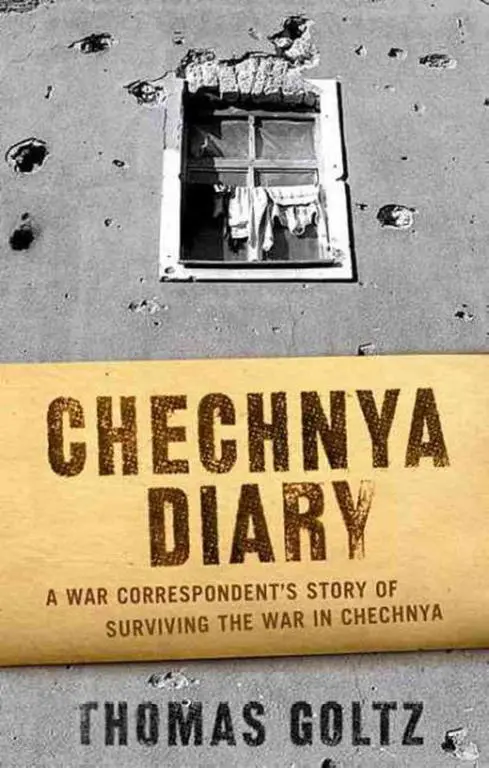
- Название:Chechnya Diary
- Автор:
- Издательство:Thomas Dunne Books
- Жанр:
- Год:2011
- Город:New York
- ISBN:0-312-26874-2
- Рейтинг книги:3 / 5. Голосов: 1
-
Избранное:Добавить в избранное
- Отзывы:
-
Ваша оценка:
Chechnya Diary: краткое содержание, описание и аннотация
Предлагаем к чтению аннотацию, описание, краткое содержание или предисловие (зависит от того, что написал сам автор книги «Chechnya Diary»). Если вы не нашли необходимую информацию о книге — напишите в комментариях, мы постараемся отыскать её.
is part of a larger exploration of the role (and impact) of the media in conflict areas. And at its heart,
is the story of Hussein, the leader of the local resistance in the small town that bears the brunt of the massacre as it is drawn into war.
This is a deeply personal book, a first person narrative that reads like an adventure but addresses larger theoretical issues ranging from the history of ethnic/nationalities in the USSR and the Russian Federation to journalistic responsibility in crisis zones.
is a crossover work that offers both the historical context and a ground-level view of a complex and brutal war.
Chechnya Diary — читать онлайн бесплатно полную книгу (весь текст) целиком
Ниже представлен текст книги, разбитый по страницам. Система сохранения места последней прочитанной страницы, позволяет с удобством читать онлайн бесплатно книгу «Chechnya Diary», без необходимости каждый раз заново искать на чём Вы остановились. Поставьте закладку, и сможете в любой момент перейти на страницу, на которой закончили чтение.
Интервал:
Закладка:
The voice of the media mercenary replied: Yes, get real. Very real. Tell this mechanical driver of yours to pull over the next time you smell a wood-burning shack and get a roof for the night. You are a media mercenary on assignment and need every piece of footage you can get to put this show together . This Show. Don’t forget you are on assignment, Mister Truth-in-Reporting. Enough altruism. You need that door getting cracked open, and you need whatever Hussein’s response is to the fact that you have now once again shown up on his doorstep, camera in hand. And you need it on tape. And for that you need daylight. Approach your prey in the full light of camera-friendly day. Your Prey. And remember : You only get one shot at this.
And then the nice guy replied: You are so tired of war and violence and all the attendant fear and anxiety that you just want to go home, home to a hole, maybe a grave. But you have come this far, way too far, by convincing other people that what you say you believe in and care about is what they should believe in and care about, too. Your driver will sleep in the freezing car if you tell him to. Don’t. And, as for the need for daylight footage suggested by your media mercenary alter ego, tell him to go fuck himself Have a little respect. Hussein is not your prey; he was your protector, and if he lets you into his house on this freezing February evening in the middle of northeastern nowhere, Kazakhstan, he will de facto have become your protector again. Drive on until you find his home, and hope you arrive in the middle of the night with your damned camera stuffed safely in your bags, and turned off. This is not just a “story,” as your media mercenary alter ego would have you believe. This is your life.
Voices, voices.
“Let’s go.”
It is Vladimir the driver. Whatever he has done to the engine, we are now back on the road, rolling down the gouged track at dusk, and closing in on Little Hope with every kilometer gained, if indeed we were going in the right direction.
Consultations with a trucker, a local farmer, a kid riding a bicycle down the highway in the middle of nowhere, now at night, now 40 degrees below. A correction here, a slight overshot there, forcing a return to that still smaller, unmarked road to the right after the bridge. No more gutted tracks, just snow-covered local roads winding through another wood-smoke-stinking town without a light in sight, save for the occasional dim glow of a candle through a roadside windowpane. Climbing now, crawling uphill, the stars and half moon reveal trees on either side of the winter road. Natural national forest, or the row-upon-row work of a Soviet-style youth brigade, like the one Hussein once led in these parts? Star and moon reflections dance on the frost-wrapped boughs of dwarf pine and are a long glide down toward another nameless, smoke-infused village of wood-fired houses with no lights, despite the electrical poles lining the road.
It is past midnight by my watch, and we have been on the road since six that morning. I am about to tell Vladimir to pull over so we can sleep in the car when the headlights pick up some guy stumbling across our snow-encrusted path. He is either drunk or slipping on ice or both.
“Which way is Nadayzhdovka?” asks Vladimir.
“ Zdes, ” replies the baffled midnight rambler. “Right here.”
The house is at the end of the right-hand turn at the top of the icy road rising through town. Vladimir has to reverse out of several deep potholes, gunning the motor and working the wheel like a rudder, and then start climbing again.
Maybe he has heard the engine at high throttle gunning uphill, the grunt and groan of an after-midnight motor negotiating the rutted road, closing on his place of exile, making its way to his door? Has he loaded a gun in anticipation of trouble and sent the kids to the cellar? I don’t know. The moon has set, and it is dark, very dark, when Vladimir pulls the car in front of the very last house on that upper-right-hand lane, off the icy, potholed uphill climb through the middle of a village called Little Hope. There are no cameras blazing. There are no cameras at all. It is much, much better that we have arrived in the middle of the night and that there is no record of the moment, aside from personal memory. Some things are better when left like that.
Knock-knock.
Who’s there?
An old friend.
There is a pause—and on that hiatus in the cold Kazakh night hangs the future of my one and only dear and precious but recently most miserable life.
“I knew you would come.”
It is my friend Hussein, and I am three feet off the ground, held aloft in a two-armed, non-Chechen style, full embrace.
He was the first Chechen to live in the town of Little Hope, sent in as an agricultural brigade leader of the Young Communist organization called Komsomol.
“We were pariahs,” said Hussein, explaining away seventy years of Soviet-style contradiction with minimal verbiage. “We were forced to excel—and we excelled. The Communist system may have attempted to destroy us, but the Communist system also gave us the chance to destroy it. We did so. We crept inside the party structure and took what we wanted and left what we didn’t. We came close to taking over the Soviet system. And then the democratic system that replaced communism gave us the opportunity to destroy ourselves, and we did so, too.”
What began to emerge was a portrait of Hussein quite different from the romantic guerilla commander I had known in Samashki. No, not a different or contradictory portrait, but rather something far more nuanced than that black-and-white portrait of the bold and decisive man I had needed to embody the “Chechen spirit.” Here was family man Hussein, young Communist Hussein, Soviet Army Special Forces Deep-Penetration Specialist Hussein, and director of the local collective dairy farm Hussein. Here was ostracized Chechen Hussein, who had, in effect, taken control of a Russian town in post-Soviet Kazakhstan and filled it with his own people to become lord of the manor Hussein, before stripping house and hearth of human, animal, and mechanical capital, throwing it all away for the kaleidoscope promise of some post-Soviet style nationalistic dream, only to see that dream explode into nightmare.
“Look at this mess,” said Hussein as we toured the broken-down diary facility where he had once been boss. “There used to be a really nice cafeteria over there, and a decent after-work bar right here where we are standing. And now? Wandering steers, collapsing buildings, no gas or electricity in five years, and every girl with tits wandering off to the capital to fuck visiting American oilmen for money.”
Three Kazakh kids rode up on a single horse, a blizzard whirling between them and the remnant herd of cattle in the background of my camera frame.
Yes, not only was Hussein allowing me to film these other aspects of his life, but he was encouraging me to do so.
Weird shots, weird moments : an IMZ/Ural sidecar motorcycle, unsuccessfully tow-started by attaching a rope to the tail of a horse, in hopes of bumping it to life in first gear; Musa’s son, the doe-eyed Sultan, dragging up the calf to be slaughtered in my honor, then slitting its throat with a pious epithet; Hussein and his second son, Ruslan, inspecting the components of a machine gun stored in a shed for easy use; Hussein and I in the homemade vanya, or Russian sauna, and his whipping me with a traditional oak branch and handing me a jar of bee pollen to absorb into my heat-opened pores, while suggesting that he invite in the Russian neighbor’s big-breasted and possibly lascivious wife to give me the obligatory sauna massage.
Читать дальшеИнтервал:
Закладка:
Похожие книги на «Chechnya Diary»
Представляем Вашему вниманию похожие книги на «Chechnya Diary» списком для выбора. Мы отобрали схожую по названию и смыслу литературу в надежде предоставить читателям больше вариантов отыскать новые, интересные, ещё непрочитанные произведения.






Обсуждение, отзывы о книге «Chechnya Diary» и просто собственные мнения читателей. Оставьте ваши комментарии, напишите, что Вы думаете о произведении, его смысле или главных героях. Укажите что конкретно понравилось, а что нет, и почему Вы так считаете.