Thomas Goltz - Chechnya Diary
Здесь есть возможность читать онлайн «Thomas Goltz - Chechnya Diary» весь текст электронной книги совершенно бесплатно (целиком полную версию без сокращений). В некоторых случаях можно слушать аудио, скачать через торрент в формате fb2 и присутствует краткое содержание. Город: New York, Год выпуска: 2011, ISBN: 2011, Издательство: Thomas Dunne Books, Жанр: Биографии и Мемуары, military_history, Публицистика, на английском языке. Описание произведения, (предисловие) а так же отзывы посетителей доступны на портале библиотеки ЛибКат.
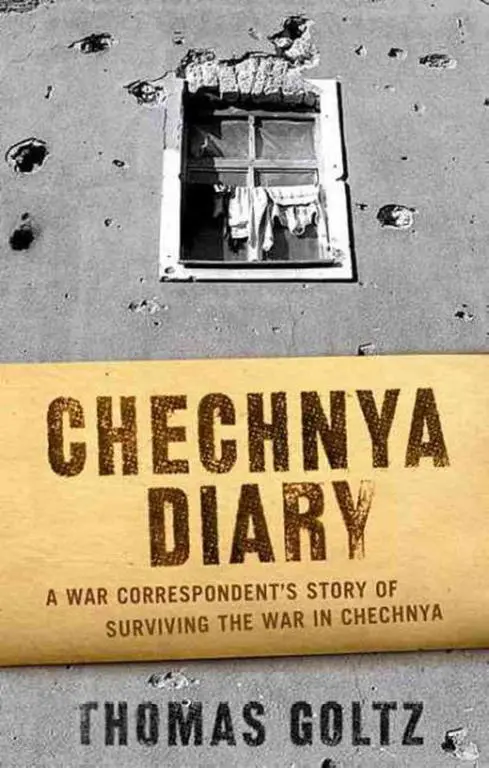
- Название:Chechnya Diary
- Автор:
- Издательство:Thomas Dunne Books
- Жанр:
- Год:2011
- Город:New York
- ISBN:0-312-26874-2
- Рейтинг книги:3 / 5. Голосов: 1
-
Избранное:Добавить в избранное
- Отзывы:
-
Ваша оценка:
Chechnya Diary: краткое содержание, описание и аннотация
Предлагаем к чтению аннотацию, описание, краткое содержание или предисловие (зависит от того, что написал сам автор книги «Chechnya Diary»). Если вы не нашли необходимую информацию о книге — напишите в комментариях, мы постараемся отыскать её.
is part of a larger exploration of the role (and impact) of the media in conflict areas. And at its heart,
is the story of Hussein, the leader of the local resistance in the small town that bears the brunt of the massacre as it is drawn into war.
This is a deeply personal book, a first person narrative that reads like an adventure but addresses larger theoretical issues ranging from the history of ethnic/nationalities in the USSR and the Russian Federation to journalistic responsibility in crisis zones.
is a crossover work that offers both the historical context and a ground-level view of a complex and brutal war.
Chechnya Diary — читать онлайн бесплатно полную книгу (весь текст) целиком
Ниже представлен текст книги, разбитый по страницам. Система сохранения места последней прочитанной страницы, позволяет с удобством читать онлайн бесплатно книгу «Chechnya Diary», без необходимости каждый раз заново искать на чём Вы остановились. Поставьте закладку, и сможете в любой момент перейти на страницу, на которой закончили чтение.
Интервал:
Закладка:
The days passed in discussion—discussion about what went right and what went wrong and what to do. There were local history lessons, the details of which I cannot remember, because the subject matter itself, like the words of Russian-language auto mechanics, was sufficiently outside my ken that I have not so much forgotten what Hussein was speaking about so passionately, as that I never understood it well enough to remember. Details of the near Sino-Soviet war in the early 1970s that nearly brought the two Communist superpowers to self-conflagration over, it seems, precisely the chunk of northeastern Kazakhstan where Little Hope was located; Hussein and local Chechens and Kazakhs were tempted to become a fifth column against Moscow, and back the Chinese.
“It was a good thing we did not,” he explained, and then his explanation was lost in nuance and obscure references that I just did not understand.
The conversations and talk lurched here and there and got corporate and confessional, including discussions of Soviet-style agriculture policy versus that in the U.S.A., when and where we determined that the macro-farms and ranches in the American West were just as damaging to the perceived ideal of small-family, land-holding farmers (as Hussein defined himself) as a latifundia in Argentina on the one hand, and a Kolkoz collective farm in the communist-socialist world on the other. Or human relationships.
“Approach a woman like a farmer does his field,” advised Hussein during the course of one of the days among days, using his own family, and then clan, as examples of how to take over a village of émigré Russians in Kazakhstan, literally and legally.
His marriage and family spoke volumes about personal history and identity and belonging in the late-Soviet world.
Fatma was an ethnic Kazakh, meaning a Turkic-Mongol mixture native to Central Asia’s most centrally Asian state. She had met the young Hussein at the Russian-language agriculture institute they both attended. Presumably, sparks flew between the young Komsomol Chechen lad and the young Komsomol Kazakh girl (in their mutual language, Russian) the way sparks fly everywhere in this world. They dated. They got married. They had a family of one, two, and then three. Sociology 101 would dictate that the Chechen-Kazakh Soviet couple would speak the lingua franca of the USSR (Russian) among themselves, and pass it on as the lingua familia to their children.
Not . The language of the household was Noxchi Mot —or Chechen, the North Caucasus language of the mountains, with no lingual connection whatsoever with Russian, Turkish, or Arabic, save for the usual transfer verbs, nouns, and military terms.
“I learned Chechen from my children,” said native Kazakh, Fatma. “And they learned it from their grandparents.”
After his father and mother came his second brother Musa—the father of Sultan, the shy, reticent youth I had met in Samashki, and who was now back in Little Hope after his baptism of fire—and then his youngest brother, Ussam. Next, Communist Youth Party boss Hussein assigned work for other Chechens in the almost completely Russian émigré village—second cousin Shirvani, the lanky Quran reader and expert on nuclear warheads and undulant fever in sheep, then Shirvani’s cousin, or brother-in-law, or both, the man named Xamid, and then others. Literally and legally, they took over the town of Little Hope.
Iknew on arrival that I was there for a purpose, an obligation. Hussein had to talk his life through, and I was the receptacle into which he poured his wisdom, fears, life, and soul. It almost made no difference that I did not understand all the details.
Maybe it was better that I did not. He rambled on about his days at some Soviet-style special forces academy for deep-penetration activities, in case war broke out between the Warsaw Pact and NATO at— where? What years ? Maybe I only use the word “ramble” because I could not follow the specifics of the subject, or why Hussein wanted me to know the specifics about this or that aspect of his life. Yes, why?
My head was spinning with a thousand highly nuanced details about Soviet and Chechen history—the intertwining of the two, the interplay between China and Russia, or, really, the USSR, the oh-so-specific this and that . I would beg his or his group’s pardon for a moment or two, and, on the excuse of needing to take a piss in the outhouse across the snow-bound yard, would retreat to the outhouse merely to think, or recover from thinking. Is there a part of my brain that will remember this forever, even though I cannot understand it all today?
And then the almost mocking words of the enigmatic Chechen Deputy Minister for Nothing , Eduard Khatchoukaev, way back when, centuries ago, in February 1994: “You Western correspondents are idiots. You show up in our lands and try to impose your own terms of reference on us, when you do not even know how we former Soviets think, taking down notes and impressions in black and white when I am talking to you in full color. You understand us the way my great-grandfather, who does not even know what electricity is, understands the mechanical functions of a Sony television… a box, in front of which is a mirror, reflecting a kaleidoscope of colorful pictures.”
Yes, yes, yes.
The biggest question that must be asked is actually very simple: what right do you have to claim to understand a thing that Hussein has to say?
Then there was Samashki, the Place of Deer.
Following his father’s lead—and using his position as boss of the local collective in the no-longer-Soviet dairy farm town, Little Hope, in newly independent and decidedly chaotic Kazakhstan, to virtually strip it of resources—Hussein decided to transfer his life back to the newly independent homeland of the Chechen Republic of Ichkeria in 1993.
This was a major step, sort of like, say, the Irish-American director of a dude ranch in Montana suddenly returning to the Emerald Isle to take up residence in Belfast, just because some Northern Irish Catholic predicted independence from the cruel British the following year.
But moving back to the ancestral homeland was complicated by more than the little logistical problem of transporting what were, in effect, stolen trucks and tractors across new international frontiers. With only half the move made, Hussein and his non-clan were confronted with the reality of war between the sub-Russian, quasi-independent Chechen Republic of Ichkeria and that thing called the Kremlin in Moscow.
Suddenly, the return to The Place of Deer from the town of Little Hope was complicated by the concept of The Cause .
“We went from town to town where we knew we lived,” said Hussein, using the plural pronoun for himself, his immediate kin, and the collective Chechen diaspora without distinction or, maybe, contradiction. What he meant was that he used his contacts across the width and breadth of Kazakhstan and other post-Soviet states of Central Asia to raise an army of indignant volunteers. What he found was that most exiled Chechens, while patriots of The Cause, were far more willing to send their money than their children.
“Our volunteer detachment of fighters ended up consisting of six men—Shirvani, Xamid, my brother Ussam, and my other brother Musa’s son, Sultan,” he concluded bitterly. “That was it.” Seylah and Ali apparently joined later.
How they managed to make the three thousand-kilometer journey from Little Hope to Samashki with a load of hidden weapons and ammunition was a mystery that required an explanation that Hussein would not directly give, or that I never quite understood.
Читать дальшеИнтервал:
Закладка:
Похожие книги на «Chechnya Diary»
Представляем Вашему вниманию похожие книги на «Chechnya Diary» списком для выбора. Мы отобрали схожую по названию и смыслу литературу в надежде предоставить читателям больше вариантов отыскать новые, интересные, ещё непрочитанные произведения.





Обсуждение, отзывы о книге «Chechnya Diary» и просто собственные мнения читателей. Оставьте ваши комментарии, напишите, что Вы думаете о произведении, его смысле или главных героях. Укажите что конкретно понравилось, а что нет, и почему Вы так считаете.