Thomas Goltz - Chechnya Diary
Здесь есть возможность читать онлайн «Thomas Goltz - Chechnya Diary» весь текст электронной книги совершенно бесплатно (целиком полную версию без сокращений). В некоторых случаях можно слушать аудио, скачать через торрент в формате fb2 и присутствует краткое содержание. Город: New York, Год выпуска: 2011, ISBN: 2011, Издательство: Thomas Dunne Books, Жанр: Биографии и Мемуары, military_history, Публицистика, на английском языке. Описание произведения, (предисловие) а так же отзывы посетителей доступны на портале библиотеки ЛибКат.
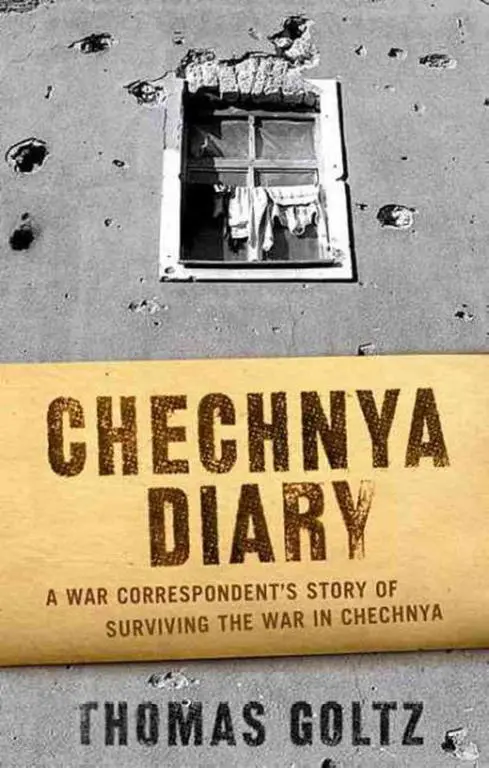
- Название:Chechnya Diary
- Автор:
- Издательство:Thomas Dunne Books
- Жанр:
- Год:2011
- Город:New York
- ISBN:0-312-26874-2
- Рейтинг книги:3 / 5. Голосов: 1
-
Избранное:Добавить в избранное
- Отзывы:
-
Ваша оценка:
Chechnya Diary: краткое содержание, описание и аннотация
Предлагаем к чтению аннотацию, описание, краткое содержание или предисловие (зависит от того, что написал сам автор книги «Chechnya Diary»). Если вы не нашли необходимую информацию о книге — напишите в комментариях, мы постараемся отыскать её.
is part of a larger exploration of the role (and impact) of the media in conflict areas. And at its heart,
is the story of Hussein, the leader of the local resistance in the small town that bears the brunt of the massacre as it is drawn into war.
This is a deeply personal book, a first person narrative that reads like an adventure but addresses larger theoretical issues ranging from the history of ethnic/nationalities in the USSR and the Russian Federation to journalistic responsibility in crisis zones.
is a crossover work that offers both the historical context and a ground-level view of a complex and brutal war.
Chechnya Diary — читать онлайн бесплатно полную книгу (весь текст) целиком
Ниже представлен текст книги, разбитый по страницам. Система сохранения места последней прочитанной страницы, позволяет с удобством читать онлайн бесплатно книгу «Chechnya Diary», без необходимости каждый раз заново искать на чём Вы остановились. Поставьте закладку, и сможете в любой момент перейти на страницу, на которой закончили чтение.
Интервал:
Закладка:
“Contacts,” he breathed. “We have contacts and debts everywhere. At police check-points, dams, bridges, borders—and even nuclear facilities.”
We walked, we talked, both of us tacitly avoiding the subject that everything else revolved around until almost the last minute of the last night.
Finally, without even really broaching the subject, we sat down at his kitchen table, put the camera on its tripod, and checked levels and framing and lighting. Hussein then asked Fatma to leave the room, and I pushed on the record button.
We talked about war, about life, about death. We talked about this and that and the other thing, and we both knew that this was all wasted tape, designed to get both interviewer and interviewee in the same space before the real question was asked: What really happened on that awful night of April 7, 1995.
Hussein addressed the question of collaboration first. He dismissed it as disinformation spread by cowards who wanted to capitulate, meaning the Samashki elders, who had forced him to abandon the people he had vowed to defend.
Then he began to recall details of that long night, when he and his men, camped in the nearby forest, had been forced to watch—or rather listen—as Samashki was attacked by the double-crossing Russians.
“From the forest, we could see the town; and as the bombs began to fall, we heard another sound. Music. Music! And cranked up to the highest volume…”
And precisely at that moment, the bare bulb dangling from the ceiling flickered and then waned into darkness, as Hussein’s generator began to stumble and die. Someone had forgotten to fill the tank with diesel. And there I was filming. That is what I had come there to do. To capture this moment. I could not ask the same question twice. I had come too far for a technical glitch out of my control to destroy everything.
You have a millisecond to find a way out of this, because darkness will envelope you in about a nanosecond.
The camera, positioned on a tripod on the table at which Hussein and I sat, records the moment. Hussein’s voice quality improves, as the ambient drone of the distant generator drops. Then there is a quick falter in the yellowish light above us, and both Hussein and I sort of bend our eyes upward. While Hussein continues to talk, obsessed, I reach for a match and light it. A candle is somehow at hand, and I light the wick. Then I place it first on one side of the table, think better about light distortion and shadows, and shove it to the other side of the frame. All this takes place in a seamless three seconds, and the frame dims, but never goes completely dark.
From a technical point of view, all this was disaster writ large. I was sure that the moment had been irredeemably destroyed. But in the BBC studio back in London, producer Keith Bowers taught me a term that I have cherished forever: strength from weakness . He took the stolen moment and turned it into brilliance, simply by adding context to the narrative. “ Under failing lights he told me ….”
And this is what Hussein said:
“From the forest we could see the town burning, and as the bombs fell we heard another sound. Music. Music! And cranked up to the highest volume. And to that music, Thomas, they killed a village. A village. They were not killing people, Thomas, but a village. That was the first time I saw a village killed.”
Samashki killed to music. Hussein had not seen Coppola’s famous beach-bombing scene in Apocalypse Now , but someone in the Russian command had. Samashki had been blitzed to symphonic music—only, not Wagner, but Shostakovich.
“Which symphony?” I asked.
“The Third,” replied the former Komsomol youth leader, former collective farm boss, and ethnic Chechen from a town called Little Hope in Kazakhstan.
Our last night together was spent at Musa’s house—Hussein’s second brother, whose kidney problems had dictated that his son Sultan would serve in the volunteer Little Hope brigade instead of him. Sultan, the doe-eyed youth who had become a killer at age sixteen along the railroad tracks outside Samashki, hovered around his elders for a spell before removing himself from adult company to listen to disco music with my driver. It seems they had more in common than with us.
When the kids left, the adult talk started in earnest, only occasionally broken up by the arrival of the standard Chechen boiled-beef chow, served by the nameless daughters of the house. They were beautiful. I was never introduced.
The evening progressed, and I recorded hours of material of everyone present, as they plotted and planned their return to Chechnya and Samashki.
“We are going back, and we will leave our mark,” said Hussein, looking directly into my camera, detailing several sabotage plans he had in store against targets en route through southern Russia. “This is just a little pause, Thomas, a peririvka, and we are using it for our own preparations. The war is not over. Perhaps it has just begun.”
Great quotes.
But aside from abstract confession, why was Hussein telling me this self-incriminating stuff? The man who knew Shostakovich’s symphonies must also know that the generals, colonels, and majors of the Russian FSB/KGB and their local Kazakh equivalents monitored the BBC as part of their basic database, or at least had their secretaries do so.
“Self-exiled Chechen fighters from Kazakhstan, meanwhile, suggest that their cause is far from over. Communist-era collective farm boss Hussein and his team of hardened volunteer fighters from the town of Samashki say they are ready to blow up nuclear power facilities to avenge Russian brutality used against their town, and do the same to other Chechens who happen to disagree with their take on how the war should end…”
Did Hussein want me to report that? And if not, why was he telling me such things, and on camera? It wasn’t like he was some sort of noble savage who did not know better, or could not imagine the consequences of his words or actions—but then again, what about me? Was I such a noble vessel of neutrally-recorded truth? Did the medium have nothing to do with the message? Did the observer not affect the observed?
It had been so much simpler when it was merely a David-versus-Goliath story of the plucky Chechens taking on the Russian Bear. Now it was about bitterness, bravado, and betrayal, about different eras in different lives, my own included.
That last day in Little Hope dawned sun-on-snow crisp, bright, and clear.
Dazzling, actually.
I spent the morning with Hussein’s wife, trying to get a read on what she thought of her husband’s dangerous life.
“I knew my man would come home,” she said.
Home.
What home, which home, which country was she talking about? Little Hope, on the northeastern fringe of newly independent Kazakhstan, recognized by the world as a legitimate state almost by default, or The Place of Deer, on the north slope of the desperate-to-be-independent Chechen Republic of Ichkeria, the blighted landscape unrecognized by anyone, save for the almost unrecognized-by-anyone Emirate of Afghanistan, soon to be obliterated by the American Central Command?
Vladimir, my driver, was opening the trunk and sticking in the hind quarter of the calf slaughtered by Sultan in my honor, and I was packing my camera kit and bags into the backseat, numb with emotional exhaustion.
Next would come the twelve- or eighteen-hour drive down the gouged track back to Alma Ata, followed by another six-hour-delayed flight back to Moscow, and then another five-hour air-hop to London to somehow thread the disparate and scattered pieces of this story into some workable and broadcast-worthy whole, before taking yet another twenty-hour journey back to deepest, darkest Livingston, Montana. There, good friends at the Owl Bar will order me a drink and ask where have you been and how are you doing, and I will smile and say something like great and be completely unable to say one real word, because I am so fucking far on the other side of the planet, the other side of life, that I cannot begin to explain where my head is really at, not even today.
Читать дальшеИнтервал:
Закладка:
Похожие книги на «Chechnya Diary»
Представляем Вашему вниманию похожие книги на «Chechnya Diary» списком для выбора. Мы отобрали схожую по названию и смыслу литературу в надежде предоставить читателям больше вариантов отыскать новые, интересные, ещё непрочитанные произведения.





Обсуждение, отзывы о книге «Chechnya Diary» и просто собственные мнения читателей. Оставьте ваши комментарии, напишите, что Вы думаете о произведении, его смысле или главных героях. Укажите что конкретно понравилось, а что нет, и почему Вы так считаете.