Thomas Goltz - Chechnya Diary
Здесь есть возможность читать онлайн «Thomas Goltz - Chechnya Diary» весь текст электронной книги совершенно бесплатно (целиком полную версию без сокращений). В некоторых случаях можно слушать аудио, скачать через торрент в формате fb2 и присутствует краткое содержание. Город: New York, Год выпуска: 2011, ISBN: 2011, Издательство: Thomas Dunne Books, Жанр: Биографии и Мемуары, military_history, Публицистика, на английском языке. Описание произведения, (предисловие) а так же отзывы посетителей доступны на портале библиотеки ЛибКат.
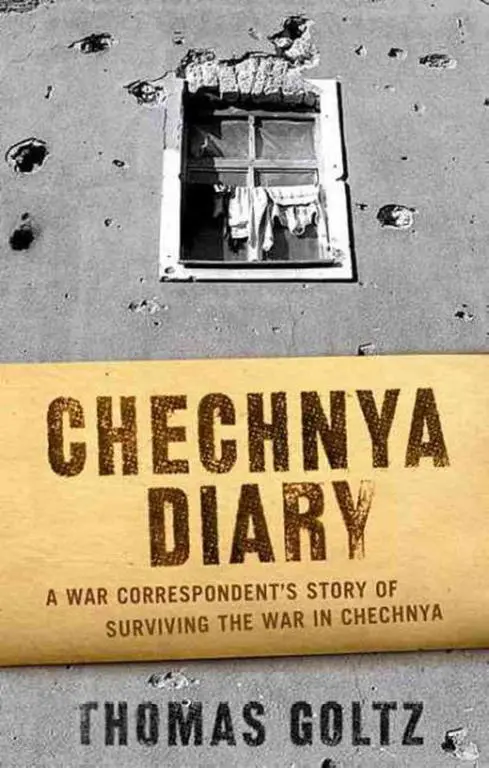
- Название:Chechnya Diary
- Автор:
- Издательство:Thomas Dunne Books
- Жанр:
- Год:2011
- Город:New York
- ISBN:0-312-26874-2
- Рейтинг книги:3 / 5. Голосов: 1
-
Избранное:Добавить в избранное
- Отзывы:
-
Ваша оценка:
Chechnya Diary: краткое содержание, описание и аннотация
Предлагаем к чтению аннотацию, описание, краткое содержание или предисловие (зависит от того, что написал сам автор книги «Chechnya Diary»). Если вы не нашли необходимую информацию о книге — напишите в комментариях, мы постараемся отыскать её.
is part of a larger exploration of the role (and impact) of the media in conflict areas. And at its heart,
is the story of Hussein, the leader of the local resistance in the small town that bears the brunt of the massacre as it is drawn into war.
This is a deeply personal book, a first person narrative that reads like an adventure but addresses larger theoretical issues ranging from the history of ethnic/nationalities in the USSR and the Russian Federation to journalistic responsibility in crisis zones.
is a crossover work that offers both the historical context and a ground-level view of a complex and brutal war.
Chechnya Diary — читать онлайн бесплатно полную книгу (весь текст) целиком
Ниже представлен текст книги, разбитый по страницам. Система сохранения места последней прочитанной страницы, позволяет с удобством читать онлайн бесплатно книгу «Chechnya Diary», без необходимости каждый раз заново искать на чём Вы остановились. Поставьте закладку, и сможете в любой момент перейти на страницу, на которой закончили чтение.
Интервал:
Закладка:
Yet, ever the media mercenary, I realized I didn’t have a necessary shot. I had nothing close to anything resembling a shot that could serve as the opener or closer for this segment, this film, of what I guess I have to call “my journey to my friend Hussein,” or something like that. This is the sort of clip that is a very difficult product to acquire if you are a one-man camera band like me, and requires not so much advance planning as the ability to think on your media-mercenary feet. So, in the middle of tossing my bags in the backseat of my transport, I sort of tossed my camera at Hussein’s son Ruslan with one hand, while reaching out toward his father with the other for a good-bye embrace.
The kid is a natural, and instinctively understands what I want, capturing the last moments of my reunion with Hussein for me.
“Adik yurl, ” I say.
“Adik dali, ” Hussein replies.
Then he extends his other arm around me for a full bear embrace.
19
EXPERT PURVEYOR OF PAIN
Little Hope, Alma Ata, Moscow, London.
The editor assigned to the task of molding my material into something resembling BBC documentary style throws up his hands and calls in the boss.
“He doesn’t have a script, there is no preplanned story!”
“This is an experiment,” says Keith Bowers. “Just try and work with him.”
Edit your heart away; eat your heart away, and listen to the Rolling Stones sing “Paint It Black” from their Aftermath album. We’re in London, after all.
I see a red door and I want it painted black
No colors anymore, I want them to turn black…
Then, during the first part of week number two, for a job that is supposed to only take three or four days, the expert editor stops moaning and groaning and gets it. Yes, this piece of television was not shot according to a pre-agreed script. This piece of television is going to lurch around the globe and into the caverns of the darkened soul. And, suddenly, the piece is cut and voiced and done and in the can and scheduled for release on Saturday night prime time in England, Ireland, Scotland, and Wales, as well as everywhere else the BBC broadcasts its prime-time program, Correspondent.
Ten, nine, eight, seven, six, five, four, three, two, one, squirt… 00:00- Cue; natural sound: A yellow bus lurches around car; gunshot sounds.
00:11- Goltz voice-over : Samashki. The word in Chechen means The Place of Deer. To me, it meant the horror of war.
00:15- Cue; natural sound: Pix show fighting, running, chaos.
00:18- Goltz , voice-over : I was there as the nondescript farm town was turned into the symbol of Russian brutality, as Moscow tried to reassert “constitutional order” through the barrels of guns.
00:24- Cue ; sound on tape, heavy breathing; pix show RED house sniper nest.
00:31- Goltz , voice-over: The place is indelibly carved on memory. I was inside the ring of fire—and have never been so frightened in my life. I often wondered if I’d get out alive.
00:48- Cue; natural sound; pix of chopper flying across screen, shoots tractor and cow; Blast!!
Ten minutes and forty-eight seconds later everything, everything was in the ether—the school, the wedding party, Muhammad standing on a ladder saying he thought I was dead, Ussam declaring that he would never believe his brother could sell out his people, and, finally, Hussein in Kazakhstan, talking about how his idealized village had been killed to the music of Shostakovich. Years of my life and decades of my soul, and the most important subject in the world reduced to ten minutes and forty-eight seconds of TV time and then, squirt , and its over—in the ether, gone.
And then the announcer was thanking viewers for having tuned in, and to please tune in again next week for three more Assignment pieces: Hope Springs Eternal In Mexico City Slums, Cowboy Poets in Montana, and A Throat Singer From Mongolia.
“Thanks, good night, and stay tuned for the BBC Comedy Hour, Live!”
A guy could get suicidal about this sort of stuff, if a guy did not know that that is just the way it goes, even in the best television biz.
Squirt, gone. Vapor.
Return to Samashki (I preferred to call the piece Aftermath ) was nominated for the Rory Peck Prize in its third year. The judges, however, felt the world had moved on from interest in the chaos and confusion that was Chechnya, or maybe that the market was saturated with war-related news. The winner that year was a secretly shot piece called “Bringing Home the Bacon,” wherein the videographer rigged himself up with a miniature camera hidden in his glasses to film life and death on a pig farm and slaughterhouse in Scotland.
Meanwhile, I was commissioned by my new fans at the BBC to do another “I remember an obscure war” piece on the siege and fall of the Georgian Black Sea city of Sukhumi, where I had first befriended a certain Lawrence Sheets. Coupled with the publication of my book on Azerbaijan, I was turning into something of a perceived expert on war and ethnic strife in the post-Soviet lands. ABC’s Nightline roped me in as a consultant for a story they were doing on Caspian crude oil. This was followed by an appearance on CBS’s 60 Minutes with correspondent Bob Simon, and then an hour-long broadcast on C-SPAN of the Samashki and Abkhazia pieces, with attendant discussion.
Somewhere around that time I got looped into managing a feel-good program funded by some feel-good international agency that brought together two Ingush and two Ossetian television reporters to shoot and edit a mutually acceptable documentary on their obscure conflict. The exercise was staged to “build mutual trust” between the mutually inimical North Caucasus communities, both of which bordered on Chechnya. I am not sure if we succeeded in that task or not, but the trip got me down to Nazran in Ingushetia, from where I was able to courier a copy of my Aftermath film to Hussein’s father in Samashki. I do not know whether it ever arrived.
Back in the United States, universities and think tanks began lining up to have me drop by. Announced lecture titles varied, but generally focused on the theme ethnic conflict in the Caucasus and the Chechen crisis . I spoke to local committees on foreign relations in Birmingham, Boise, Casper, Dallas, Detroit, Houston, Indianapolis, Little Rock, Rochester, Salt Lake City, Tampa, and Wichita, Kansas. University appearances included everywhere from Columbia, Georgetown, Harvard, Northwestern, Princeton, and Tufts, to Berkeley, University of Chicago, University of Kentucky, University of Massachusetts, University of Minnesota, University of Washington, and University of Wisconsin. Other showings included featured positions in the annual Middle East Studies Association convention in Chicago, the annual Human Rights Film Festival in New York and the Mountain Film Festival in Telluride, Colorado. I was asked to participate on a panel of war correspondents, entitled Dateline Hell , at New York University’s journalism school on my way to cover Kosovo, and I accepted two separate appearances at the Air Force Special Forces Training School at Hurlburt Field outside Pensacola, Florida, where pilots and soldiers were taking a crash course on guerilla warfare, although it was probably labeled something like “Terrorism in the Caucasus.”
“This is where the rubber meets the road,” whistled Cap’n Pfaff at the SpecOps school. “Can you come back next year?”
The scariest gig was a very special appearance at Barnes & Noble Books, arranged by a high school friend named Gayle whom I had not seen in over twenty years, and attended by other graduates of the Class of ‘72 along with diverse other family and friends, and the weirdest was an appearance at the Central Intelligence Agency, also arranged at the insistence of an old friend. Once inside the old headquarters building, I took advantage of the occasion to study the Killed In Action commemorative plaques decorating the entrance to look for that commemorating my old friend and superspy, Freddie Woodruff, killed under a cloud of mystery in Georgia in 1993. It wasn’t there, although I was later told that this was because Freddy was still officially working undercover, even though he had been dead for years. Then I smoked a cigarette in the outside courtyard, where Aldrich Ames used to cadge information from nicotine-addicted secretaries. I had the impression that many in the spooky audience were almost jealous. I was leading (or had at least in part led) the life they had joined The Agency to lead, but they had only ended up sitting behind computer screens, endlessly analyzing.
Читать дальшеИнтервал:
Закладка:
Похожие книги на «Chechnya Diary»
Представляем Вашему вниманию похожие книги на «Chechnya Diary» списком для выбора. Мы отобрали схожую по названию и смыслу литературу в надежде предоставить читателям больше вариантов отыскать новые, интересные, ещё непрочитанные произведения.




Обсуждение, отзывы о книге «Chechnya Diary» и просто собственные мнения читателей. Оставьте ваши комментарии, напишите, что Вы думаете о произведении, его смысле или главных героях. Укажите что конкретно понравилось, а что нет, и почему Вы так считаете.