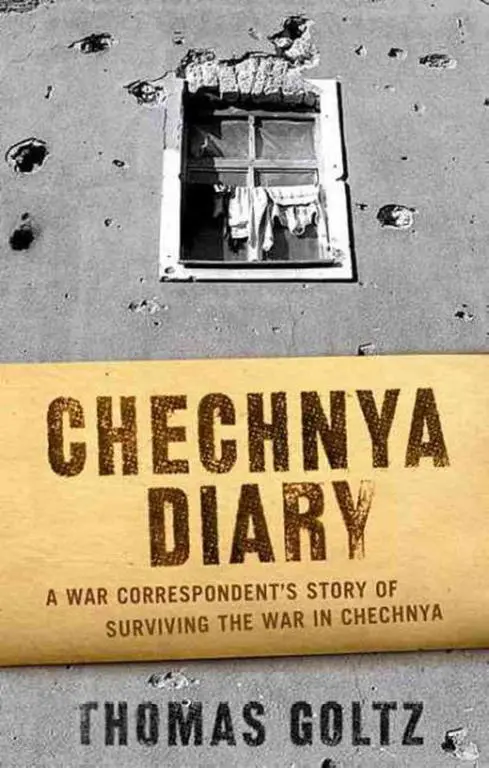
Thomas Goltz - Chechnya Diary
Здесь есть возможность читать онлайн «Thomas Goltz - Chechnya Diary» весь текст электронной книги совершенно бесплатно (целиком полную версию без сокращений). В некоторых случаях можно слушать аудио, скачать через торрент в формате fb2 и присутствует краткое содержание. Город: New York, Год выпуска: 2011, ISBN: 2011, Издательство: Thomas Dunne Books, Жанр: Биографии и Мемуары, military_history, Публицистика, на английском языке. Описание произведения, (предисловие) а так же отзывы посетителей доступны на портале библиотеки ЛибКат.
- Название:Chechnya Diary
- Автор:
- Издательство:Thomas Dunne Books
- Жанр:
- Год:2011
- Город:New York
- ISBN:0-312-26874-2
- Рейтинг книги:3 / 5. Голосов: 1
-
Избранное:Добавить в избранное
- Отзывы:
-
Ваша оценка:
Chechnya Diary: краткое содержание, описание и аннотация
Предлагаем к чтению аннотацию, описание, краткое содержание или предисловие (зависит от того, что написал сам автор книги «Chechnya Diary»). Если вы не нашли необходимую информацию о книге — напишите в комментариях, мы постараемся отыскать её.
is part of a larger exploration of the role (and impact) of the media in conflict areas. And at its heart,
is the story of Hussein, the leader of the local resistance in the small town that bears the brunt of the massacre as it is drawn into war.
This is a deeply personal book, a first person narrative that reads like an adventure but addresses larger theoretical issues ranging from the history of ethnic/nationalities in the USSR and the Russian Federation to journalistic responsibility in crisis zones.
is a crossover work that offers both the historical context and a ground-level view of a complex and brutal war.
Chechnya Diary — читать онлайн бесплатно полную книгу (весь текст) целиком
Ниже представлен текст книги, разбитый по страницам. Система сохранения места последней прочитанной страницы, позволяет с удобством читать онлайн бесплатно книгу «Chechnya Diary», без необходимости каждый раз заново искать на чём Вы остановились. Поставьте закладку, и сможете в любой момент перейти на страницу, на которой закончили чтение.
Интервал:
Закладка:
“The Russians then said that all weapons had to be surrendered by a certain hour, and that all militants had to leave by a certain route. There were no more weapons to give, and because we did not trust the Russians, we all left and went into the forest via a different path. That is when the Russians attacked, and after that people started to say that Hussein was to blame, because he first brought war to Samashki by defending against the train, but then left it undefended and allowed the massacre. So Hussein left. He was forced to leave. God, I know how he did not want to go! I can never believe that my brother, my older brother, would ever betray his people.”
Ussam twiddled his thumbs.
One—left or right?—lacked the entire nail and the top quarter of the joint.
When did he lose it, I wondered but did not ask.
“It is dangerous for you here,” said Ussam. “There are people who want to kill you.”
“Kill me.”
“Yes.”
Another long shudder down a spine that was no longer mine and along nerves made of mud.
“Do not leave the house, Toms,” said Hussein’s father. “My son Ussam shall sneak you out of town in darkness, tonight!”
“No,” said Ussam, reflecting. “Perhaps if people see you on the streets, it will convince them of your true intent. If you were really a Russian agent, you would be insane to return to Samashki by yourself.”
There was a certain logic to what Ussam said.
My very presence in town would either wipe the slate clean, or rid the earth of me. And if showing my face in Samashki could serve to soften the evil attitude of many people toward my person, perhaps doing so might also ameliorate the perceived sins of Hussein. Yes. I owed it to him to risk a public lynching, or whatever might happen to me in the street.
Head spinning with A Tale of Two Cities altruism mixed with a direct desire to just bolt, I pulled on my boots, put the BBC camera on its tripod, and stepped out into an ice-and-mud-encrusted world, not knowing if I would ever see another day.
The stares of incredulity slowly turned to frowns and then to smiles as I made my way through the familiar landscape of Samashki. Whether my presence with camera in hand helped restore Hussein’s reputation in any concrete way was not immediately clear, but Ussam’s conviction that insanity was the greatest proof of my innocence seemed to register with others.
I happened upon a garage being used as the Friday mosque; the real structure had been destroyed and not yet rebuilt. There, I found myself engaging in the Chechen handshake-cum-half-embrace with a dozen men I had known before, including leading members of the elders group who had banished Hussein.
Next, I stopped by Alkhazur’s blacksmith shop. He was astonished to see me, as was his wife and new child. I had had no idea he was a married man.
“Don’t you think it is… dangerous for you to be here?” he delicately asked.
“Why?”
“Oh, the kidnappers and renegades, you know,” the blacksmith responded. “They say foreigners should not travel alone, but with guards assigned by the state authorities.”
“I registered with the state authorities in Grozny,” I said, skipping the truth for the sake of security. “They know I am in Samashki with friends—it is not so?”
Word spread, and soon people were seeking me out to swear they had never believed that business about—well, you know. Bekist, the laughing lady who collapsed in the road outside of Sernavodsk after she had related the carnage in Samashki; Commander Ali, who had twice arrested me during my first day in town nearly two years before; Akhmad Amaev, the Samuel Pepys of Samashki, who recorded literally every event in his longhand diary as it occurred. The saddest entry he read concerned the killing of his second son, gunned down by a helicopter while the sixteen-year-old was tending to a flock of sheep in a field just before the so-called Second Storming of the town in March 1996.
Still others came up to embrace me, telling me they had been told I was dead—apparent evidence of the confusion in identity between myself and the late Fred Cuny, whom members of the Western media wanted to place in Samashki, a name resonant with death and destruction.
“We thought we’d lost you, that you were shot and killed!” cackled a familiar-looking man from atop a ladder precariously leaning against an electricity pole next to a familiar-looking house. “That means you will live a long life!”
It was Isa’s brother Muhammad.
Sights and sounds of Samashki, my Samashki, swirled around my head.
A zikr for a recently deceased neighbor, where the youth and elders joined together in the wild religious ceremony that so thoroughly defined the Chechen soul; a vodka bust performed by the newly established morality police, raiding some poor woman’s stash on a tip, and smashing two dozen bottles of booze at her curbside; a wedding party at the house of the beehive-keeping bomb maker who had repaired my battery charger, the monotonous thump of gunfire now replaced with a wild Caucasian dance band, consisting of an out-of-tune accordion and the seat of a wooden chair used for a drum; another feast in my honor, the table sagging under a load of boiled beef, bowls of boiled beef broth, and pickled tomatoes (but this time supplemented with an illicit bottle of vodka); a school in a makeshift classroom in the basement of the bombed-out collective farm cannery, the walls festooned with survival art depicting jets and tanks with Russian emblems on them, and burning houses with the Chechen flag, where the children were using Soviet-era textbooks to work on a certain Russian plural possessive noun ending.
“…and then the city was in the hands of the Bolsheviks,” read their teacher.
“…then the city was in the hands of the Bolsheviks,” the children repeated.
“… yes, the Bolshyvikov…”
I filmed it all, and more. I was recording a town of sorrow come back to life.
The Russian soldiers might have gone, but their signature of death and destruction was everywhere to be seen. Samashki appeared to have been used as a test firing range for artillery shells and vacuum bombs during the so-called “second storming” of the town. The remnants of the miniature parachutes that held the so-called “vacuum bombs” aloft before their in-air explosion still clung to twisted pieces of rebar sticking up from masonry rubble throughout the town, usually with a telltale, perfectly symmetrical twenty-meter gouge in the earth nearby.
I remembered secondhand reports of the second storming posted on the Internet by Chris Hunter, the leader of the Quaker component of the Soldiers’ Mothers’ March. Quoting fleeing refugees, he had described a three- or four-day assault on the town in which neighborhoods were effectively erased from the map. When and why the Russian soldiers had left, necessitating their recapture of the town, remained unclear.
“We forced them out, and then we fought back,” explained Ahmed Amaev’s first son, Musa, the body-armor garment maker associated with Hussein’s platoon of 1995, and the man I had nicknamed “Little Joe” of Ponderosa fame. He filled in the details of the second storming of Samashki, which sounded more horrific than the first, with one notable exception. The Russian Army never got back in the town.
“The federals issued an ultimatum that we were to demilitarize, just like in 1995,” he said, taking me on a quick tour of the front-line positions. “This time, we fighters sent all the elders, women, and children away—into the forest via a sanitary corridor, or into shelters. Then we let the federals have it.”
According to Musa, the federals—meaning, the Russians—lost up to a thousand men and maybe one hundred pieces of armor before they retreated. The lynchpin defensive position was the three-story red brick house on the northwest edge of town, which I had used as one of my front-line filming positions so many months before. It was now a pile of red brick rubble, with shell casings crunching under every step as we inspected the destruction.
Читать дальшеИнтервал:
Закладка:
Похожие книги на «Chechnya Diary»
Представляем Вашему вниманию похожие книги на «Chechnya Diary» списком для выбора. Мы отобрали схожую по названию и смыслу литературу в надежде предоставить читателям больше вариантов отыскать новые, интересные, ещё непрочитанные произведения.





Обсуждение, отзывы о книге «Chechnya Diary» и просто собственные мнения читателей. Оставьте ваши комментарии, напишите, что Вы думаете о произведении, его смысле или главных героях. Укажите что конкретно понравилось, а что нет, и почему Вы так считаете.