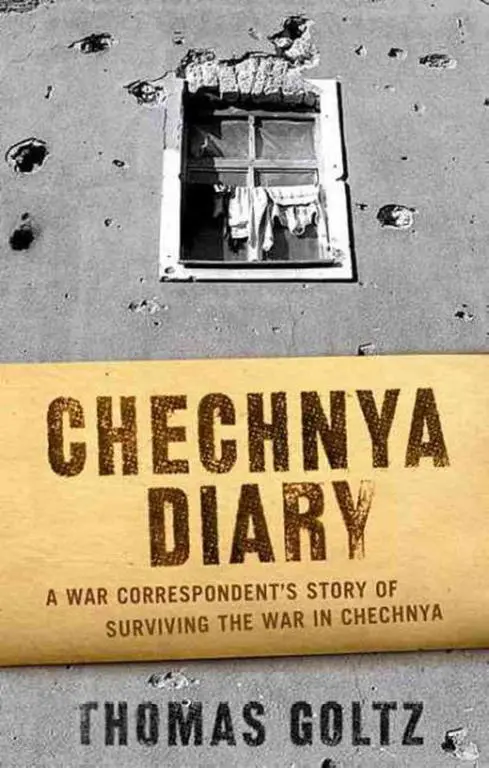
Thomas Goltz - Chechnya Diary
Здесь есть возможность читать онлайн «Thomas Goltz - Chechnya Diary» весь текст электронной книги совершенно бесплатно (целиком полную версию без сокращений). В некоторых случаях можно слушать аудио, скачать через торрент в формате fb2 и присутствует краткое содержание. Город: New York, Год выпуска: 2011, ISBN: 2011, Издательство: Thomas Dunne Books, Жанр: Биографии и Мемуары, military_history, Публицистика, на английском языке. Описание произведения, (предисловие) а так же отзывы посетителей доступны на портале библиотеки ЛибКат.
- Название:Chechnya Diary
- Автор:
- Издательство:Thomas Dunne Books
- Жанр:
- Год:2011
- Город:New York
- ISBN:0-312-26874-2
- Рейтинг книги:3 / 5. Голосов: 1
-
Избранное:Добавить в избранное
- Отзывы:
-
Ваша оценка:
Chechnya Diary: краткое содержание, описание и аннотация
Предлагаем к чтению аннотацию, описание, краткое содержание или предисловие (зависит от того, что написал сам автор книги «Chechnya Diary»). Если вы не нашли необходимую информацию о книге — напишите в комментариях, мы постараемся отыскать её.
is part of a larger exploration of the role (and impact) of the media in conflict areas. And at its heart,
is the story of Hussein, the leader of the local resistance in the small town that bears the brunt of the massacre as it is drawn into war.
This is a deeply personal book, a first person narrative that reads like an adventure but addresses larger theoretical issues ranging from the history of ethnic/nationalities in the USSR and the Russian Federation to journalistic responsibility in crisis zones.
is a crossover work that offers both the historical context and a ground-level view of a complex and brutal war.
Chechnya Diary — читать онлайн бесплатно полную книгу (весь текст) целиком
Ниже представлен текст книги, разбитый по страницам. Система сохранения места последней прочитанной страницы, позволяет с удобством читать онлайн бесплатно книгу «Chechnya Diary», без необходимости каждый раз заново искать на чём Вы остановились. Поставьте закладку, и сможете в любой момент перейти на страницу, на которой закончили чтение.
Интервал:
Закладка:
On a more casual level, he labeled himself a “Chechen agent,” a term that carried not only the familiar associations with dark deeds of espionage, but entertainment. Assisted by Khashoggi’s third wife, Shahpari, and a best-left-nameless CPA for the stars in Los Angeles, Mansour orchestrated a grand project to entice Elizabeth Taylor and Julio Iglesias to bombed-out Grozny to act as hosts for a one-thousand-dollar-a-plate Chechen war orphan benefit.
What? A Polish Jewish-Catholic convert to Sufi Islam fronting for a Saudi arms merchant supporting a former KGB hit man semiassociated with Osama bin Laden in league with Liz Taylor and Julio Iglesias, all sitting around the same one thousand dollars-a-plate benefit dinner to aid Chechen children in Grozny?
Well, yes—but who says geopolitics can’t be fun?
Actually, seeing old violet eyes in Grozny would have been a great coup, but then Liz got brain cancer and had to cancel. After her recovery, however, there she was with Julio, sitting at Mansour and Khoj Akhmed’s table for the slightly postponed charity bash, although for logistical reasons it had been transferred from downtown Grozny to Istanbul’s spectacularly expensive Ciragan Palace Hotel on the middle Bosphorus. The next stop for Mansour and Khoj Akhmet was London, for a meeting with Baroness Margaret Thatcher and other Tory lords interested in Chechnya’s oil pipeline schemes. The pair got around.
Meanwhile, in independent Chechnya itself, the charred and bloody landscape where heroes once fought was falling into the grip of nameless fear and dread. Friends were only friends-apparent. Trusted guides and protectors could turn. No one really knew who was who anymore. People had become booty to be exchanged for cash ransoms; Russian television reporters could fetch millions, and foreigners—well, it was assumed that all were worth their weight in gold, if you wanted to bother keeping them alive.
The most celebrated case of foreigners disappearing in Chechnya belonged to the unfortunate American humanitarian aid worker, Fred Cuny, who went missing at the time of the Samashki Massacre in the Spring of 1995. Subsequent consensus suggests that Cuny had pushed a bridge too far, and was executed by Chechen rebels in the vicinity of Fortress Bamut on suspicion of being a Russian spy.
But Cuny was not the only outlander to go missing at the hands of suspicious guards, rapacious kidnappers, or psychotic killers. Arguably the most horrible incident was when six Red Cross workers were slaughtered in their sleep in the town of Novi Atagi in November 1996. Although a shroud of conspiracy continues to obscure the identities of the killers, word had it that, far from being a murderous plot hatched by Moscow that was designed to destabilize Chechnya and drive all foreign observers from the country—which was the effective result—the killings were carried out by disgruntled security men who thought they would teach the Red Cross a lesson for declining the group’s professional “protection” services. Equally awful was the beheading of four British Telecom workers, abducted for ransom by unknowns and then killed when the gang felt the antikidnapping squad on their trail was getting too close.
The fate dealt out to a pair of devoted British aid workers in a Grozny orphanage, Jonathan James and Camilla Carr, was only marginally less harsh: Captured for ransom, they were tortured and raped, but ultimately freed by Asian Maskhadov’s security detail.
The nagging question of whether the kidnappers and the antikidnapping security squads were not possibly made up of the same people working in collusion seemed to be answered, at least for me, by the case of Fazil Özen, president of the Chechen Solidarity Committee in Istanbul, whom I had first met way back when, in the winter of 1995, even before my first trip to Samashki.
Inspired by the example of other diasporas, the Chechen Solidarity Committee in Istanbul had raised and then pumped in some ten million dollars in material aid to the homeland, a place most diaspora Chechens living in Turkey had never seen, and where a language was spoken— Noxchi Mot —that they had long forgotten.
It was the same story of a romanticized relationship of people in diaspora toward their distant, beleaguered kinsmen, as experienced by such disparate peoples as the Los Angeles Armenians, Boston Irish, and New York Jews. Find a leader, send the money.
Some aid took the form of rented satellite time, so that Chechen television could continue to broadcast their idea of news, free of Moscow’s informational feed. Wireless communication equipment was smuggled in to aid fighters in the mountains. Getting material (and military) aid past Russian checkpoints was a little trickier and usually took the form of sending trusted couriers into Chechnya, who would bribe their way past the guards and then deliver high density aid—that is, hard cold cash.
“Djohar knows what he needs better than we do,” Fazil had explained to me back in the winter of 1995-96. “The Russian soldiers sell everything just to raise the funds to run away. There is no need for us to smuggle in weapons when the fighters can bargain for them and buy them on the spot.”
That arrangement worked well enough, until April 21, 1996. That was the day Djohar Dudayev was killed, allegedly by a guided missile that homed in on the satellite telephone he was using. The telephone and the expenses associated with its use were a gift of the diaspora community, where the shock of his death was arguably greater than in Chechnya itself.
I learned about Dudayev’s death from Fazil. It was very early in the morning in Montana when the telephone rang. I picked it up, heard the distinctive hum of an international call, waited for it to subside, and then found myself listening to a sobbing Fazil Özen on the Istanbul end of the line.
“I am calling you because I do not know who else to talk to,” wept Fazil. “They killed Djohar today, but everyone has a different version, and I have no idea whom to trust!”
He related the four or five or eight theories, including the one that Fazil had initially clung to for the first few hours: That all reports of Dudayev’s death were greatly exaggerated, and just another example of Russian disinformation. That one was punctured fairly quickly. Within hours of the announcement that the President was dead, seemingly every Chechen in Istanbul was advertising himself as Dudayev’s appointed heir—and demanding access to the monetary and material aid collected by the Istanbul Solidarity Committee.
Fazil Ozen’s immediate response to the announcement that Dudayev had been killed was to take revenge by volunteering to fight as a guerrilla.
“Fazil,” I cautioned him. “You are not a soldier, you do not know the country, you do not know the factions, you do not even really know enough Chechen to respond if some one tells you to duck because there is an incoming shell, or to shoot because you have fallen into a trap.”
“This is true,” he replied.
“Your role in the dava (cause) is to provide the second line of support,” I said. “You have raised and sent millions of dollars. Don’t do what you are not cut out for. You are not a fighter. If you try to be, you will only end up as a corpse. Don’t go.”
Of course Fazil went. Not as a fighter per se, but as the head of a tiny, over-the-mountain delegation from the diaspora to check out the new Chechen leadership in the person of Asian Maskhadov, the wily Chechen military commander who would bring the Russian Army to its knees.
“You see, I did not listen to you—I went!” beamed Fazil Özen the next time I saw him in Istanbul after the Russian collapse. He was sitting beneath a large, grainy slide-to-print color photograph of himself standing next to a triumphant and grinning Maskhadov. “No one thought we could do it—staring down the Russian bear!—and yet we did. And we, as members of the Chechen community in diaspora, would like to think that we played our small part in this legendary triumph!”
Читать дальшеИнтервал:
Закладка:
Похожие книги на «Chechnya Diary»
Представляем Вашему вниманию похожие книги на «Chechnya Diary» списком для выбора. Мы отобрали схожую по названию и смыслу литературу в надежде предоставить читателям больше вариантов отыскать новые, интересные, ещё непрочитанные произведения.






Обсуждение, отзывы о книге «Chechnya Diary» и просто собственные мнения читателей. Оставьте ваши комментарии, напишите, что Вы думаете о произведении, его смысле или главных героях. Укажите что конкретно понравилось, а что нет, и почему Вы так считаете.