Thomas Goltz - Chechnya Diary
Здесь есть возможность читать онлайн «Thomas Goltz - Chechnya Diary» весь текст электронной книги совершенно бесплатно (целиком полную версию без сокращений). В некоторых случаях можно слушать аудио, скачать через торрент в формате fb2 и присутствует краткое содержание. Город: New York, Год выпуска: 2011, ISBN: 2011, Издательство: Thomas Dunne Books, Жанр: Биографии и Мемуары, military_history, Публицистика, на английском языке. Описание произведения, (предисловие) а так же отзывы посетителей доступны на портале библиотеки ЛибКат.
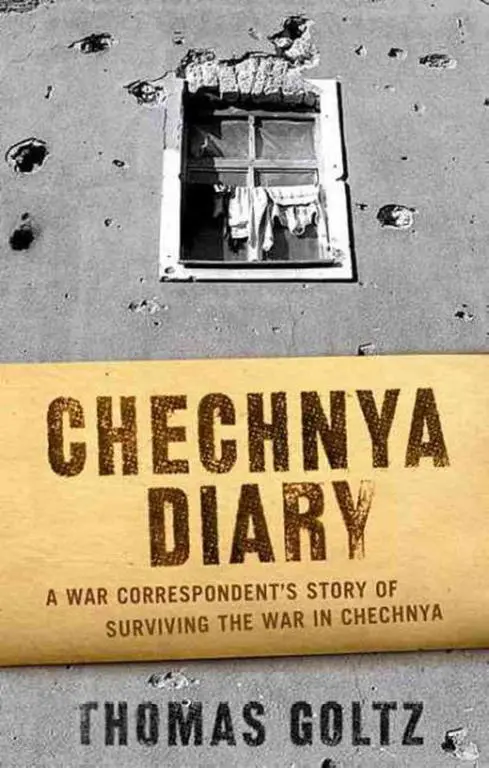
- Название:Chechnya Diary
- Автор:
- Издательство:Thomas Dunne Books
- Жанр:
- Год:2011
- Город:New York
- ISBN:0-312-26874-2
- Рейтинг книги:3 / 5. Голосов: 1
-
Избранное:Добавить в избранное
- Отзывы:
-
Ваша оценка:
Chechnya Diary: краткое содержание, описание и аннотация
Предлагаем к чтению аннотацию, описание, краткое содержание или предисловие (зависит от того, что написал сам автор книги «Chechnya Diary»). Если вы не нашли необходимую информацию о книге — напишите в комментариях, мы постараемся отыскать её.
is part of a larger exploration of the role (and impact) of the media in conflict areas. And at its heart,
is the story of Hussein, the leader of the local resistance in the small town that bears the brunt of the massacre as it is drawn into war.
This is a deeply personal book, a first person narrative that reads like an adventure but addresses larger theoretical issues ranging from the history of ethnic/nationalities in the USSR and the Russian Federation to journalistic responsibility in crisis zones.
is a crossover work that offers both the historical context and a ground-level view of a complex and brutal war.
Chechnya Diary — читать онлайн бесплатно полную книгу (весь текст) целиком
Ниже представлен текст книги, разбитый по страницам. Система сохранения места последней прочитанной страницы, позволяет с удобством читать онлайн бесплатно книгу «Chechnya Diary», без необходимости каждый раз заново искать на чём Вы остановились. Поставьте закладку, и сможете в любой момент перейти на страницу, на которой закончили чтение.
Интервал:
Закладка:
The Chechens might seem to have won an incredible victory against tremendous odds, but it was at the price of having lost up to a tenth of the population, with survivors living in an utterly destroyed landscape filled with refugees, orphans, and murderous psychopaths—even while a five-way power struggle began for the right to claim the mantle of the fallen Djohar Dudayev. Individuals would appear in Istanbul demanding money for a gaggle of different field commanders—and accuse Fazil of embezzlement of charity funds when he did not immediately fork over cash.
Inevitably, the question of fraud and misappropriation had even begun to touch on the reputation of the president of the Solidarity Committee, Fazil himself. His name was on the bank account in Istanbul to which donors might wire funds; but so were the names of the Vice-President and the Treasurer. Despite the fact that all incoming and outgoing funds had been painstakingly recorded and even registered with the Turkish tax officials, vicious gossip had it that Fazil had used some of the money for his own pleasure. For a man who had devoted the last few years of his life to the Chechen cause—almost to the point of destroying his marriage through neglect—it was not a happy time.
Equipped with copies of the documents concerning all cash transfers made by a score of couriers over the course of two years, he set off for Grozny to set the record straight.
Significantly, it was Fazil’s first legal trip to Chechnya. Rather than trudging over mountains or hiding in the trunk of a car, he and a companion applied for and received a visa to visit the Russian Federation, and flew from Istanbul to Nalchik, capital of the tiny North Caucasus republic of Kabardino-Balkaria. From there they made their way by road across the Republic of Ingushetia and then across the frontier into “free” Chechnya.
In Grozny, Fazil Özen began his business of resolving any misunderstandings about the purloined or misappropriated aid. He had meetings with old friends, such as President Maskhadov and the redoubtable Shamil Basayev, now Minister for Industry. All indications are that those contacts were friendly. There were, no doubt, other contacts and meetings, too, pertaining to various aid projects to be funded by the diaspora—a new school, perhaps, as well as scholarships for Chechen students in Turkish universities.
Business accomplished and name cleared, Fazil and his companion traveled to the town of Shali, located in the foothills of the towering Caucasus mountain range, and from there went to spend the last night in a neighboring village. One day, two, and then a week with no news. Fazil and his companion had been swallowed up by the earth. And in Chechnya, that meant only one thing. Kidnappers. But who, and why?
Fazil and his friend were not heard from again for eight months. And when they emerged from the last of a series of cellars and caves, they were completely emaciated and wearing chest-long beards caked with mud. They had become, Fazil later told me, experts in “the behavior of ants” and decent portrait artists. To relieve boredom, he and a cell mate had sketched pictures of each other in the caked-dirt filth that built up on their trousers.
The most frightening moment aside from the original capture, he informed me, came on the last day of captivity, when the two were dragged from their pit and brought into Grozny for potential release, only to be returned to another dungeon that evening.
“I broke down and wept, because I was sure that signaled a breakdown in negotiations, and that our captors would kill us,” he recalled. “Then one of the guards, who was not supposed to talk to us, tried to calm me by saying that we would be released at eleven that night. I was sure he was lying. But at a quarter to eleven our guards just disappeared into the night, and fifteen minutes later our liberators appeared. In other words, our kidnappers and liberators were the same people.”
And the rationale for kidnapping Fazil in the first place?
“They accused me of using the Solidarity Committee funds for my own purposes. I replied that I had not taken a dime, but even sold my car for the cause. They said that meant I was not a true Chechen, because a real Chechen would of course steal half the money. That is when my heart broke, and when I returned to Turkey I kissed the tarmac of the airport. I never want to see that place again.”
That was the confused atmosphere of Chechnya I planned to walk into for my Aftermath assignment for the BBC.
17
THE LAW OF THE MOUNTAINS
Iplanned my Return to Samashki assignment to overlap with the Chechen presidential elections of January 1997. The government of Acting President Zelimkhan Yandarbiyev, and the military forces under the command of victorious General Asian Maskhadov, had promised complete security for all foreign journalists and election observers who decided to pop into the country to monitor the polls.
The obvious problem with this pledge was whether the “rogue elements,” held responsible for the daily diet of murder and mayhem before the elections, would now listen to the country’s leadership and desist from their destabilizing activities. More to the point, if the successful secessionist government could not control said elements from kidnapping and killing foreigners when there were almost no foreign targets in the country, how could the government possibly control the same unidentified elements from kidnapping foreigners leading up to election day, when there would be more exposed targets than ever before?
Formally, the presidential elections were being held to replace the martyred Djohar Dudayev. The field of candidates was led by Asian Maskhadov, the silent and successful general of the resistance campaign and architect of the reconquest of Grozny that had resulted in the de facto independence of Chechnya from the Russian Federation. General Maskhadov was the clear favorite among all segments of Chechen society, but particularly among those folks who might be called traditional conservatives. He also commanded a grudging respect from the Russian military, and thus from a Kremlin perspective was viewed as a man with whom the Yeltsin government could do business.
Next came Shamil Basayev, the flamboyant 35-year-old field commander and Maskhadov deputy. Basayev was favored by the radical youth, who were not satisfied with some of the fuzzier points of the Khazavyurt Accords negotiated by Maskhadov that had formally ended the Chechen-Russian war. The fuzziest of all was the postponing of Chechnya’s de jure status as being a state legally independent from Russian for a period of five years. As for Moscow’s attitude toward Basayev, quite simply he was known as the most wanted man in Russia.
The dark horse candidate in the elections was Acting President Zelimkhan Yandarbiyev. Although the principal ideologue of the Chechen Revolution, his candidacy was tainted in the eyes of many locals by the fact that he had never been a combatant, and stained in the eyes of many outside observers by real or perceived connections to the “Wahhabi” foreign fighters, such as Khattab.
A handful of other candidates, most of whom were successful unit commanders, added color, if little contention, to the field.
Aside from specific political agendas and the personal style of the candidates, the main issue at hand was security, or rather the lack of it, throughout the land. The appalling murder of six Red Cross workers who had been bludgeoned to death in their sleep in Novi Atagi a month before remained unsolved, and scores of would-be international election monitors had canceled their trips to Chechnya, fearing for their lives.
This was a severe blow to whoever might eventually win the presidency, as well as to Chechnya as a whole, as the very act of monitoring elections suggested some tacit recognition of the renegade state. The head of the Organization for Security and Cooperation in Europe mission to Chechnya, Swiss diplomat Tim Guldermann, had invested a huge amount of personal effort and political capital to convince Moscow to accept the concept of Chechnya holding any elections at all. But his pleas to other OSCE states to send official observers to Grozny fell largely on deaf ears due to security concerns, and with the exception of a group of Polish monitors brought down from Moscow by the mysterious Mansour Jachimczyk (who was simultaneously campaigning for Yandarbiyev), official OSCE attendance was embarrassingly thin.
Читать дальшеИнтервал:
Закладка:
Похожие книги на «Chechnya Diary»
Представляем Вашему вниманию похожие книги на «Chechnya Diary» списком для выбора. Мы отобрали схожую по названию и смыслу литературу в надежде предоставить читателям больше вариантов отыскать новые, интересные, ещё непрочитанные произведения.









Обсуждение, отзывы о книге «Chechnya Diary» и просто собственные мнения читателей. Оставьте ваши комментарии, напишите, что Вы думаете о произведении, его смысле или главных героях. Укажите что конкретно понравилось, а что нет, и почему Вы так считаете.