Thomas Goltz - Chechnya Diary
Здесь есть возможность читать онлайн «Thomas Goltz - Chechnya Diary» весь текст электронной книги совершенно бесплатно (целиком полную версию без сокращений). В некоторых случаях можно слушать аудио, скачать через торрент в формате fb2 и присутствует краткое содержание. Город: New York, Год выпуска: 2011, ISBN: 2011, Издательство: Thomas Dunne Books, Жанр: Биографии и Мемуары, military_history, Публицистика, на английском языке. Описание произведения, (предисловие) а так же отзывы посетителей доступны на портале библиотеки ЛибКат.
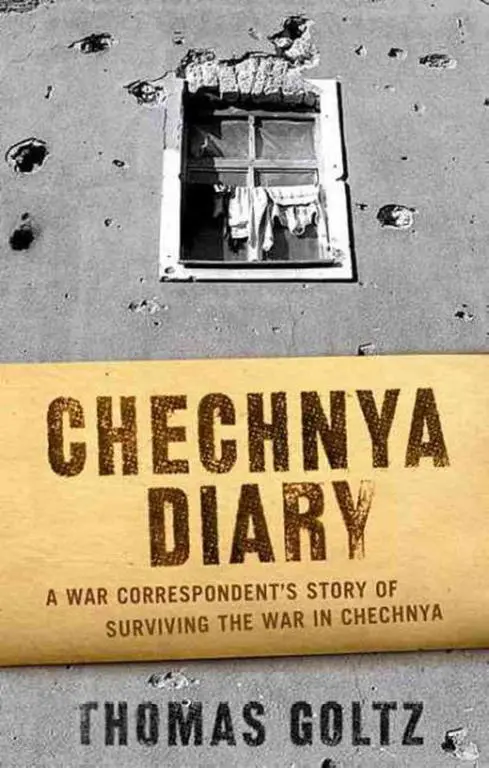
- Название:Chechnya Diary
- Автор:
- Издательство:Thomas Dunne Books
- Жанр:
- Год:2011
- Город:New York
- ISBN:0-312-26874-2
- Рейтинг книги:3 / 5. Голосов: 1
-
Избранное:Добавить в избранное
- Отзывы:
-
Ваша оценка:
Chechnya Diary: краткое содержание, описание и аннотация
Предлагаем к чтению аннотацию, описание, краткое содержание или предисловие (зависит от того, что написал сам автор книги «Chechnya Diary»). Если вы не нашли необходимую информацию о книге — напишите в комментариях, мы постараемся отыскать её.
is part of a larger exploration of the role (and impact) of the media in conflict areas. And at its heart,
is the story of Hussein, the leader of the local resistance in the small town that bears the brunt of the massacre as it is drawn into war.
This is a deeply personal book, a first person narrative that reads like an adventure but addresses larger theoretical issues ranging from the history of ethnic/nationalities in the USSR and the Russian Federation to journalistic responsibility in crisis zones.
is a crossover work that offers both the historical context and a ground-level view of a complex and brutal war.
Chechnya Diary — читать онлайн бесплатно полную книгу (весь текст) целиком
Ниже представлен текст книги, разбитый по страницам. Система сохранения места последней прочитанной страницы, позволяет с удобством читать онлайн бесплатно книгу «Chechnya Diary», без необходимости каждый раз заново искать на чём Вы остановились. Поставьте закладку, и сможете в любой момент перейти на страницу, на которой закончили чтение.
Интервал:
Закладка:
The monks and mothers and other attendant Russian religious pacifists, as well as Chris Hunter and the Quakers are back, planning a chant-march- zikr down the road from Sernovodsk to Samashki, breaching the barrier at Post 13.
They march. We march. We are them and they are us, Orthodox Jew silent marching, zikr- dance Muslim ecstatic chanting, Buddhist drum-beating. One hundred yards from the barrier, the colonel who used my flak jacket for target practice and the baby-faced sergeant come out to greet us with a dozen soldiers with their guns at the ready.
Halt, they say. We do. A discussion ensues; the marching mood dissipates; another wave of refugees trudges around the far side of the APC. And then a white land cruiser with the markings of the International Committee of the Red Cross is driving toward us, coming from Samashki. It stops at the barrier.
Odd.
Jean-Paul Corbaz, director for the North Caucasus region of the ICRC, gets out. Talking to the cameras, he explains how he has just been taken on a tightly controlled tour of Samashki, after previously having been refused access on multiple occasions by the Russian high command.
“There are many ways to take a town in accordance with the rules of war,” Corbaz says carefully. “By all indications, this was not the case in Samashki.”
That tightly worded statement is a complete break with the ICRC policy of never sharing anything in the field with the press. It is a virtual condemnation of the Russian high command, and a war crime inference.
That is news.
Not without bodies, say all the editors I petition.
Vodka that night. Buckets of it.
13
WITNESS
“ The true scale of the tragedy that struck the Chechen settlement of Samashki on April 12 [ April 7-8, ed. ] will be revealed at a later date, but even now it is clear that it can be equated with Lidice, Khatyn, and Son My.” [20] Dmitry Balburov, Moscow News Weekly, English edition, No. 15, April 21-27, 1995. 21 Gillian Findley, ABC World News Tonight with Peter Jennings, April 12, 1995.
“Silence hung over Samashki today. Everywhere, it seems, there were bodies.” [21] One was the American national Aukai Collins, who lost a leg in fighting. Cf. Amy Barrett, “Holy Warrior,” New York Times Magazine , August 4, 2002. Collins also wrote a book entitled My Jihad (Guilford, Conn.: Lyons Press, 2002).
“ They are pulling me,” said Uncle Larry, hanging up his sat phone.
“They say there is nothing more we can do with this story without real pictures.”
This was extraordinarily bad news. Lawrence was my car, my phone, my rent. Without Sheets, I had no resources. But however frustrating, I had to admit that I was about to give up, too. I’d been burning up a lot of time at fifteen dollars a minute on Uncle’s satellite phone, trying to get someone, anyone, interested in the Samashki massacre story, but with no results. No bodies, no story, said everyone I ever worked for, and I was getting a little tired racing to the Slepsovski airport every evening to beg or bribe pilots or passengers to courier the tapes I shot that day to the ABC Moscow bureau in the vain hope that they would use something.
“Let’s just make one last run.”
“I just don’t get the point any more,” said Sheets. “We have done this story to death.”
“Please.”
Back through the muddy streets of Slepsovski down to the market, over the bridge left then right toward Assinovskaya before jagging left again down the tree-lined road to Sernovodsk. There was Memorial’s Alexandr Guryanov at the mosque, a mass of people gathered around him as he continued to read from his list of dead or living. A couple of the monks associated with the Soldiers’ Mothers’ March were chanting at the corner of the field, attracting the listless attention of several more newly arrived journalists. Sheets and I drove on, pausing to take keepsake pictures of each other under a poster of Djohar Dudayev someone had nailed to a telephone pole. The banner underneath read: Freedom or Death!
Next came Post 13.
But there was something different, something wrong.
There was no APC blocking the road.
We stopped where the APC should have been and went to the Post canteen to find our baby-faced sergeant. He was drinking tea with a plump peroxide blonde dressed in camouflage.
“Well?” he asked us. “What do you want?”
“You know what we want. The same thing we have wanted for almost a week.”
“So? Who’s stopping you? Not me.”
We got back in the car. Maybe we put up a white flag or tidied up the tape on the windscreen that spelled out PRESS in reverse. And then we were driving into Samashki, and even Uncle Larry was incapable of coming up with a gallows joke.
The first body was that of a man lying in the mud outside a house at 102 Stepnaya Street. He was dressed in a red vest with a plaid lining on the inside of his coat, partially covered by a green blanket with a white floral pattern. I might have known him, but could not tell due to his shattered face. Lawrence and I sucked up our guts and moved on.
“I don’t know what to say, I just do not know what to say,” said a familiar-looking grandfather, keening in the shattered remnant of his home. “They came and they killed us like we were animals, and then did not even allow us to bury our dead. What can I say?”
His son had been killed right in front of him
A young mother almost deranged with grief, described how a tank had barged through the gate of her parents’ home and then started blasting away at point-blank range. Her father tried to hide in the oil pit of the family garage, but had been found, dragged out and doused with gasoline and then set afire before her eyes. She did not know how her mother and brother were killed; she just buried them in the garden along with her father, a week after having planted the spring onions. She worked the mud between her fingers like religious beads. I forgot to write down her name; it was not that important—she was just one of hundreds of walking wounded, so stunned by grief they could not even wail.
The destruction down some streets was nearly total, with houses gutted from the inside. Weirdly, other streets suffered virtually no damage at all, save for shattered windows and often not even that.
We stopped by the house where I had witnessed my first zikr ; it had been converted into a morgue where the dirge leader was washing the body of a young man just brought in from the forest. We spotted the man I called Santa Claus due to his rosy complexion and long white beard—not Commander Ali, but a town elder. He was rolling the charred remains of three girls in white burial linen. We followed him to the cemetery to find something like a hundred fresh graves. A cleric was chanting the Muslim prayer for the dead over each fresh hole. Survivors shoveled in dirt.
I kept my camera running. It was difficult to stay sane.
We drove down the main street to the southeastern part of town, by the water tower, market, and school. The first stop was Alkhazur’s. His welding shop and home were empty.
Dead, or fled?
I instructed Nodar to turn the corner and drive down a short, muddy street I walked down so many times before. The gate was shut, but the house looked sound. I knocked until my knuckles bled.
“Let’s go,” said Laurence. “This is not good for you.”
And then a shuffle behind the gate, and the creak of a bolt being removed.
The door opened a crack. It was Hussein’s mother.
“Toms!” she cried, grabbing me. “Djivut! He’s alive!”
Читать дальшеИнтервал:
Закладка:
Похожие книги на «Chechnya Diary»
Представляем Вашему вниманию похожие книги на «Chechnya Diary» списком для выбора. Мы отобрали схожую по названию и смыслу литературу в надежде предоставить читателям больше вариантов отыскать новые, интересные, ещё непрочитанные произведения.





Обсуждение, отзывы о книге «Chechnya Diary» и просто собственные мнения читателей. Оставьте ваши комментарии, напишите, что Вы думаете о произведении, его смысле или главных героях. Укажите что конкретно понравилось, а что нет, и почему Вы так считаете.