Thomas Goltz - Chechnya Diary
Здесь есть возможность читать онлайн «Thomas Goltz - Chechnya Diary» весь текст электронной книги совершенно бесплатно (целиком полную версию без сокращений). В некоторых случаях можно слушать аудио, скачать через торрент в формате fb2 и присутствует краткое содержание. Город: New York, Год выпуска: 2011, ISBN: 2011, Издательство: Thomas Dunne Books, Жанр: Биографии и Мемуары, military_history, Публицистика, на английском языке. Описание произведения, (предисловие) а так же отзывы посетителей доступны на портале библиотеки ЛибКат.
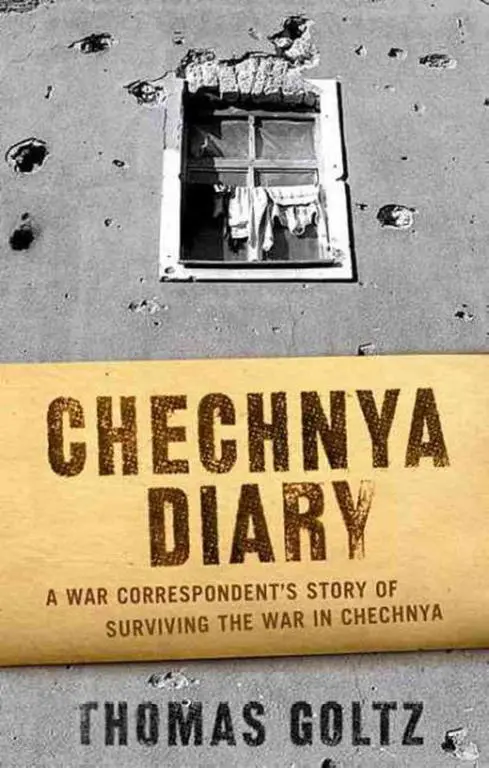
- Название:Chechnya Diary
- Автор:
- Издательство:Thomas Dunne Books
- Жанр:
- Год:2011
- Город:New York
- ISBN:0-312-26874-2
- Рейтинг книги:3 / 5. Голосов: 1
-
Избранное:Добавить в избранное
- Отзывы:
-
Ваша оценка:
Chechnya Diary: краткое содержание, описание и аннотация
Предлагаем к чтению аннотацию, описание, краткое содержание или предисловие (зависит от того, что написал сам автор книги «Chechnya Diary»). Если вы не нашли необходимую информацию о книге — напишите в комментариях, мы постараемся отыскать её.
is part of a larger exploration of the role (and impact) of the media in conflict areas. And at its heart,
is the story of Hussein, the leader of the local resistance in the small town that bears the brunt of the massacre as it is drawn into war.
This is a deeply personal book, a first person narrative that reads like an adventure but addresses larger theoretical issues ranging from the history of ethnic/nationalities in the USSR and the Russian Federation to journalistic responsibility in crisis zones.
is a crossover work that offers both the historical context and a ground-level view of a complex and brutal war.
Chechnya Diary — читать онлайн бесплатно полную книгу (весь текст) целиком
Ниже представлен текст книги, разбитый по страницам. Система сохранения места последней прочитанной страницы, позволяет с удобством читать онлайн бесплатно книгу «Chechnya Diary», без необходимости каждый раз заново искать на чём Вы остановились. Поставьте закладку, и сможете в любой момент перейти на страницу, на которой закончили чтение.
Интервал:
Закладка:
Then the situation got a lot nastier.
A cropped-haired man named Alexandr Guryanov, representing the Russian human rights group Memorial, an organization founded in the hallowed name of Andrei Sakharov, announced his presence with a speech.
“Let me say this quite clearly, in front of these young Russian soldiers,” Guryanov intoned. “Events in Samashki, a defenseless town and surrounded by the overwhelming force of the Russian Army, can only be described as an attempted genocide.”
The words were no sooner out of his mouth than the blond Special Forces kid in the black flak jacket and Reebok or Nike sneakers was in Guryanov’s face.
“The genocide is of the Russian soldiers who fought for our country!” he snarled. “You want to talk genocide, that is your genocide! ”
I pulled out my camera to document a little tension at the checkpoint, but then felt a hand on my arm.
“You foreign correspondents all seem to like wearing your fancy flak jackets, as if you were afraid we were going to shoot you,” smirked a wiry gentleman with officer bars on his arms—captain, major, or colonel, I really couldn’t say. “Why are you so concerned? But just for fun, let’s see what your Western, NATO stuff really absorbs, shock-wise.”
All the Russian grunts chortled. Their commander was looking at us all, everyone sporting a blue flak jacket. Then he was looking at me and raising his gun.
Keep cool, I said to myself, flipping. Dance on thin ice, now…
“Point blank?” I said, scoffing. “Let’s see what you can do from one hundred meters.”
One, two, three, four, five… I started counting off steps, stripping the Velcro snaps off the blue flak jacket as I went. Just get it off and let him shoot it out of my hand!
At one hundred paces, I propped the jacket up in the weeds like a target, relieved—and furious with myself, the gunman, and the world.
One, two, three, four, five…
“Are you insane? That shock plate is worth five hundred dollars!” hissed Sheets.
He was furious and had a right to be. I left my ABC-owned body armor in Moscow, and I was wearing Reuters’ flak gear.
Plung!
The officer whacked my flak jacket from one hundred yards, then sent a grunt to collect it for our inspection. The bullet had smashed into the lower left-hand area of the chest plate. A liver shot. Fatal, perhaps, had it not been for the ceramic Kevlar plate. It actually had stopped the slug, although anyone wearing the jacket during impact would have been extremely uncomfortable, with shattered ribs, bruised guts, and likely internal bleeding. At the very least, the wearer would have become temporarily incapacitated in the way that folks get immobilized when punched in the solar plexus.
More to the point, the five hundred dollar ceramic shock plate was ruined. Hairline cracks emanated from the impact hole, reaching at least into the center. Its integrity had been destroyed with one relatively low-impact round from an AK-47 at one hundred yards. The next bullet would have just gone straight through. Stop the war, I want to get off . [17] Years later, at a Special Forces school in Florida, I was treated to a shooting display, including a demonstration of what types of shock plate in the modern American flak jacket can withstand what kind of shot from what kind of range. At the end of the program, we guests were invited to inspect the target vests, and most folks were mightily impressed with the absorptive powers of the fancy Kevlar ceramic plates. Not wanting to ruin everyone’s fun, I took one of the SF guys aside and asked about second-shot integrity. “We don’t use this shit in the field,” he admitted. “It’s too heavy and limits your ability to roll out of the way when you need to. The only folks we think need to wear it are Secret Service guys guarding the president, so they can leap in the way and take that one shot. After that, the vest is toast.”
Laurence Sheets was seething.
“You fuck!” he screamed. “How am I going to explain this to Reuters?”
Not bothering to suggest that maybe I had literally taken the flak for our whole group, I managed to say that if the ceramic chest plates were one-timers, then perhaps they were overrated as protection.
“It stopped that bullet, ass!” shouted Uncle Larry.
“And the second?” I asked rhetorically.
“That’s not the point!”
“It is the point,” I loudly suggested. “Am I supposed to stand up and ask everyone to stop shooting while I change plates?”
The Russian grunts chortled. Having two foreign journalists screaming at each other in front of everyone was better fun than having almost just shot one.
Ahelicopter landed, kicking up dirt. A much-epauletted officer got off and scuttled over to the base. General Antonov, perchance? No telling, but at least some good visual action. Takeoff, landing, and menacing overflight. It soon got better.
Distantly, down the road and to the left, at the base of the Sundja Hills, came the dust devils. One, two, five, ten. Growing. Tanks. Lots of them. A whole column. Crossing the road. Now on the right side, moving toward the Post 13 trenches, and beyond. A dozen APCs; no, a score or more. A dozen howitzers and at least that many T-72 and T-83 battle tanks. And kitchen trucks, and jeeps, and ammunition wagons. The turrets and aprons of all vehicles were crowded with grunts dressed in Rambo-black, pirate scarves cinched around their foreheads, sitting beneath the red hammer and sickle flag of the defunct USSR, instead of the Russian tricolor. An army was on the move.
I put my camera down on its tripod at an angle that would capture the armor as it rolled by the base. A tidal wave of dust started to float over us until it obscured virtually everything. The only way to track the column was to try and see where the dust started and stopped.
“And now, Bamut,” I heard one of the grunt guards chuckle to another mate.
“What unit is that?” I asked.
“Three-sixty-sixth, I think,” said one of the grunts.
The 366th. That was the unit held responsible for the massacre at Xodjali in Azerbaijan back in 1992, when the Karabkah Armenians decided to make an example out of that little town, killing nearly a thousand souls.
Distracted by the column, no one else seemed to notice the car coming down the road from Sernovodsk under a white flag. It pulled up in front of the APC and two elderly men got out. To all the other journalists gathered around, the pair probably just looked like local farmers. To me, they looked like ghosts. One was Lema Abdulkhajiev, the head of the local administration in Samashki, a man I did not know well. The other was Akhmad Amaev, the Samuel Pepys of Samashki. Both were supposed to be dead, killed along with the other elders on the night of April 6, in one of the acts the Russian command used to justify the attack on the town. Something was very wrong.
Throwing off all protocols learned in my time in Samashki concerning respect of youth toward age, I rushed over to greet Amaev. He was as stunned to see me as I him.
“We have been used, horribly used!” he hissed. “We are all alive!”
Sheets was at my side; I quickly brought him up to speed.
“I must go,” said Amaev, trying to break away. “I have to negotiate with these animals about getting out the wounded, the women and children.”
“You must tell the world the truth, that you are alive.”
“I must go.”
“You must tell us, and on camera. For the sake of the truth and history.”
The soldiers atop the APC were absorbed in something else—the magnificence of the armored column that just rolled by, the gaggle of foreign correspondents and aid workers on the far side of the vehicle, or maybe just the fourth playing of “Smoke on the Water” on their cassette player. I covered Sheets as he turned his camera on Amaev.
Читать дальшеИнтервал:
Закладка:
Похожие книги на «Chechnya Diary»
Представляем Вашему вниманию похожие книги на «Chechnya Diary» списком для выбора. Мы отобрали схожую по названию и смыслу литературу в надежде предоставить читателям больше вариантов отыскать новые, интересные, ещё непрочитанные произведения.






Обсуждение, отзывы о книге «Chechnya Diary» и просто собственные мнения читателей. Оставьте ваши комментарии, напишите, что Вы думаете о произведении, его смысле или главных героях. Укажите что конкретно понравилось, а что нет, и почему Вы так считаете.