Thomas Goltz - Chechnya Diary
Здесь есть возможность читать онлайн «Thomas Goltz - Chechnya Diary» весь текст электронной книги совершенно бесплатно (целиком полную версию без сокращений). В некоторых случаях можно слушать аудио, скачать через торрент в формате fb2 и присутствует краткое содержание. Город: New York, Год выпуска: 2011, ISBN: 2011, Издательство: Thomas Dunne Books, Жанр: Биографии и Мемуары, military_history, Публицистика, на английском языке. Описание произведения, (предисловие) а так же отзывы посетителей доступны на портале библиотеки ЛибКат.
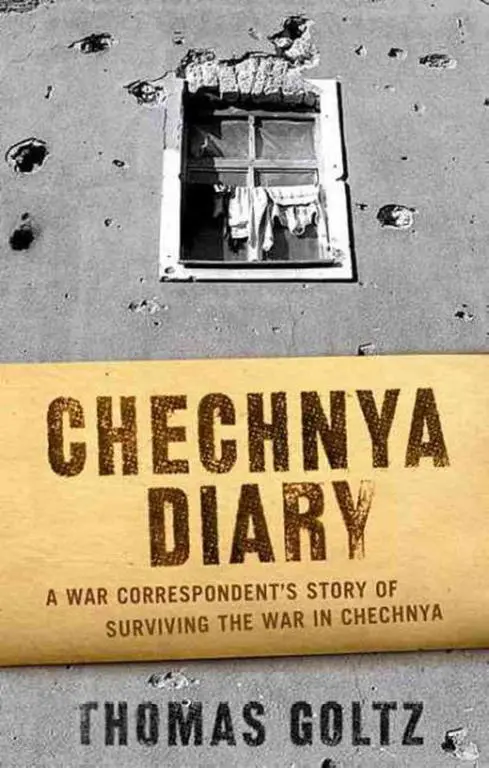
- Название:Chechnya Diary
- Автор:
- Издательство:Thomas Dunne Books
- Жанр:
- Год:2011
- Город:New York
- ISBN:0-312-26874-2
- Рейтинг книги:3 / 5. Голосов: 1
-
Избранное:Добавить в избранное
- Отзывы:
-
Ваша оценка:
Chechnya Diary: краткое содержание, описание и аннотация
Предлагаем к чтению аннотацию, описание, краткое содержание или предисловие (зависит от того, что написал сам автор книги «Chechnya Diary»). Если вы не нашли необходимую информацию о книге — напишите в комментариях, мы постараемся отыскать её.
is part of a larger exploration of the role (and impact) of the media in conflict areas. And at its heart,
is the story of Hussein, the leader of the local resistance in the small town that bears the brunt of the massacre as it is drawn into war.
This is a deeply personal book, a first person narrative that reads like an adventure but addresses larger theoretical issues ranging from the history of ethnic/nationalities in the USSR and the Russian Federation to journalistic responsibility in crisis zones.
is a crossover work that offers both the historical context and a ground-level view of a complex and brutal war.
Chechnya Diary — читать онлайн бесплатно полную книгу (весь текст) целиком
Ниже представлен текст книги, разбитый по страницам. Система сохранения места последней прочитанной страницы, позволяет с удобством читать онлайн бесплатно книгу «Chechnya Diary», без необходимости каждый раз заново искать на чём Вы остановились. Поставьте закладку, и сможете в любой момент перейти на страницу, на которой закончили чтение.
Интервал:
Закладка:
A very blonde Russian youth dressed in a black flak jacket only worn by special forces—the regular Russian grunts wear the more cumbersome green jobbies that carry multiple steel “alligator skin” plates—jumped down from the APC and swung his gun barrel at us. He was wearing Reebok running shoes, or maybe Nikes.
“Davai!” he ordered us, “Clear out, now!”
He was instantly joined by a knot of similarly ill-disposed Russian servicemen.
Lawrence got out of the car and extended his hand, trying to break the ice and reason with the man. But this was one checkpoint he was not going to talk his way across. Further discussion—or a monologue, really—in Lawrence’s perfectly fluent Russian (he even knows the word for “phlegm,” as opposed to just “spit” or “snot”) only served to get the guards to call in their sergeant, who emerged from a nearby command trench with a smile on his face and a piece of paper and pencil in his hand, noting first our license plate number, and then our names and press affiliations.
“Sorry,” he smiled. “You are not on the master list from Mozdok and cannot enter this particular area of the zone of conflict.”
“Master list from Mozdok?” Lawrence asked. “But we have our permissions from the Ministry of Defense.”
“Sorry,” smiled the captain or sergeant. “There is a special operation underway right now, and new permissions are required. You have to go to Mozdok to get it.”
Mozdok. The headquarters of the Russian command in the Chechen campaign, and one of the great “filtration” centers. It was at least three hours away by bad road. Lawrence lingered to argue the inanity of our having to go there, but got nowhere. A distant explosion over the blocking APC, and a new plume of smoke from the general direction of Samashki. More distant rat-tat-tat. We were at a dead end.
“Did you get it?” Sheets hissed to his cameraman once we were back in the car.
“What?” asked the maybe-junkee sitting in the front of the SUV.
“The post, the sergeant, the explosion and smoke over Samashki!”
“What?”
“Durak!” snarled Sheets. “Fool! Why do you think I kept talking?”
Uncle Larry could get mean when he felt deprived of news footage.
The only good news, as it were, was seeing the two cars bearing the AP and WTN television teams heading toward the checkpoint we just left. It seemed they took the wrong road in the morning, and that meant we were ahead of them. We did not bother to stop to tell them what they could expect. Letting them get tied up for an hour or more gave us the time to bag something exclusive, newswise.
Competition, and all that.
Back through Sernovodsk. Back through Slepsovski. Back down the main highway to Nazran, with a cut right at Karabuk, and up and over the Sundja Hills via very bad and muddy roads to Mozdok via the back door. The hills were starting to take on a veneer of green, with splashes of wildflower erupting in yellows, reds, and blues here and there. Spring in the Caucasus. Shepherds drove their sheep; vicious dogs attempted to attack the car; an outdoor market in the middle of nowhere was specializing in automotive parts; a hippodrome of sorts was tucked between two hills, with a horse race game called jirit underway. All of this would have made lovely B-roll footage for a documentary feature on the region, or even one on the weirdness of life-goes-on-as-normal-in-the-midst-of-war. But we did not have the time nor inclination to stop. The Novosti news program on Channel One was carrying a report, sourced to the military, of MVD forces conducting a “mop up” operation in the area of Samashki. Russian losses were reported as sixteen killed and forty wounded. The fighting must have begun just after we had left the Post 13 checkpoint on the distant western fringe of the town. I thought of all the point positions I knew of on the Samashki periphery, the gun pits and slit trenches—and their occupants. I was sick at heart of it all, but mainly sick at heart for not being there.
Lawrence was sick, too.
He was sitting in the backseat of an SUV Reuters-mobile with a driver and a cameraman and guide (me), all going in the wrong direction.
“That is bullshit news,” he announced to all of us, but mainly to himself. “Nothing but propaganda.”
I only hoped he was right.
Finally, Mozdok—another drab farm town in the Russian North Caucasus, but one situated in the pro-Russian minirepublic of North Osetia, that now calls itself Alanya. Most of its citizens claimed descent from some proto-Persian stock, and that Josef Stalin is (or was) one of their number. Aside from total loyalty to the concept of “Russia” for a century or two, not a lot distinguished Alanya from its various North Caucasian neighbors. It was rural; it was a dump. As for Mozdok, its main distinguishing characteristic was that it supported a large military base and was filled with soldiers and their equipment. That, in turn, meant the roads were worse than elsewhere: Tank treads are not gentle on asphalt, nor the huge rubber wheels of the Soviet-style APCs.
We flashed our papers to the guards at the entrance to the base and were duly registered according to name, vehicle registration, and Defense Ministry press pass. We sought out the public affairs office to acquire the new permission papers, watching helicopters land and take off for Chechnya and trucks arrive to be loaded with boxes of ammunition. Behind our every step was the thought that somewhere on this base was the notorious “filtration” center that served as the torture factory for young Chechen men, such as the man named Vakha I had interviewed that first night in Samashki so many centuries ago. You could almost smell the evil, but never see it. This warehouse? Those railway cars?
But if the torturers and their victims were not to be seen, neither was anybody else who might issue the new, special passes allegedly required to make a legal foray into Samashki. After an hour or two of getting shuffled from one office to the next, we decided we were wasting our time. Two hours later we were back in Slepsovski, and a half hour later parked in front of the APC blocking the road to Samashki in front of Post 13.
This time, we were not alone. In addition to the APTV and WTN rivals, and a couple of other reporters drawn to the Samashki story like flies to fresh manure, I noticed an empty yellow bus flying a white flag. Next to it stood a man best described as Jesus-when-he-got-old, whose white beard and general mien suggested he was a Russian peacenik. He and the bus were there to go in and pick up the wounded. But no one was coming out.
Once again, we could hear the distant rat-a-tat-tat of small arms fire, often punctuated by the deeper bomb-boom of cannon or mortar. Smoke billowed from a dozen distant fires, merging into a single grayish haze over the town before merging with the enveloping dusk.
“I would truly like to allow you to go down the road, but it is simply too dangerous,” smirked the baby-faced sergeant or captain who had sent us to Mozdok that morning. “I have to guarantee your security, but I cannot. Even we do not know what is going on in there.”
Sheets and I discussed the idea of calling the officer on his words and taking security on our own shoulders. It was a crazy notion—but then again, we had done crazy things before. Then the blonde OMON man in the Reebok or Nike sports shoes we had encountered that morning came rushing at us, screaming. Actually, he was addressing the Russian peacenik wearing the long white beard.
“Why do you human rights-loving pacifist creeps care so much for these Chechen dogs!” he howled. “They are cutting off the legs and arms and heads of every one of our boys they capture, and sticking them in garbage cans!”
Читать дальшеИнтервал:
Закладка:
Похожие книги на «Chechnya Diary»
Представляем Вашему вниманию похожие книги на «Chechnya Diary» списком для выбора. Мы отобрали схожую по названию и смыслу литературу в надежде предоставить читателям больше вариантов отыскать новые, интересные, ещё непрочитанные произведения.




Обсуждение, отзывы о книге «Chechnya Diary» и просто собственные мнения читателей. Оставьте ваши комментарии, напишите, что Вы думаете о произведении, его смысле или главных героях. Укажите что конкретно понравилось, а что нет, и почему Вы так считаете.