Thomas Goltz - Chechnya Diary
Здесь есть возможность читать онлайн «Thomas Goltz - Chechnya Diary» весь текст электронной книги совершенно бесплатно (целиком полную версию без сокращений). В некоторых случаях можно слушать аудио, скачать через торрент в формате fb2 и присутствует краткое содержание. Город: New York, Год выпуска: 2011, ISBN: 2011, Издательство: Thomas Dunne Books, Жанр: Биографии и Мемуары, military_history, Публицистика, на английском языке. Описание произведения, (предисловие) а так же отзывы посетителей доступны на портале библиотеки ЛибКат.
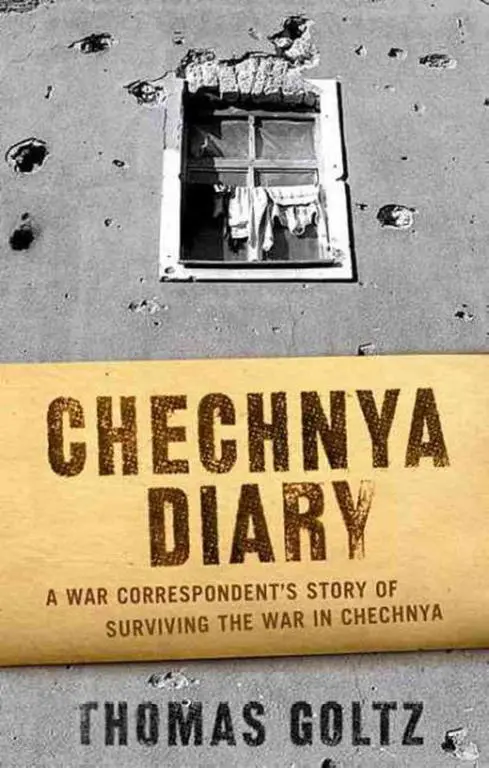
- Название:Chechnya Diary
- Автор:
- Издательство:Thomas Dunne Books
- Жанр:
- Год:2011
- Город:New York
- ISBN:0-312-26874-2
- Рейтинг книги:3 / 5. Голосов: 1
-
Избранное:Добавить в избранное
- Отзывы:
-
Ваша оценка:
Chechnya Diary: краткое содержание, описание и аннотация
Предлагаем к чтению аннотацию, описание, краткое содержание или предисловие (зависит от того, что написал сам автор книги «Chechnya Diary»). Если вы не нашли необходимую информацию о книге — напишите в комментариях, мы постараемся отыскать её.
is part of a larger exploration of the role (and impact) of the media in conflict areas. And at its heart,
is the story of Hussein, the leader of the local resistance in the small town that bears the brunt of the massacre as it is drawn into war.
This is a deeply personal book, a first person narrative that reads like an adventure but addresses larger theoretical issues ranging from the history of ethnic/nationalities in the USSR and the Russian Federation to journalistic responsibility in crisis zones.
is a crossover work that offers both the historical context and a ground-level view of a complex and brutal war.
Chechnya Diary — читать онлайн бесплатно полную книгу (весь текст) целиком
Ниже представлен текст книги, разбитый по страницам. Система сохранения места последней прочитанной страницы, позволяет с удобством читать онлайн бесплатно книгу «Chechnya Diary», без необходимости каждый раз заново искать на чём Вы остановились. Поставьте закладку, и сможете в любой момент перейти на страницу, на которой закончили чтение.
Интервал:
Закладка:
Flares lit the night.
Multiple, incidental, horrible stops in the middle of multiple nowheres.
Then finally, blissfully, a tarmac road, and then finally, blissfully, a highway—meaning we would not be killed that night. While the rest of the trucks and buses continued on to Vladikavkaz, we peeled off and drove to Sonia’s base at Nazran, arriving at three or four in the morning.
My first order of business was to say a prayer for my friends.
The second thing was to accept that drink of whiskey offered by Sonia, and then drink her bottle dry. I had not had a sip for weeks. [13] Sonia’s sole public recollection is that I ruined her beauty sleep by snoring—and thus earned the name she still calls me: Radio Montana.
In the morning, sitting among the chickens and turkeys while eating a breakfast of toast, eggs, bacon and cheese, all washed down by real coffee and orange juice from the ARD supply stash, I heard the motor sound of an approaching helicopter and surprised myself when I did not duck.
I was out. I was alive. I had my tapes. I had my story.
No. Our story.
That was my part of the bargain.
PART THREE
11
GETTING OUT THE NEWS BLUES
That something was sour between myself and my employers at Video News International should have been evident even before I had left Philadelphia nearly three months before. Instead of enticing me to go cover the chaos and confusion of war in the Caucasus with a wad of emergency cash and a decent flak-jacket, my producers had relied more on my reaction to the inference of cowardice when I had expressed reluctance to wander off to war without the requisite equipment—such as cash and Kevlar. The contract between us seemed fraught with legal loopholes that protected them and not me, but in the end I caved and signed it because a war correspondent is not a war correspondent without a war.
Yes, there was bad blood between us. That I knew. But when I stumbled bruised and broke into the ABC office in Moscow, I was not ready for what awaited.
The first surprise was that no one in the ABC office really expected me, mainly due to the fact that I had been declared missing and presumed dead on Russian TV. This was news to me, but of a pleasant kind in the general scheme of things. The second thoroughly unpleasant surprise was learning that there was, in fact, no institutional link or contract between ABC and VNI that obliged the Moscow bureau to do anything for me at all. The night watchman for news, Chris Gehring—later murdered in Kazakhstan—was kind enough to let me sleep on the library floor and use the international line to clear up what I hoped was just some small misunderstanding.
My first call was to the VNI office to tell them I was alive and to brief them on the story I now envisaged for Nightline. A portrait of the Chechen spirit, as seen through Hussein, the bold and no doubt doomed effort to stop the train, the attacks on my muddy little Grovers’ Corner town on the north Chechen plain, and the weird and wonderful Mothers’ March to save their sons. I even had a working title for the piece— Devotion.
“But did you get bang-bang?” was the distant producer’s first response.
The question was so ridiculous that my answer was probably disproportionate. I do not quite remember; I had been up for nearly forty-eight hours under a bit of stress.
“Of course I’ve got fucking bang-bang,” I probably screamed.
“Ok, ok,” came the reply. “Just send in the tapes and we will take a look and see what there is to work with.”
“What about the script?”
“Uh, we’ll work on that once we’ve seen the tapes and give Night line a little taste to see if they are interested.”
“What do you mean by that?” I asked.
“Well, we have been having some really interesting conversations with Tom Battag and others over there, but haven’t sewn up the package deal we want quite yet.”
I was stunned. There was, in fact, no Nightline contract—only a sort of general expression of interest and intent.
“Well, what about that money you were supposed to have sent me. I had to beg my taxi fare from the night watchman here.”
“We are going to have to wait until Nightline says yes. So just send the tapes.”
“Send me the money you owe me.”
“Don’t get pushy with me. Just send the tapes.”
“Send the money.”
It was all down hill from there.
Steve Coppen, the ABC bureau chief, caught me in the hallway coming down from the employee restaurant and my crash pad on the library floor.
“Welcome!” he said. “It must have been tough!”
“Yeah,” I said, trying to avoid his eyes and move past him down the stairs. The conversation I had had with Philadelphia the night before had thrown a real monkey wrench into the works of my relationship with ABC, from what I could see. The staff didn’t want an outsider like me around in the best of times. And these were not the best of times.
“Look,” said Coppen, grabbing me by the elbow and preventing my egress. “I got a message from your people in Philadelphia this morning, these vee-en-eye folks.”It was pretty strange. I don’t see language like that often. Do you have a problem?”
I did not know Steve Coppen from Adam, aside from the fact that he was the bureau chief of the Moscow office of the TV network for which I was, apparently, not working.
“Yeah,” I said. “I have a problem. A big problem.”
And I leveled with him. I said that unless I had grossly misunderstood the conversation I had had with Philadelphia the night before, the people who had paid me nothing to go and maybe lose my life in Chechnya were so disappointed in the fact that I was not dead that they had just cut me loose; that not only was there no longer any ABC relationship, but that what had been described to me as a Nightline contract was in fact only a Nightline “connection.” I explained how I was screwed, shafted, and generally left up the proverbial creek without the proverbial paddle, but that none of that was any of his business or responsibility.
“I am sorry for any confusion or misunderstanding I have created,” I said. “I’ll clear my stuff out within the hour.”
“And go where?”
“I have no idea.”
“Look,” said Coppen, still holding on to my arm. “I have no idea who you really are and what you really do or what you have just done, and I certainly have no idea who these people called vee-en-eye are. But I have been around the block a few times myself, and one of the things I know is that you do not throw people out on the street. The library is yours to sleep in; the canteen food is for free; the telephones are yours to use within reason, and if you need cash, I can front you some of that, too.”
“Why?” I asked, stunned.
“I did not like the tone of that twit in Philadelphia calling me at home at five in the morning with instructions to kick you out. This is my office.”
With some sort of base to work from secured, it was how to get the Samashki material on the air. I had rather a rude awakening. A subdued and short explanation of the “problem” to Ted Koppel’s executive producer Tom Battag at ABC Nightline D.C. elicited an interesting response. Battag said that while he had the greatest respect for my courage and person, and could and would certainly vote for me when I ran for the papacy, he would not and could not sacrifice a potential long-term relationship with VNI by viewing my Samashki material independent of that agency. ABC’s competitors proved even more reluctant to know me. Either through the VNI grapevine, or maybe just the simple protocols of the television news business, it quickly became apparent that, while producers and shooters at CBS, NBC, and elsewhere might have had the highest respect for my courage and endeavor (frequent phrases), no one wanted to look at or consider the work. My entire stock of Samashki tapes was regarded as tainted goods.
Читать дальшеИнтервал:
Закладка:
Похожие книги на «Chechnya Diary»
Представляем Вашему вниманию похожие книги на «Chechnya Diary» списком для выбора. Мы отобрали схожую по названию и смыслу литературу в надежде предоставить читателям больше вариантов отыскать новые, интересные, ещё непрочитанные произведения.








Обсуждение, отзывы о книге «Chechnya Diary» и просто собственные мнения читателей. Оставьте ваши комментарии, напишите, что Вы думаете о произведении, его смысле или главных героях. Укажите что конкретно понравилось, а что нет, и почему Вы так считаете.