Thomas Goltz - Chechnya Diary
Здесь есть возможность читать онлайн «Thomas Goltz - Chechnya Diary» весь текст электронной книги совершенно бесплатно (целиком полную версию без сокращений). В некоторых случаях можно слушать аудио, скачать через торрент в формате fb2 и присутствует краткое содержание. Город: New York, Год выпуска: 2011, ISBN: 2011, Издательство: Thomas Dunne Books, Жанр: Биографии и Мемуары, military_history, Публицистика, на английском языке. Описание произведения, (предисловие) а так же отзывы посетителей доступны на портале библиотеки ЛибКат.
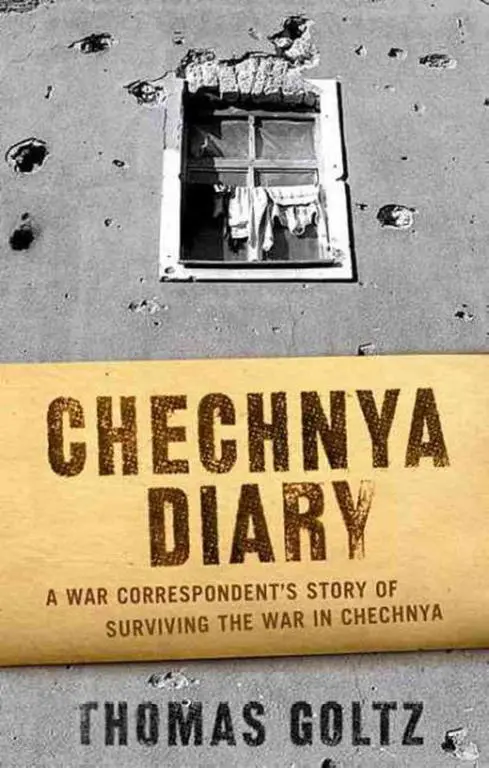
- Название:Chechnya Diary
- Автор:
- Издательство:Thomas Dunne Books
- Жанр:
- Год:2011
- Город:New York
- ISBN:0-312-26874-2
- Рейтинг книги:3 / 5. Голосов: 1
-
Избранное:Добавить в избранное
- Отзывы:
-
Ваша оценка:
Chechnya Diary: краткое содержание, описание и аннотация
Предлагаем к чтению аннотацию, описание, краткое содержание или предисловие (зависит от того, что написал сам автор книги «Chechnya Diary»). Если вы не нашли необходимую информацию о книге — напишите в комментариях, мы постараемся отыскать её.
is part of a larger exploration of the role (and impact) of the media in conflict areas. And at its heart,
is the story of Hussein, the leader of the local resistance in the small town that bears the brunt of the massacre as it is drawn into war.
This is a deeply personal book, a first person narrative that reads like an adventure but addresses larger theoretical issues ranging from the history of ethnic/nationalities in the USSR and the Russian Federation to journalistic responsibility in crisis zones.
is a crossover work that offers both the historical context and a ground-level view of a complex and brutal war.
Chechnya Diary — читать онлайн бесплатно полную книгу (весь текст) целиком
Ниже представлен текст книги, разбитый по страницам. Система сохранения места последней прочитанной страницы, позволяет с удобством читать онлайн бесплатно книгу «Chechnya Diary», без необходимости каждый раз заново искать на чём Вы остановились. Поставьте закладку, и сможете в любой момент перейти на страницу, на которой закончили чтение.
Интервал:
Закладка:
Male headgear came in two flavors: the conical lamb’s wool papakhs and the comical Dudayev fedora. Virtually all women wore spun-wool shawls. Long leather coats dominated for men and women alike, the exception being a couple of western aid workers, dressed in loud purple and orange ski parkas that stuck out ridiculously in this crowd. The evening air resounded with the distant thunder of artillery, a barrage that was more intense than I had ever heard in this war before.
Sheets and I fought off the taxi and transport scalpers and jumped in the Reuters-mobile, a land cruiser driven by Uncle Larry’s loyal driver, Nodar. The huge, happy bear of a Georgian had an atrocious accent in Russian, imposing all sorts of Georgian clicks and clacks where those consonants do not exist, and casually disposing of many or most case and declension niceties of the literary tongue spoken in Moscow and St. Petersburg. Traveling with Nodar up from Tbilisi was another Georgian who worked as a cameraman. Sheets suspected he was a secret heroin junkie.
Curiously, perhaps, a good percentage of the correspondents covering the Chechen conflict on a daily basis for various international news organs (with alphabet-souplike acronyms such as AFP, APTV, and WTN) were Georgians or had spent time in that post-Soviet republic. Many, like Sheets and myself, had received their baptisms of fire as war correspondents (or participants) in Abkhazia and had a much higher tolerance for violence than many of their “Western” colleagues. They roosted much closer to the action than the Moscow-based foreigners and aid workers who monopolized accommodations in Nazran, having virtually taken over a small guest house in Slepsovski called the Sundja Hotel. That is where we went, setting up Lawrence’s satellite telephone and telex in the walled courtyard for his evening file. The satellite telephone was about as large as a small suitcase, and weighed perhaps fifty or seventy-five pounds—big, awkward, and expensive. A minute on the phone cost something like fifteen bucks American. [16] While a wondrous device at the time, technology rapidly made the SAT-phone obsolete. The advent of the cell phone in the late 1990s (and then videophones) completely transformed the communications environment in remote areas. But in 1995, reporters were still obliged to stay within range of expensive uplinks through local television stations, such as that at Ingush TV at Nazran. That meant that television crews had to time their days to collect news in Chechnya no later than early afternoon, and then dash back to Nazran to make a shaky feed from the local TV station by midnight, lest their product no longer be “news.” The alternative was to make a mad dash back to the Slepsovski airport and beg and bribe passengers to take film to Moscow—a truly nerve-wracking experience for the purveyor of exclusive news, due to the question of whether the courier would really deliver or not. Cf. my article of February 16, 1997 in the New York Times Magazine entitled “Uncle Fidel.” The original title was “Cigars as Bribes.”
Uncle Larry’s file essentially consisted of color copy that allowed Reuters to cheat a dateline close enough to Chechnya to merit attention on their clients’ desks. Accordingly, Lawrence pumped Nodar for a few details about the mood among refugees in the Slepsovski market, cadged a despairing quote from the hotel cook, and then wrote a story that emphasized the intensity of the distant bombing and speculated as to the target.
The night’s work done, we settled into a meal of borsht and vodka. Then the satellite telephone in the courtyard gave a buzz. It was Reuters Moscow demanding answers to a few questions. The most important concerned the veracity of an Interfax report, carried both on the Channel One state-run television news, as well as the Segodnya (“Today”) news program on the NTV channel. Both claimed that “Dudayevist fighters,” who had previously fought in Abkhazia, had shot and killed seven village elders outside Samashki. The elders, it would appear, had called on the rebels to quit the village, and survivors of the assassination attack were begging Russian Interior Ministry forces to intervene and help them evacuate the town.
Sheets was shocked—and furious. If the stories about the assassination murder were true, he had been sitting no more than twenty miles away from a major development in the Chechnya-at-war story, but without any means of verification.
I was stunned. If true, it meant that the so-called Abkhazian Battalion, under the command of Shamil Basayev, had pounced on Samashki and eradicated the local leadership—or that Hussein and his men were the perpetrators of the killings of the negotiators, a group that would include the imam as well as diarist Akhmad Amaev.
And the invitation for the MVD to demilitarize the town by force?
There was nothing to do but drink another long shot of vodka and stare at the ceiling of the Sundja guest house and wait for morning, listening to the constant, distant thunder of heavy artillery. The windows thumped and threatened to shatter, as evil, synthetic sheet lighting lit up the sky until dawn.
It was a rotten night’s sleep of no sleep at all.
Dawn, or at least close enough to first light to pass for it, and we were drinking instant coffee, smoking cigarettes, and packing the car. The rival AP and WTN crews had already left, and Lawrence was angry. There was no question where they were off to, and he had extracted a pledge that they would check out this Samashki story together with him. But the competitive edge of the others led them to violate their promise; there would not be much assistance from Lawrence in the future. War is news but news is business.
The big car moved out through the muddy, rutted streets of Slepsovski, passed the market area, and turned left down the side road to Sernovodsk, the ambiguous town on the new border of Chechnya and Ingushetia that was sort of claimed by both and thus served as a sieve for traffic. We ran into the first Russian checkpoint after about a kilometer or two. The fact that Nodar’s car had Georgian plates helped: The sergeant in control of the checkpoint was an ethnic Georgian who somehow ended up not only in Russia, but serving in the Russian military. Nodar glad-handed him and slipped him some cigarettes and chocolates and we were let through, not sure if anything illegal had transpired, but not really caring. We had just entered the “zone of conflict,” even if we were only on the apron.
Sernovodsk. Another forlorn Friday market town of walled compounds and one-story buildings built along a byway, which is half the size of a highway, or something close to that. We stopped for bottled mineral water and biscuits and tried to gather some basic information about events of the night before in general, and about events in Samashki in particular. Everyone was incredibly tight-lipped. Maybe they thought that Sheets and I were Russian spies. It was the first time I had felt the real difference of being an outside reporter, as opposed to an insider, and I did not like it.
We proceeded down the main road past the hospital and Friday Mosque, and toward Samashki, some five kilometers away. The road was empty of traffic. A haze of smoke rose in the distance, but it was too far away to determine anything concrete. There was also the sound of distant small arms fire. Rat-a-tat-tat and all that.
Over a small rise, and then our path was blocked by a Russian MVD armored vehicle that was completely blocking the road. To its right radio antennas were sticking through camouflage mesh. Closer inspection revealed a network of trenches containing more armor and men, all partially concealed beneath more camouflage mesh. Post 13.
Читать дальшеИнтервал:
Закладка:
Похожие книги на «Chechnya Diary»
Представляем Вашему вниманию похожие книги на «Chechnya Diary» списком для выбора. Мы отобрали схожую по названию и смыслу литературу в надежде предоставить читателям больше вариантов отыскать новые, интересные, ещё непрочитанные произведения.







Обсуждение, отзывы о книге «Chechnya Diary» и просто собственные мнения читателей. Оставьте ваши комментарии, напишите, что Вы думаете о произведении, его смысле или главных героях. Укажите что конкретно понравилось, а что нет, и почему Вы так считаете.