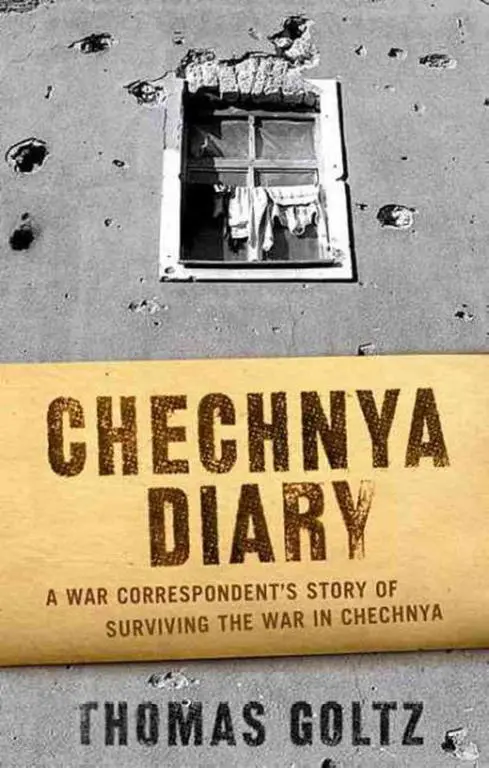
Thomas Goltz - Chechnya Diary
Здесь есть возможность читать онлайн «Thomas Goltz - Chechnya Diary» весь текст электронной книги совершенно бесплатно (целиком полную версию без сокращений). В некоторых случаях можно слушать аудио, скачать через торрент в формате fb2 и присутствует краткое содержание. Город: New York, Год выпуска: 2011, ISBN: 2011, Издательство: Thomas Dunne Books, Жанр: Биографии и Мемуары, military_history, Публицистика, на английском языке. Описание произведения, (предисловие) а так же отзывы посетителей доступны на портале библиотеки ЛибКат.
- Название:Chechnya Diary
- Автор:
- Издательство:Thomas Dunne Books
- Жанр:
- Год:2011
- Город:New York
- ISBN:0-312-26874-2
- Рейтинг книги:3 / 5. Голосов: 1
-
Избранное:Добавить в избранное
- Отзывы:
-
Ваша оценка:
Chechnya Diary: краткое содержание, описание и аннотация
Предлагаем к чтению аннотацию, описание, краткое содержание или предисловие (зависит от того, что написал сам автор книги «Chechnya Diary»). Если вы не нашли необходимую информацию о книге — напишите в комментариях, мы постараемся отыскать её.
is part of a larger exploration of the role (and impact) of the media in conflict areas. And at its heart,
is the story of Hussein, the leader of the local resistance in the small town that bears the brunt of the massacre as it is drawn into war.
This is a deeply personal book, a first person narrative that reads like an adventure but addresses larger theoretical issues ranging from the history of ethnic/nationalities in the USSR and the Russian Federation to journalistic responsibility in crisis zones.
is a crossover work that offers both the historical context and a ground-level view of a complex and brutal war.
Chechnya Diary — читать онлайн бесплатно полную книгу (весь текст) целиком
Ниже представлен текст книги, разбитый по страницам. Система сохранения места последней прочитанной страницы, позволяет с удобством читать онлайн бесплатно книгу «Chechnya Diary», без необходимости каждый раз заново искать на чём Вы остановились. Поставьте закладку, и сможете в любой момент перейти на страницу, на которой закончили чтение.
Интервал:
Закладка:
Most exasperating was the lack of interest as framed in the rhetorical context of “What is the story?”
“The Chechen story” had been the siege and fall of Grozny and the retreat of the Chechen leadership to the mountains. Then “the Chechen story” had become an interview with Djohar Dudayev, preferably as he hunted bear in the mountains, or possibly a profile of the elusive Shamil Basayev, the diminutive commando leader who had so ripped up Russian armor in the capital and who was now leading the defense of the eastern front from his hometown of Vedeno. “The Chechen story” next became the battle for Fortress Bamut, a former Soviet missile base in the crotch of the mountains near the Ingushetian frontier, where rumor had it that Djohar Dudayev stashed his alleged nuclear arsenal. This story in turn attracted the American humanitarian worker Fred Cuny, whose disappearance and presumed execution then became virtually the only story from or about Chechnya that American print and electronic editors were interested in, thanks to the unspoken rule that, unless there was an American at the center of the story, there was no story.
And Samashki? What was that and where was that and why should anyone be interested in a group of guerrillas in a surrounded town in the northern plains of Chechnya that had been under Russian control for the past month or more?
It was maddening, insulting—and finally, enlightening.
“ Look at this,” said Uncle Larry, thrusting a batch of Reuters news copy at me. “The official news we are picking up and reprinting from official sources suggests your little town is packed with bandits.”
“That is bullshit.”
“I know it. You know it. But does anyone else, and what do you intend to do about it?”
Uncle Larry, better known as Lawrence Sheets, was an old friend and fellow crisis correspondent during some of the nastier times of the post-Soviet Caucasus. As the Reuters bureau chief in Tbilisi, and with me based in Baku, we had ridden quite a few highways and byways together. Arguably, the low point was the siege and fall of Sukhumi in September 1993.
Sukhumi had been pretty scary, all right—but it was nothing like covering or reporting from Chechnya, which Sheets had been doing for Reuters since the very start of the war. He had been inside Dudayev’s presidential apparatus when the first Russian planes attacked, had then become a cellar dweller when the Russian army fought the Chechen resistance for control of the destroyed capital. He was ubiquitous with his satellite telephone, earning himself a reputation for extreme bravery bordering on a death wish. Taken to task about driving straight through a Russian checkpoint at night despite a blanket ban on crossing armed barriers, he casually replied: “Checkpoint? What checkpoint? That was just some guys with guns standing along the side of the road.” [14] A few years later, while a Knight Journalism Fellow at Stanford University, a more sober Sheets penned an article comparing Russian media policy in Chechnya in wars One and Two. Referring to his own antics, he wrote: “I covered the first Chechen conflict from 1994-96 extensively. It was a ridiculously dangerous business. Nineteen of my fellow correspondents, both Russian and foreign, paid for that final story with their lives.” Cf. “Russia’s Media Policy in Chechnya” in Contemporary Caucasus Newsletter, no. 10, Fall 2000.
And now he was bored and restless in Moscow and itching to get back into the fray.
“So let’s go,” said Sheets, sitting in the TV editing suite at the Reuters office in the Raddison-Slavaskaya Hotel, where I was often found hanging around, twiddling thumb.
“Where?”
“Samashki, of course.”
“Uncle, I don’t have any money. None.”
“So, I fund you. Won’t cost you a dime.”
“Why?”
“Because then I get to tell the boss that you are my minder, to keep me out of trouble.”
“I’ve never kept you out of trouble.”
“They don’t know that. Not yet, anyway,” said Sheets. “Saddle up, cowboy. There’s a flight to Nazran tonight.”
12
MASSIVNI UBITZVA V SAMASHK (MASS KILLING IN SAMASHKI)
On April 6, a meeting of MVD officers, village elders, the imam and the head of the village administration took place at Post No. 13. Lieutenant General A. Antonov, deputy commander of Russian forces in Chechnya, issued an ultimatum: Hand over, by 7:00 A.M. on April 7, 264 automatic weapons, two machine guns, and one APC (which allegedly appeared on an aerial snapshot of the village) and allow MVD units freely into the village. The Chechen delegation… requested to be given three days to attempt to hand over around fifty automatics, but not more. The general refused. Having returned to the village, the leaders and elders gathered village residents and informed them about the ultimatum, but no one brought forth any weapons… that day an MVD internal troops division began advancing on the outskirts of Samashki, seeking to strengthen their positions there; but about 1.5 kilometers from the northern end of the village an APC and a tank exploded on mines, and an APC later blew up on a mine on the village outskirts…. Shooting on the outskirts of the village had begun long before the ultimatum deadline ran out. Beginning at 10:30 P.M. on the night of April 6, Russian forces heavily bombarded the area outside Samashki with artillery fire until 1:30 A.M. The village was hit with aerial bombardments for twenty-five minutes on the morning of April 7, beginning at 5 A.M. APCs heading toward the village from the north spread cannon fire on Samashki from 7 A.M. to 9 A.M . [15] By All Available Means, pp. 24-25, based largely on the Akhmad Amaev diaries.
The YAK-40 gently banked to the right, giving passengers on the starboard side of the small, workhorse aircraft a good look at the majestic, shark-tooth range of the Caucasus Mountains.
This is where the Greek gods banished the Titan-turned-traitor, Prometheus, for having stolen Olympian fire as a gift for mankind, chaining him to a rock to have his liver eternally gnawed by birds. The gods had something else in store for mankind—Pandora and her box of evil tricks, including Death, Disease, Pestilence, and Plague. It was curious what was left at the bottom of the box once the punishments had escaped—Hope. The usual theory is that this virtue was left to comfort mankind, although the argument can be made that all Hope does in a useless world is to extend suffering and inevitable despair. Perhaps that complex myth had some relevancy for the complex situation in the Caucasus. But now was not the time to dwell on such literary issues. The pilot had pulled down the flaps and dropped the wheels in preparation for an evening landing at Slepsovski field, not twenty miles, as the crow flies, from Samashki. Were those flashes of artillery fire in the penumbral shadows to the east? Or merely the tinkling of early evening lights and automobile traffic in the Ingush capital of Nazran to the south?
Ingushetia. If it didn’t exist, someone would have had to make it up. The mini-state was sort of a warped, post-Soviet world version of Monaco or Andorra, or maybe a Russian Federation clone of West Virginia. But that is really reaching for some sort of comparison when none really exists. Like the origins and meaning of myths and legends of the local giants called Narts and their Titan kinsmen, this is a complex subject and best left for a more reflective day. It was time to focus on the moment. It was the evening of April 6, and Samashki was getting blitzed, and I was on the outside and not the inside.
The aircraft touched down, and taxied toward the extended shack that served as the departure terminal. There was no arrivals section, only a farm truck that pulled up to the luggage bay, and a flimsy security gate separating the airfield from the crowded parking lot. It was teeming with family members, taxi drivers, hucksters and, no doubt, two dozen spies from both sides of the conflict, taking note of who was coming and going from this obscure piece of asphalt.
Читать дальшеИнтервал:
Закладка:
Похожие книги на «Chechnya Diary»
Представляем Вашему вниманию похожие книги на «Chechnya Diary» списком для выбора. Мы отобрали схожую по названию и смыслу литературу в надежде предоставить читателям больше вариантов отыскать новые, интересные, ещё непрочитанные произведения.






Обсуждение, отзывы о книге «Chechnya Diary» и просто собственные мнения читателей. Оставьте ваши комментарии, напишите, что Вы думаете о произведении, его смысле или главных героях. Укажите что конкретно понравилось, а что нет, и почему Вы так считаете.