Thomas Goltz - Chechnya Diary
Здесь есть возможность читать онлайн «Thomas Goltz - Chechnya Diary» весь текст электронной книги совершенно бесплатно (целиком полную версию без сокращений). В некоторых случаях можно слушать аудио, скачать через торрент в формате fb2 и присутствует краткое содержание. Город: New York, Год выпуска: 2011, ISBN: 2011, Издательство: Thomas Dunne Books, Жанр: Биографии и Мемуары, military_history, Публицистика, на английском языке. Описание произведения, (предисловие) а так же отзывы посетителей доступны на портале библиотеки ЛибКат.
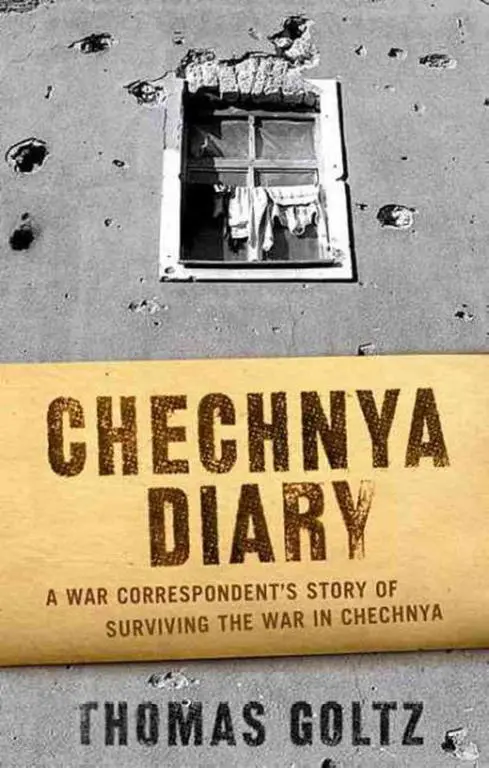
- Название:Chechnya Diary
- Автор:
- Издательство:Thomas Dunne Books
- Жанр:
- Год:2011
- Город:New York
- ISBN:0-312-26874-2
- Рейтинг книги:3 / 5. Голосов: 1
-
Избранное:Добавить в избранное
- Отзывы:
-
Ваша оценка:
Chechnya Diary: краткое содержание, описание и аннотация
Предлагаем к чтению аннотацию, описание, краткое содержание или предисловие (зависит от того, что написал сам автор книги «Chechnya Diary»). Если вы не нашли необходимую информацию о книге — напишите в комментариях, мы постараемся отыскать её.
is part of a larger exploration of the role (and impact) of the media in conflict areas. And at its heart,
is the story of Hussein, the leader of the local resistance in the small town that bears the brunt of the massacre as it is drawn into war.
This is a deeply personal book, a first person narrative that reads like an adventure but addresses larger theoretical issues ranging from the history of ethnic/nationalities in the USSR and the Russian Federation to journalistic responsibility in crisis zones.
is a crossover work that offers both the historical context and a ground-level view of a complex and brutal war.
Chechnya Diary — читать онлайн бесплатно полную книгу (весь текст) целиком
Ниже представлен текст книги, разбитый по страницам. Система сохранения места последней прочитанной страницы, позволяет с удобством читать онлайн бесплатно книгу «Chechnya Diary», без необходимости каждый раз заново искать на чём Вы остановились. Поставьте закладку, и сможете в любой момент перейти на страницу, на которой закончили чтение.
Интервал:
Закладка:
“Thomas, it’s me — Sonia!”
“Sorry, didn’t recognize you. Say, by the way, you don’t happen to have any Hi-8 tapes, now do you? I am nearly out, and everything here is going downhill pretty fast.”
Without taking a second to excuse himself for the appalling greeting, and after having nicked me for some mineral water and chocolate, he manages to extract the promise from me to make him a member of my team in order to slip through checkpoint control.
“The Russians are after me. ”
“Why?”
“They think I have been helping the Chechens blow up the train tracks.”
“Well, have you?
“No, not really. I just filmed it all and sort of encouraged them by my presence”
Thomas uses up the rest of his film. His documentary on Samashki will win prizes in the U.S.A. the next year. Filmed under life-threatening conditions, with passion. [9] Sonia Mikich, Planet Moskau: Geschichten aus dem neuen Russland (Köln: Verlag Kiepenheuer und Witsch, 1998), pp. 128, 129. Translation from the German is mine.
Sonia got a couple of the details wrong. I was not wearing a khaki uniform, my beard was gone, and the cap on my head was actually a gift from a Kurdish general in northern Iraq. I did win a runner-up prize for my work, but it was in Europe and not the U.S.A. But there is no question about her capturing the essence of the moment. I was crazed and about to attack her cameraman, and I did manage to impose myself on her team as my one chance to get out of town. God bless her for recognizing me. And for the chocolate.
Sonia’s presence on the road outside Samashki was due to her part in—one might better use the word devotion to—one of the most extraordinary events of the Chechen war: the Soldiers’ Mothers’ March on Grozny. [10] The Mothers’ Movement was organized on a shoestring budget by Maria Iva nova Kirbasova from the Turkic/Buddhist Russian subrepublic of Kalmukia.
Drawn from all over Russia, and representing every class of woman in the vast land, from collective farm peasant to university instructor, some two hundred ladies had gathered in the Ingush capital of Nazran to march on Grozny and, presumably, end the war by demanding information about their sons who were either missing, captured, or simply conscripted and sent to cesspool Chechnya. Reinforced by a component of Quakers, a contingent of ethnic Russian converts to a Japanese Buddhist order, and other antiwar activists, ranging from religious Jews to Eastern Orthodox Christians (and even a gaggle of Chechen and Ingush lady zikr- chanters) , the pacifist protestors numbered perhaps four hundred when they turned the corner toward Samashki on the morning of March 27.
And that was the moment when my old friend Sonia Mikich, bureau chief of the German ARD office in Moscow, jumped out of the vehicle to intervene before I physically assaulted her cameraman, buying me off with mineral water and chocolate.
The column of 400 (or now 401, with me) reached the crossroads near the Friday Mosque within the next half-hour and then began moving down the main artery through town. Local women came pouring out of the homes, bearing traditional greetings of bread and salt and offering the tired and cold marchers beds for the night and basins to wash in. But there was no time to linger if the column was to make it to the larger city of Achkoi Martan, as planned. The big push to Grozny was scheduled for the next day.
I had to work quickly, too. This was my out! Making Sonia promise that she would not leave town without me, I dashed back to Hussein’s house to grab my kit, and then dashed back to the convoy to stash my tapes and kit in her car. I would pick them up if and when I ever got back up to Moscow, I said. The point was to separate the tapes from my person and salvage one or the other, but not lose both.
“You’re staying?” she asked with incredulity. “ I think not!”
Although I was not her cameraman, Sonia was sensitive to needless risk in the line of reporting. She had been my friend Rory Peck’s employer that sad October day in Moscow, 1993, when that extraordinary cameraman got his head blown off while reporting on Boris Yeltsin’s bombing of the Russian parliament.
I assured her I would make every effort to leave. Maybe I could slip out with the Slavic Buddhist monks; my moustache was not in keeping with their naked faces, but at least I shaved my head like they did. The lack of an orange robe was admittedly a problem. On second thought, maybe I could just insinuate myself into the mass of other, heterodox marchers. The Eastern Orthodox and Jews wore beards, as did the man identified as Chris Hunter, a young Englishman who led the Friends involved in the march, meaning the Quakers.
“Just get in!” cried Sonia Mikich, as I started off-loading my tapes and camera kit.
Out of the corner of my eye I saw Shirvani. He clasped his hands together in a sign of friendship and victory, and raised them above his head, smiling.
“Adik yurl! ” he shouted.
And then Sonia’s ARD-mobile was spinning wheels down the road to catch up with the marching mothers and their other pacifist allies, passing them at some speed in order to get to Achkoi Martan to capture the glorious entry of the column on the penultimate day of their extraordinary action for peace and dignity. An action, I might add, that with the help of Sonia Mikich eventually won them a place in the annals of peace and protest marching (and won Sonia quite a few awards and well-deserved kudos, too). But that was later.
On the evening of March 27, the goal was to reach Achkoi Martan.
The mothers never made it. Neither did we.
“ Stoi!” barked a sergeant of the armed forces of the Russian Federation, as Sonia’s driver pulled up at the roadblock three kilometers outside Martan. “Stop!”
There was really no need to be told; two or three huge slabs of concrete had been lowered to completely block the road into town, and on either side of the highway the muddy fields seemed to be infested with armor: APCs of both the eight-wheel and track variety, known as BTRs and BMPs, and more distantly and menacingly, perhaps a dozen hulking specimens of the huge, self-propelled Russian cannon that fall under the general rubric “howitzer.”
“Privet, rabonik!” called out Sonia’s cameraman Maxim, the guy I had nearly assaulted outside Samashki. “How’s tricks, guys?” There followed a friendly banter about where everyone was from, and which school they had attended, and a variety of other Russian chitchat that put my Chechenized nerves on edge. Sonia had just set herself up with a Russian agent who was going to turn me in!
Of course Maxim had no such intention; his glad-handing, hale and hearty attitude, rather, was survivalist subterfuge honed through years of dealing with state authority.
“Keep him in the car!” he hissed in German, as he got out to schmooze with the well-armed guys wearing Spesnatz uniforms. He was referring, of course, to me.
“What seems to be the problem, sir?” asked Sonia when a huge specimen of Spesnatz ambled over to look at our papers. He stood at least six-foot-five, was built like that “Russian” boxer in Rocky III, and wore a black band around his forehead, the same way so many Chechen fighters wore the green Islamic band around theirs.
“Terrorists,” he said. He was about to launch into an interrogation when the first group of Peace Marchers arrived, now traveling in a variety of cars culled from Samashki. “Excuse me,” he said. “Do not leave here.”
Читать дальшеИнтервал:
Закладка:
Похожие книги на «Chechnya Diary»
Представляем Вашему вниманию похожие книги на «Chechnya Diary» списком для выбора. Мы отобрали схожую по названию и смыслу литературу в надежде предоставить читателям больше вариантов отыскать новые, интересные, ещё непрочитанные произведения.





Обсуждение, отзывы о книге «Chechnya Diary» и просто собственные мнения читателей. Оставьте ваши комментарии, напишите, что Вы думаете о произведении, его смысле или главных героях. Укажите что конкретно понравилось, а что нет, и почему Вы так считаете.