Thomas Goltz - Chechnya Diary
Здесь есть возможность читать онлайн «Thomas Goltz - Chechnya Diary» весь текст электронной книги совершенно бесплатно (целиком полную версию без сокращений). В некоторых случаях можно слушать аудио, скачать через торрент в формате fb2 и присутствует краткое содержание. Город: New York, Год выпуска: 2011, ISBN: 2011, Издательство: Thomas Dunne Books, Жанр: Биографии и Мемуары, military_history, Публицистика, на английском языке. Описание произведения, (предисловие) а так же отзывы посетителей доступны на портале библиотеки ЛибКат.
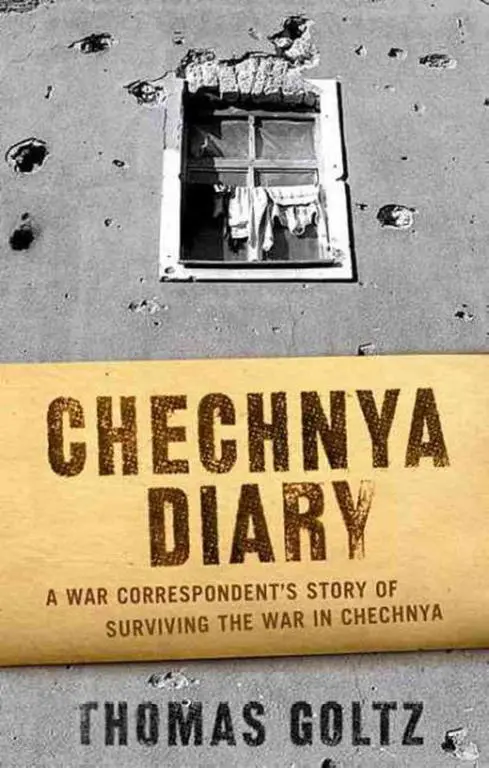
- Название:Chechnya Diary
- Автор:
- Издательство:Thomas Dunne Books
- Жанр:
- Год:2011
- Город:New York
- ISBN:0-312-26874-2
- Рейтинг книги:3 / 5. Голосов: 1
-
Избранное:Добавить в избранное
- Отзывы:
-
Ваша оценка:
Chechnya Diary: краткое содержание, описание и аннотация
Предлагаем к чтению аннотацию, описание, краткое содержание или предисловие (зависит от того, что написал сам автор книги «Chechnya Diary»). Если вы не нашли необходимую информацию о книге — напишите в комментариях, мы постараемся отыскать её.
is part of a larger exploration of the role (and impact) of the media in conflict areas. And at its heart,
is the story of Hussein, the leader of the local resistance in the small town that bears the brunt of the massacre as it is drawn into war.
This is a deeply personal book, a first person narrative that reads like an adventure but addresses larger theoretical issues ranging from the history of ethnic/nationalities in the USSR and the Russian Federation to journalistic responsibility in crisis zones.
is a crossover work that offers both the historical context and a ground-level view of a complex and brutal war.
Chechnya Diary — читать онлайн бесплатно полную книгу (весь текст) целиком
Ниже представлен текст книги, разбитый по страницам. Система сохранения места последней прочитанной страницы, позволяет с удобством читать онлайн бесплатно книгу «Chechnya Diary», без необходимости каждый раз заново искать на чём Вы остановились. Поставьте закладку, и сможете в любой момент перейти на страницу, на которой закончили чтение.
Интервал:
Закладка:
The problem was, how to get out.
“I think it almost impossible that the local traitors have not informed on you to the KGB,” Hussein pointed out. “It is most likely that you will be arrested and searched on sight, and your tapes— our tapes —seized and destroyed, or used against us in some way.”
He was right. I was not a reporter with a notebook that could be memorized and destroyed before it fell into the wrong hands. I was a high-profile courier, bearing an often-incriminating collection of cassettes. In a word, I had the physical evidence that Hussein and all his men were participants in what the world regarded as a rebellion. Hussein, said my pictures, was a rebel. And one man’s rebel may be another man’s freedom fighter, but he is also another man’s terrorist.
The issue of disposing of the tapes gnawed at both of us. One way to get them out would be to hide them on the person of either a respected elder—such as Hussein’s father—or a woman, such as Ussam’s wife, Rana. The security checkpoints generally did not check women or the elderly, and a bribe here or there could generally help get things done. The problem was what to do with the tapes, once past the checkpoints. Who was to be trusted in Sernovodsk, Slepsovski, or distant Nazran, the headquarters of most of the floating journalists in the theater of war? I did not know anyone there—and neither, for that matter, did Hussein.
Finally, we hit upon a solution that made everyone equally nervous. By sheerest chance—or was it, the paranoid in me wondered—an old school friend of Hussein’s had shown up in town to take a look at the ancestral homeland and the general situation. His name was Musa, a thoroughly Russified Chechen living in Moscow. I had the ABC bureau’s telephone number, so they could theoretically pick up the stash. As for trusting Musa to perform his part of the bargain—well, Hussein had blessed the venture and made the introduction.
We met for breakfast at Musa’s family home at midmorning. A silent woman walked in with tea; noisy kids reached for Hussein’s gun and wanted to play. I said something about the nature of the tapes and Hussein interrupted, launching into a long lecture about history, Chechen nationalism, and love of country that culminated in the recollection of the use of tombstones in the local cemetery, where both he and Musa had once played.
It was a touching, intimate moment between two old friends, and I was reaching for my camera to capture it on tape when the regular morning drone of distant helicopters came closer—and closer and closer—until the whole house was buzzing from the whirling blades and windows were shuddering and threatening to implode.
“Vertilot!” shouted Hussein, grabbing his weapon and spinning out the door. “Helicopters!”
Ridiculously, Musa urged me to stay and finish the breakfast that had just arrived on the table. I did not so much decline as bolt, dropping the camera and breaking the on/off switch in so doing. I had forgotten that my left prehensile thumb no longer worked.
A bread knife was on the table, so I grabbed it and carved off the plastic around the broken switch until I hit the main metal toggle, and then I carved still further until I could get a finger in deep enough to turn the camera on and off in a way it was not designed for, but it still worked. Then I was out the door and down the street and sprinting into the cough and sputter and brrrt! brrrt! brrrt! of heavy-caliber machine guns and small cannon sounds ripping the air like crumpled paper.
The station. The mosque. The road. The periphery. I tried to make a mental map of where and what the Russians were shooting at.
Wham! A rocket slammed into a tractor trying to make it across the street a block ahead of me, and I looked up and almost casually noted the presence of a helicopter floating in the air straight down the street from where I was standing. It was searching for people looking exactly like me—or so I concluded. I dove toward the shelter of a nearby wall and found a knot of people huddled in utter terror who were already making maximum use of the thin protection it provided. I took their picture. They looked like what they were; a bunch of very frightened people huddling in utter terror in the shadow-shelter of a wall.
Not good television. Good television was on the street. Or actually, good television was the helicopter shooting down the street at us or at least in our general direction. I had to act fast, or fail—which could be worse than dying, sometimes. I knew I was on the verge of a massive failure of nerve, so if I didn’t do it then, I never would.
I put the camera on the tripod and stepped out into the middle of the road.
Done.
I only had to turn the camera on and make sure I did not turn it off. I stuck my finger inside the hole I carved in the casing and tickled the toggle switch. The camera clicked and whirred and the timer started to count seconds shot and film left to shoot.
Done.
There was a new shudder down the street. A chopper. I was faced with a decision. I could dive back toward the wall without the camera and maybe film my own death when that chopper shot its pods at me, as it clearly would, or I could start shooting back on full automatic before the chopper blasted it and maybe me to kingdom come.
What was I doing here?
Take a step. Forward. Another. Go. Pick up the camera with your right hand; squeeze the tripod around your waist. Keep filming. Get tighter. Don’t forget you cannot refocus with your left hand because only your left-hand fingers work and you can’t get a grip on the lens without that thumb. Use your right hand for that, and I do not care if you have never used it for focusing a lens before. Learn now. Learn fast. You better learn how to focus now and fast with your right hand because that metal bird is looking down its crosshair sights at you just like you are looking down your crosshair sights at it, only the difference is you are shooting film and it is shooting rockets.
Wham!
The rocket just made a bunch of burger out of the cows fifty feet ahead.
Move.
Move in jags. Bunny right, bunny left. Don’t give them a clean shot. Make ’em blast you on the turn, on the jog, on the rabbit-run up these oh-so-straight streets.
Bunny, bunny, and it ain’t funny.
Wham! Brrt! Brrrt!
By the time I got to the mosque, the station was ablaze—and the real firefight began.
The armored train, again.
It was maybe half a mile away, spitting flame from the tanks and big guns aboard it, spraying the big, empty houses used as sniper nests on the town’s southern periphery. The problem was, I needed to film it broadside, or at least at a better angle than I had. Mixing sprinting and insanity, I got up to the crossroads beyond the bridge, beyond the mosque, and hunkered down behind some pathetically thin chunks of three-foot-thick concrete slabs of something. It was only about two feet high but at least it was three feet thick and solid.
I caught my breath and assessed the neighborhood. Guys were squirting out of nowhere, running for their lives across my lens. Really hauling ass. Others huddled in ditches, pissing in their pants, too afraid to move. Then a gate opened and out walked a man dressed all in black and wearing a black fedora and white shoes, who just sort of sauntered down the road as if nothing particular was going on. I shoot it all.
War is weird.
But my focus was the train. I had to get it broadside. I had to get in front of it. A helicopter wooooshed overhead while I rolled and then scooted out from behind my concrete-block salvation and lurched— no, I flew like the very wind! —down what I called Mosque Street. Behind me came a white car and a bus— a fucking passenger bus! —and as machine guns rattled and the larger stuff burped, the bus driver hit the gas and saaaaggged around the white car, nearly turning over during the course of that very stupid maneuver. You wanna survive the shooting, but die in a dumb accident?
Читать дальшеИнтервал:
Закладка:
Похожие книги на «Chechnya Diary»
Представляем Вашему вниманию похожие книги на «Chechnya Diary» списком для выбора. Мы отобрали схожую по названию и смыслу литературу в надежде предоставить читателям больше вариантов отыскать новые, интересные, ещё непрочитанные произведения.









Обсуждение, отзывы о книге «Chechnya Diary» и просто собственные мнения читателей. Оставьте ваши комментарии, напишите, что Вы думаете о произведении, его смысле или главных героях. Укажите что конкретно понравилось, а что нет, и почему Вы так считаете.