Thomas Goltz - Chechnya Diary
Здесь есть возможность читать онлайн «Thomas Goltz - Chechnya Diary» весь текст электронной книги совершенно бесплатно (целиком полную версию без сокращений). В некоторых случаях можно слушать аудио, скачать через торрент в формате fb2 и присутствует краткое содержание. Город: New York, Год выпуска: 2011, ISBN: 2011, Издательство: Thomas Dunne Books, Жанр: Биографии и Мемуары, military_history, Публицистика, на английском языке. Описание произведения, (предисловие) а так же отзывы посетителей доступны на портале библиотеки ЛибКат.
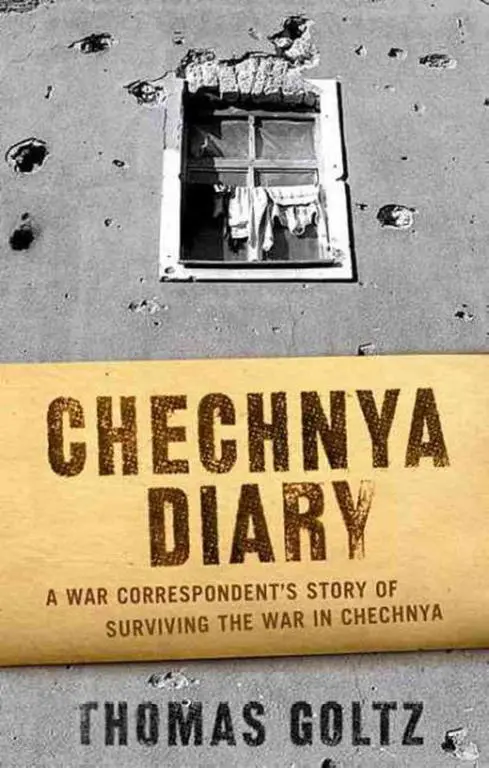
- Название:Chechnya Diary
- Автор:
- Издательство:Thomas Dunne Books
- Жанр:
- Год:2011
- Город:New York
- ISBN:0-312-26874-2
- Рейтинг книги:3 / 5. Голосов: 1
-
Избранное:Добавить в избранное
- Отзывы:
-
Ваша оценка:
Chechnya Diary: краткое содержание, описание и аннотация
Предлагаем к чтению аннотацию, описание, краткое содержание или предисловие (зависит от того, что написал сам автор книги «Chechnya Diary»). Если вы не нашли необходимую информацию о книге — напишите в комментариях, мы постараемся отыскать её.
is part of a larger exploration of the role (and impact) of the media in conflict areas. And at its heart,
is the story of Hussein, the leader of the local resistance in the small town that bears the brunt of the massacre as it is drawn into war.
This is a deeply personal book, a first person narrative that reads like an adventure but addresses larger theoretical issues ranging from the history of ethnic/nationalities in the USSR and the Russian Federation to journalistic responsibility in crisis zones.
is a crossover work that offers both the historical context and a ground-level view of a complex and brutal war.
Chechnya Diary — читать онлайн бесплатно полную книгу (весь текст) целиком
Ниже представлен текст книги, разбитый по страницам. Система сохранения места последней прочитанной страницы, позволяет с удобством читать онлайн бесплатно книгу «Chechnya Diary», без необходимости каждый раз заново искать на чём Вы остановились. Поставьте закладку, и сможете в любой момент перейти на страницу, на которой закончили чтение.
Интервал:
Закладка:
That report, culled from page twenty-two of the meticulously researched Memorial Human Rights Center report on the massacre at Samashki, dramatically underlines the problems involved in reconstructive history—and especially the problem of dependency on the Moscow press. I say this with all due respect. But the fact remains that the Memorial report, while correct in general, is wrong in particulars. There were no “Dudayevist snipers” or “fighters who turned up in the forest” attempting to blow up bridges to stop a military train from plowing through town. Said train never made it to Samashki. And the forest snipers were natives, with names. Hussein, his brother Ussam, their cousin Shirvani, and their nephew Sultan—and men named Xamid, Seylah, and Ali.
And me.
The plan is to attack the train if it comes or to scare off the track repair team if it approaches the section sabotaged the night before. I missed that bit of action because I was either rooftop waiting, or at that zikr, or maybe sleeping. If they had told me, I would have come along, although apparently it was not pretty.
“We ran into a patrol,” says Hussein. “Sultan was sick at what he did, what he had to do, but he is better, now.”
First blood.
Hussein jerks his head in the direction of a back room, where his fifteen-year-old nephew is listening to some Russian pop music on a radio, and mimes a puke.
I spend the morning with Ussam and Seylah as they sort out a batch of shells they managed to acquire overnight from a merchant who had somehow made an appropriate transaction with some deserting Russian soldiers. I wonder if that is the sort of thing my original guide, Isa, is involved with. I have not seen him or his brother Muhammad for days, weeks. I stand on the bed and record Ussam and Seylah as they meticulously clean the hundreds of bullets dumped out on a comforter on the floor, making little piles of good and bad bullets (how did they know?) before loading the sharp, pointy Kalashnikov rounds in banana clips, and the big, heavy-caliber stuff into a bandolier belt. The AK rounds look almost delicate next to the metal-piercing machine-gun slugs. The bullet part is as big as a man’s index finger, sticking outside the shell casing brass. Some have little red rings around the stubby tip identifying that sort of round as being tracers or something. I don’t know and am embarrassed to ask, because admitting I am not knowledgeable about this lethal stuff would cause a loss of face.
Sultan is dispatched with the heavy machine gun hidden beneath a load of hay in a small donkey-drawn cart. He is supposed to look like an innocent shepherd or something. Hussein, Shirvani, and Xamid go through a different part of the thicket, while Ussam, Seylah, and Ali bring the ammunition. I tag along with them, grateful for my personal load of cameras and tripod because it absolves me of asking if I could help carry one of the bandoliers. But what would I say if they asked? Refuse out of general press principle? I guess so. What would they think? Would I tolerate my presence if I were them ? Hussein seems to be taking his personification of the Chechen spirit literally and seriously. It is like I have become his own private camera team. Come to think of it, I am.
We weave our way through the thicket until we get to the edge of a large, denuded field overlooking the Samashki-Sernovodsk road that runs parallel to the railway tracks.
Seylah grabs the bandolier of heavy-caliber slugs, scoots out from the thicket and disappears from sight, the way a rabbit does when it has found its hutch. In this case the hutch is the forward gun pit, which is basically just a hole in the ground covered with twigs and scrub. That is where Hussein is already hiding. Well, not exactly hiding. Lurking in wait with a heavy-caliber machine gun is more like it. He is wearing some outsized plastic glasses he picked up somewhere. They are clearly not his.
The other guys fan out in the bush and start digging blinds.
“I don’t like this place,” mutters Xamid.
Ali, lazy, merely laughs and lets Ussam dig for two. Shirvani smokes. Sultan is nowhere to be seen.
Field lunch. Soviet Army spam and onions. Some Muslim fundamentalists, my pals, chowing down on cold pork like that.
“You know what kind of rock this is?” Shirvani asks me, picking up a blue-gray stone.
I turn it over in my hand once or twice and confess I have no idea.
“We call it Leaverite,” says Shirvani, taking back the stone and putting it back on the ground from where he had picked it up. “Leaverite here.”
Everyone chuckles with the exception of me, and then it sinks in.
Junk stone. Leave ’er right here .
Another round of pork spam and raw onions. More hunter jokes that could have come from any camp I ever sat at in Montana, haha. I relate the concept of “bear bells,” meaning that rather than be afraid of the sound of guns during elk season, some grizzly bears have come to associate a distant blast with dead deer and elk, and actually run toward the sound of shooting because they know it means a free meal that they did not have to work for. Seylah thinks about that one for a while, while Xamid hits me up with a non-sequitur question about my income level and marital status and makes me feel strangely and suddenly nervous in his presence again. Shirvani asks for a smoke and we chat about farming, ranching, sheep and the theoretical problem of brucellosis-infected buffalo escaping from Yellowstone Park and contaminating Montana cattle herds. Ali smiles and Ussam sulks. Sultan finally shows up with a shit-eating grin on his face, as though his absence has to do with that neighbor gal planting spring onions next door.
Boys will be boys.
More field work. More gun pits. Slit trenches and tank traps covered by a couple of guys planting spring potatoes on the front line. Sun shines. Beautiful day. See for miles, it seems. Couple of pretty horses wander by, legs tethered. Couple of shepherd kids gather firewood. If they notice us, they don’t let on. Maybe they are part of the ambush cover, sort of a screen of innocence, in case Russian spotters are scanning the forest line from the tracks or the facing hills. The Russians would be criminally negligent not to have spotters up there, thinks Johnny-come-lately military expert, me.
Couple of cars on the distant road, moving toward Samashki. They are just small specks, but still useful to calculate distance. I figure the road is less than a mile away. Maybe eight hundred yards. That is still a very long shot, especially with a gun with no telescopic sight, and Hussein has only got those funny-looking, oversized glasses. Greenhorn hunters in Montana like to brag about killing deer and elk from a mile away, but those stories are nothing but lies. Best shot I ever killed at was maybe four hundred yards and more likely only three hundred that felt like four, and that was with a scope on top of Tim Cahill’s 30.06 he let me use that day. Best shot I had with my trusty 30-30 saddle gun without a scope was maybe 250 yards that was more likely half that and that was just sheer luck. Nice buck, though.
Daydreaming done.
There is a truck on the road. No, two trucks. Now three. Military green.
I don’t know what is on them, but there is little doubt in my mind that we are outgunned three-to-one, and the mission was to ambush a train track repair crew and not take on half an army. The convoy is moving up the hill on a dirt road in back of the tracks, and Hussein is going to let them pass. Let them pass, Hussein, let them —
KirBAAMMM!!!
The percussion of Hussein’s mini-Howitzer shatters the morning air, and the red flare of barrel blast is so big that I pick it up on film. If I can see it, they can see it, and if they can see it, then they can see us.
Читать дальшеИнтервал:
Закладка:
Похожие книги на «Chechnya Diary»
Представляем Вашему вниманию похожие книги на «Chechnya Diary» списком для выбора. Мы отобрали схожую по названию и смыслу литературу в надежде предоставить читателям больше вариантов отыскать новые, интересные, ещё непрочитанные произведения.








Обсуждение, отзывы о книге «Chechnya Diary» и просто собственные мнения читателей. Оставьте ваши комментарии, напишите, что Вы думаете о произведении, его смысле или главных героях. Укажите что конкретно понравилось, а что нет, и почему Вы так считаете.