Thomas Goltz - Chechnya Diary
Здесь есть возможность читать онлайн «Thomas Goltz - Chechnya Diary» весь текст электронной книги совершенно бесплатно (целиком полную версию без сокращений). В некоторых случаях можно слушать аудио, скачать через торрент в формате fb2 и присутствует краткое содержание. Город: New York, Год выпуска: 2011, ISBN: 2011, Издательство: Thomas Dunne Books, Жанр: Биографии и Мемуары, military_history, Публицистика, на английском языке. Описание произведения, (предисловие) а так же отзывы посетителей доступны на портале библиотеки ЛибКат.
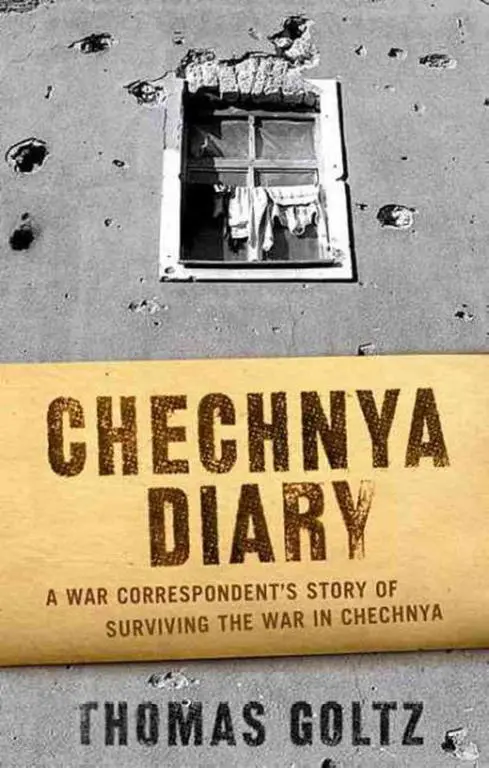
- Название:Chechnya Diary
- Автор:
- Издательство:Thomas Dunne Books
- Жанр:
- Год:2011
- Город:New York
- ISBN:0-312-26874-2
- Рейтинг книги:3 / 5. Голосов: 1
-
Избранное:Добавить в избранное
- Отзывы:
-
Ваша оценка:
Chechnya Diary: краткое содержание, описание и аннотация
Предлагаем к чтению аннотацию, описание, краткое содержание или предисловие (зависит от того, что написал сам автор книги «Chechnya Diary»). Если вы не нашли необходимую информацию о книге — напишите в комментариях, мы постараемся отыскать её.
is part of a larger exploration of the role (and impact) of the media in conflict areas. And at its heart,
is the story of Hussein, the leader of the local resistance in the small town that bears the brunt of the massacre as it is drawn into war.
This is a deeply personal book, a first person narrative that reads like an adventure but addresses larger theoretical issues ranging from the history of ethnic/nationalities in the USSR and the Russian Federation to journalistic responsibility in crisis zones.
is a crossover work that offers both the historical context and a ground-level view of a complex and brutal war.
Chechnya Diary — читать онлайн бесплатно полную книгу (весь текст) целиком
Ниже представлен текст книги, разбитый по страницам. Система сохранения места последней прочитанной страницы, позволяет с удобством читать онлайн бесплатно книгу «Chechnya Diary», без необходимости каждый раз заново искать на чём Вы остановились. Поставьте закладку, и сможете в любой момент перейти на страницу, на которой закончили чтение.
Интервал:
Закладка:
Welcome to the post-Soviet hall of mirrors!
I have no idea what evidence Hussein possessed about the imam’s alleged collaboration with the Russian military. Certainly, the imam was the point man for all negotiations and contacts with Russian authorities in the area, and frequently traveled out to Post 13, the bunker-and-trench checkpoint on the Sernovodsk road, to meet with said authorities. Accompanying him was a small group of other elders, one of whom was the obsessive diarist of the town, Akhmad Amaev—a man I started to refer to as “the Samuel Pepys of Samashki.” He was also the father of Hussein’s armored vest tailor, the guerilla who bore such a striking resemblance to the youngest of the Cartwright brothers on the TV show Bonanza that I had nicknamed him “Little Joe.”
From what I gathered, in Hussein’s view the imam was guilty of accommodation with the Russians. But did that mean treason? Or was the Imam merely reflecting the opinion of the people in town—minority or majority—who did not think that hand-to-hand fighting with the Russians on the streets of Samashki was the best of their options?
The irony of this apparent distinction was that in many ways, lifelong residents of Samashki were both more traditional and less nationalistic than more recent returnees from the Chechen diaspora, such as Hussein and his men, and thus less likely to take up arms to defend the new national homeland, but more insistent that the theoretical protocols governing behavior— adat —be rigorously observed. A son or younger brother must not smoke in front of a father or elder brother; if a person older than you enters a room, you must rise and stay standing until the elder has sat down. If you see an elder on the street, you must stop until he passes. You must never, ever speak to an elder until spoken to. For Hussein and his men, these protocols (admittedly observed more in the breach than rule) were stark nonsense. So was the idea of absolute loyalty to one’s taip, or clan. While this was allegedly a fundamental building block of the Chechen identity, I never learned what Hussein’s taip was because he dismissed it as being completely irrelevant. And as for religious zeal, such as dancing the zikr -well, I remember Hussein taking lessons from his father one day about the basics of how Muslims pray. Amazingly, he apparently did not know how.
“The war has destroyed the concept of taip, as it is destroying other social barriers in traditional Chechen society,” he explained. “And this is good.”
But wasn’t the war, in essence, about protecting and preserving traditional Chechen society from further Russifying encroachments?
One answer, I guess, was to be found in the new Russian disco music playing on Sultan’s radio night after night, and the delirious consumerism, based on sex appeal, beamed into the living room via the new Russian private television stations, if and when the generator was fired up and working. Buy this toothpaste or buy that deodorant, and dream of that new kitchen set for your house in a town that has no plumbing!
The alternative to that sort of saturation bombing of the soul was to be found elsewhere, and in traditions of which Hussein and his men did not partake.
That was zikr , or the wild dance of remembrance I had first seen in prewar Grozny more than a year before. In Samashki, there seemed to be one held almost nightly in different parts of town, although I never saw Hussein or any of his military clan participate.
Iwould be coming back from Alkhazur’s or my rooftop wait, returning to Hussein’s when I would turn a corner and then catch a buzz-like reverberation.
Distant singing voices, male, deep.
A chant, weaving its way up into and beyond the firmament. Next came the rhythm.
Clapping. Stomping . Yes, stomping, like at a barn dance in Montana.
Yes, there at a house among the houses in the darkened, drab, and muddy town of Samashki, something was happening. A zikr for another young man just killed that day.
“Ho—ahhhh!” came the tone of the tenor, sustained over a millennium.
“La illah il Allah,” came the multibaritone backdrop.
I cannot vouch for the meaning of Chechen tenors’ lines, but the bottom is all Quranic Arabic, the Shahidah , or Confession of Faith. I have heard those words in a thousand different circumstances before—in mosques as diverse as those in Egypt, Syria, Iran, and Uzbekistan, and from the lips of Muslims not only from those counties, but also in New York, Moscow, London, and Cape Town. But never, ever had the words of the Muslim Creed filled me with such unexplainable awe as there in Samashki, Chechnya. And at the moment the dirge moves from soul piercing to something that has no name, a door opens and a crack of light spills out on the muddy lane and a voice calls out in the darkness and suddenly I am inside among a mass of people, forty sweating men thumping, stomping, and dashing barefoot in a tight circle around the wooden floor of the living-room, chanting “Allah , Allah, Allah, God, God, God!” into delirium, while above it all that solo tenor keeps on keening, backed up by a wall of baritones, invoking the Highest Name for mercy, forgiveness, understanding for our foibles, and the strength to effect His terrible revenge on those who betray His trust.
“La illahi il Allah!”
My shoes are off as is my coat and flak jacket, which has never seemed so ridiculous an accessory as here and now. The camera is out and the lens fogging up with the sudden change of indoor and outdoor heat and the blast of human-based humidity—or maybe it was just the viewfinder or my glasses.
Swirling, self-hurling, stomping, singing!
And as suddenly as it started, the zikr is over, or at least put on very sudden pause.
Bread and beef broth in bowls and then bowls of tea to fortify the soul. Sweets. Now a bearded man in a far corner, who looks like Commander Santa but might be anyone with a white beard and skull cap, stands, and every one else in the room does the same, turning their palms toward heaven while the bearded man who might be Santa recites the Muslim Creed. Then either he or someone else strikes a high, plaintive note and the rest of the men in the room respond in one baritone voice, and the mystic ceremony begins once again, slowly working its way from the communal, harmonic chanting of God’s name, to the first slow clapping of hands and then the first hard stepping of foot on floor until it evolves, as it must , into the wild, barn-dance, stomping circle of ecstatic men transfixed by the moment, as am I. The nocturnal barrage has begun again, although none of the spiritual athletes seem too concerned. The zikr devotees might dance all night, dancing in the face of doom, remembering.
Then one night, the news carried on Moscow radio got everyone’s attention. It stated that up to four hundred “Dudayevist bandits” had gathered in Samashki and were threatening local leaders for advocating a peaceful surrender of the town and allowing the train to pass.
“Four hundred armed men?” chortled Xamid, smiling at the audacity of Russian lies.
Hussein was less amused.
“That is the start of their propaganda campaign,” he said darkly.
“We have to act.”
8
HUNTER AND HUNTED
Beginning on March 13, the roads surrounding Samashki were completely blocked. At their regular meeting on March 17, General Alekseev arrived with Kosolapov. On the same day, a military train arrived at the Samashki station to restore the railroad. Conscripts serving in the railroad forces who arrived with the train repaired the mined railroad tracks between Sernovodsk and Samashki… residents were in a difficult position. On the one hand, the Russian military, as a consequence of negotiations held on March 23-25, got the military train through Samashki. Had that not occurred, another Russian general participating in negotiations threatened to use force… Dudayev fighters who turned up through the forest demanded villagers not allow the train to pass through. Pro-Dudayev snipers wounded two soldiers, and previously, in mid-March, two railroad bridges were blown up between Sernovodsk and Samashki.” [8] Sakharov Foundation, By All Available Means, Memorial Report (Moscow, 1996), p. 22.
Интервал:
Закладка:
Похожие книги на «Chechnya Diary»
Представляем Вашему вниманию похожие книги на «Chechnya Diary» списком для выбора. Мы отобрали схожую по названию и смыслу литературу в надежде предоставить читателям больше вариантов отыскать новые, интересные, ещё непрочитанные произведения.








Обсуждение, отзывы о книге «Chechnya Diary» и просто собственные мнения читателей. Оставьте ваши комментарии, напишите, что Вы думаете о произведении, его смысле или главных героях. Укажите что конкретно понравилось, а что нет, и почему Вы так считаете.