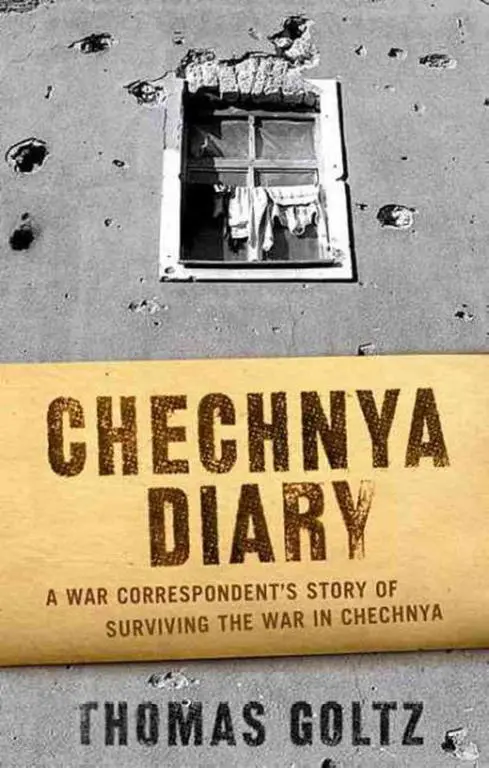
Thomas Goltz - Chechnya Diary
Здесь есть возможность читать онлайн «Thomas Goltz - Chechnya Diary» весь текст электронной книги совершенно бесплатно (целиком полную версию без сокращений). В некоторых случаях можно слушать аудио, скачать через торрент в формате fb2 и присутствует краткое содержание. Город: New York, Год выпуска: 2011, ISBN: 2011, Издательство: Thomas Dunne Books, Жанр: Биографии и Мемуары, military_history, Публицистика, на английском языке. Описание произведения, (предисловие) а так же отзывы посетителей доступны на портале библиотеки ЛибКат.
- Название:Chechnya Diary
- Автор:
- Издательство:Thomas Dunne Books
- Жанр:
- Год:2011
- Город:New York
- ISBN:0-312-26874-2
- Рейтинг книги:3 / 5. Голосов: 1
-
Избранное:Добавить в избранное
- Отзывы:
-
Ваша оценка:
Chechnya Diary: краткое содержание, описание и аннотация
Предлагаем к чтению аннотацию, описание, краткое содержание или предисловие (зависит от того, что написал сам автор книги «Chechnya Diary»). Если вы не нашли необходимую информацию о книге — напишите в комментариях, мы постараемся отыскать её.
is part of a larger exploration of the role (and impact) of the media in conflict areas. And at its heart,
is the story of Hussein, the leader of the local resistance in the small town that bears the brunt of the massacre as it is drawn into war.
This is a deeply personal book, a first person narrative that reads like an adventure but addresses larger theoretical issues ranging from the history of ethnic/nationalities in the USSR and the Russian Federation to journalistic responsibility in crisis zones.
is a crossover work that offers both the historical context and a ground-level view of a complex and brutal war.
Chechnya Diary — читать онлайн бесплатно полную книгу (весь текст) целиком
Ниже представлен текст книги, разбитый по страницам. Система сохранения места последней прочитанной страницы, позволяет с удобством читать онлайн бесплатно книгу «Chechnya Diary», без необходимости каждый раз заново искать на чём Вы остановились. Поставьте закладку, и сможете в любой момент перейти на страницу, на которой закончили чтение.
Интервал:
Закладка:
Was he talking about me? Even if only a paranoid projection of mine, so much was clear: I was—had become—utterly and completely dependent on the tolerance and humor of seven men who were holding guns and not cameras, and laying their lives on the line on a daily basis for a cause with which I was only romantically associated. I decided to keep my distance from Xamid to the extent possible.
My favorite in the group of men using Hussein’s home as their base was his tall, lanky cousin, Shirvani. When not out inspecting the defensive lines, he was reading. Much of the time it was a Russian translation of the Quran, although he did not seem particularly religious. He had spent his youth in Kazakhstan as a shepherd on a collective farm, before getting drafted into the Red Army. His term of service was spent hoisting nuclear warheads at a base in Uzbekistan.
“Two of my Chechen comrades on the same team died of cancer,” he laconically recalled. “The Russians always gave us the dirt jobs.”
The younger men, Ali, Seylah, and Ussam, shared much less of themselves. They were all mechanics, as I recall—but maybe I only recall it that way because they were all mechanically adept; then, so were all Chechens, it seemed. It was almost a generic national trait, like the Chechen familiarity with weapons. Then there was Ussam’s wife Rana. But due to adat, or the custom that suggested maintaining a respectful distance between males and females, I learned nothing about the woman who cooked all our meals (and, I suspect, cleaned all our boots every night.) Once, however, she did whisper to me that she would have preferred to be back in Kazakhstan and not here with a group of guerrillas in a surrounded town. As for Sultan—well, at heart he was a fifteen-year-old kid just feeling his hormones. I remember catching him sneaking up a ladder on his grandfather’s roof in order to peek at (or maybe signal) the girl in the garden next door, planting onions. Hussein’s father and mother, meanwhile, remained silent spectral presences. I never even learned their names, and the only time we spoke could hardly be called conversation.
It happened one morning as I was on my way to the latrine. The German shepherd chained in the yard started growling and yapping, snarling and barking, but not exactly at me. Suddenly my human ears tuned in to dog decibels, and I dove for the remnant corn stalks in the garden while the dog did a tail-between-the-legs dash for the nearest wall, just as a SUK fighter-bomber came ssscreeEEAAMMing overhead, or at least near enough to seem to be aiming at me.
“You finished with the… the unspeakable… or trying to dig a new one?”
It was Hussein’s father, wool cap jauntily perched on his head, a jug of ass-wash water in hand, and a sardonic smile on his face.
“Please, you go first,” I replied, picking myself up from the garden floor.
My fear of flying had been permanently replaced by another phobia: to die in an outhouse, literally blasted into shit.
Although Samashki was theoretically surrounded, there were always visitors bringing news from different parts of the everchanging “front” as well as the occasional vehicle bearing the occasional foreign journalist or relief worker on a quick drive through. The journalists always looked edgy and like they wanted to get back out as soon as they had shot their obligatory B-roll shots of guys with guns.
“…security is tight in this Chechen town, with rebels ‘inspecting all vehicles…’”
News.
Once, Hussein flagged down one of these “foreigner vehicles” (so called because they tended to be big, white, and brand-new land cruisers) that belonged to the Doctors Without Borders organization, and began berating the terrified French medics inside about how they were letting themselves be used by the Russian authorities. Moscow only allowed them to deliver symbolic aid, he charged, and only to places where Moscow wanted it to go. In other words, the foreign do-gooders were de facto participating in ethnic cleansing, as well as the creation of unnatural dependencies. Poor doctors. They could only nod and hope Hussein was not really as mean as he seemed. At a certain point, I thought it best to tell them that they were not in danger.
“But you speak English so well for a Chechen!” uttered a very surprised and relieved doctor.
Nor was all my time spent with Hussein and his men. For entertainment mixed with information gathering, I had become a regular over at Alkhazur’s blacksmith shop, which also served as a local after-hours men’s club of a certain fashion. Every night, fighters, petty merchants, and diverse hangers-on would gather in the blacksmith’s livingroom to drink tea, watch scratchy Chechen television (beamed in via satellite by a Turkish fund) and play cards. I never understood the rules of the game, but it always seemed to end when losers were obliged to perform something I took to calling the “duck dance,” a shake-your-bottom sort of movement that was sufficiently humiliating in a good-natured sort of way to send peals of laughter around the room.
One night, I found everyone at Alkhazur’s nightclub glued to a tiny television powered by a generator. It was tuned to the so-called Presidential Channel, a frequency that only operated when President Djohar Dudayev deigned to talk to the nation from a secret location in the mountains. The broadcast link was provided via a Turkish satellite connection paid for by diaspora Chechens in Istanbul. Finally, the president appeared on air. I did not even need a running commentary. Dudayev smirked, scowled, threatened, joked, pontificated, and generally hammed it up in front of the camera. Truly, what a strange man. And given present circumstances, it was almost embarrassing.
And I was starting to learn something of the clickity-clack growl of the Chechen tongue. I do not want to exaggerate my fluency in the language; I never got beyond a handful of nouns and verbs, greetings and goodbyes, and I depended on Russian as a means of communication. Still, here is a list of words I put down in my notebook for memorization. I have no idea why the list appears the way it does, or even if the conjugations of the verbs are accurate.
predatl— traitor
michawu— where
tzigawu— there
igawu— over there
kuzawu— here
jal— dog
so-ne-le’e— I want
huna le’e— you want
tsuna le’e— he wants
tkun le’e— we want
ho su-ne yeza— I love you
busa dika yurl— six nights
ura dika yurl— six months
de dika yurl— six days
sura dika yurl— six years
Why I was focusing on the concept of “six” I cannot today explain. Nor the “I love you” in the middle of the list, or why I passed over the most memorable Chechen noun-adjective construct that stuck in most reporters’ minds: dick cunt. It meant “good boy.”
The word at the top of the list, predatl, was actually a loan word from the Russian. In both Russian and Chechen, it meant “traitor.” The reason for its appearance was that it reflected Hussein’s primary concern about certain personalities in town, which of course then became my concern as well.
The primary focus of Hussein’s attention was a group of elders, and specifically the local imam, or prayer leader, at the Friday Mosque on the southern edge of town. Like virtually all religious leaders in the post-Soviet Union, ranging from the Russian Orthodox Patriarch in Moscow to every parish priest, deacon, or rabbi in Siberia, the imam had been appointed and remained a paid employee of the formerly Soviet, but now legally Russian, state. The fact that it was his stamp and seal that ratified the various ceasefire agreements only added to the suspicion on the street (or at least in the Hussein household) that the imam had at least two masters: Allah and the FSB, or renamed Soviet KGB. Complicating the picture even more was the fact that the imam’s brother, also an Islamic cleric, was a welcome guest at Hussein’s house—and the man who had taken upon himself to turn Hussein, a former collective farm captain and atheist, into a believing and prayer-conscious Muslim.
Читать дальшеИнтервал:
Закладка:
Похожие книги на «Chechnya Diary»
Представляем Вашему вниманию похожие книги на «Chechnya Diary» списком для выбора. Мы отобрали схожую по названию и смыслу литературу в надежде предоставить читателям больше вариантов отыскать новые, интересные, ещё непрочитанные произведения.






Обсуждение, отзывы о книге «Chechnya Diary» и просто собственные мнения читателей. Оставьте ваши комментарии, напишите, что Вы думаете о произведении, его смысле или главных героях. Укажите что конкретно понравилось, а что нет, и почему Вы так считаете.