Thomas Goltz - Chechnya Diary
Здесь есть возможность читать онлайн «Thomas Goltz - Chechnya Diary» весь текст электронной книги совершенно бесплатно (целиком полную версию без сокращений). В некоторых случаях можно слушать аудио, скачать через торрент в формате fb2 и присутствует краткое содержание. Город: New York, Год выпуска: 2011, ISBN: 2011, Издательство: Thomas Dunne Books, Жанр: Биографии и Мемуары, military_history, Публицистика, на английском языке. Описание произведения, (предисловие) а так же отзывы посетителей доступны на портале библиотеки ЛибКат.
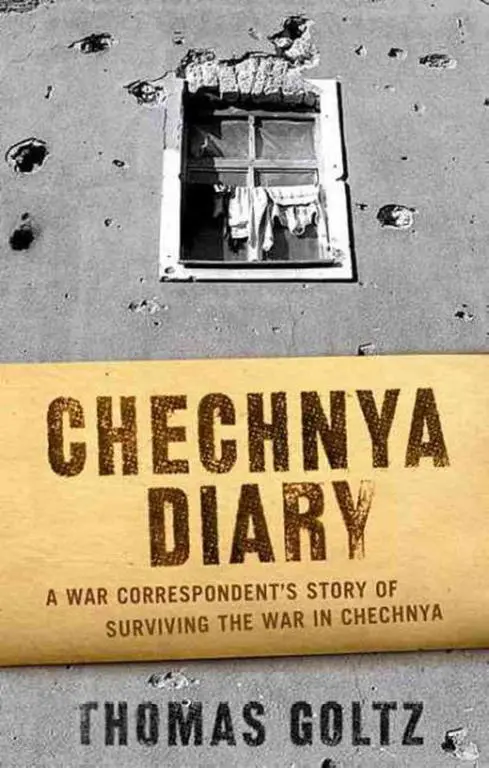
- Название:Chechnya Diary
- Автор:
- Издательство:Thomas Dunne Books
- Жанр:
- Год:2011
- Город:New York
- ISBN:0-312-26874-2
- Рейтинг книги:3 / 5. Голосов: 1
-
Избранное:Добавить в избранное
- Отзывы:
-
Ваша оценка:
Chechnya Diary: краткое содержание, описание и аннотация
Предлагаем к чтению аннотацию, описание, краткое содержание или предисловие (зависит от того, что написал сам автор книги «Chechnya Diary»). Если вы не нашли необходимую информацию о книге — напишите в комментариях, мы постараемся отыскать её.
is part of a larger exploration of the role (and impact) of the media in conflict areas. And at its heart,
is the story of Hussein, the leader of the local resistance in the small town that bears the brunt of the massacre as it is drawn into war.
This is a deeply personal book, a first person narrative that reads like an adventure but addresses larger theoretical issues ranging from the history of ethnic/nationalities in the USSR and the Russian Federation to journalistic responsibility in crisis zones.
is a crossover work that offers both the historical context and a ground-level view of a complex and brutal war.
Chechnya Diary — читать онлайн бесплатно полную книгу (весь текст) целиком
Ниже представлен текст книги, разбитый по страницам. Система сохранения места последней прочитанной страницы, позволяет с удобством читать онлайн бесплатно книгу «Chechnya Diary», без необходимости каждый раз заново искать на чём Вы остановились. Поставьте закладку, и сможете в любой момент перейти на страницу, на которой закончили чтение.
Интервал:
Закладка:
I had planned my sojourn to Chechnya to coincide with Genocide Commemoration Day of February 23-24 because I was sure it would make good television. Either the Chechens would launch a series of revenge attacks on Russian positions or the Russians would make preemptive strikes against Chechen positions that the Russian would assume were getting readying for symbolic attacks. The main point was someone would attack someone else, and that meant good television, if I could only be in the right place at the right time. That had been my plan, anyway.
But February 23-24 passed without major incident, as did the days and then weeks that followed, with my tagging along with Hussein or other members of his group around the streets of Samashki, or, once the sun set, my setting up my camera atop the apartment building Drudzhba (Friendship) in anticipation of night bombing.
It was a cold, nasty experience that was also a waste of precious battery life. I kept the camera on standby as opposed to off in order to preserve juice, hitting “on” whenever a roll of artillery erupted in the black distance—but it was always too late for the camera to catch anything useful or useable, such as a huge and distant two-second explosion. Even if I could react to the incoming ssschreeeeech ! and catch the visual explosion on the edge of town, it never matched the audio aspect of incoming destruction.
The first serious daylight soundings of Samashki’s defenses, meanwhile, caught my camera cold. Literally. Thanks to my nocturnal vigil on the town’s rooftops, not one of the dozen or so battery units I had brought to fire the camera had any juice left—and the battery charger that connected to a car cigarette lighter refused to work. Alkhazur, the blacksmith, was of no help, nor several other men identified as electricians. My last chance seemed to be a local beekeeper, a man who allegedly dabbled in bomb-making on the side. Directed to his house, I explained my problem. The beekeeper took the charger in hand, unscrewed the mount and stared at the circuitry.
“Hungry?” he asked, and suggested I sit down.
The table was soon set with tea, bread, the standard pickles and some rather good fried chicken, as well as a bowl of honey. For a moment, I was afraid the man was going to smear some of that over the dysfunctional unit—nothing else seemed to work—when he reached for a bottle of vodka, poured a small shot over the charger, and began scrubbing it with a toothbrush. Satisfied, he then set the charger near the gas stove.
“I don’t think we want to melt it,” I said.
“Don’t worry,” came the reply.
I was lifting a spoonful of honey to my mouth when suddenly the world rocked and roared and a huge cloud of smoke bellowed up and over the bramble forest and the forward lines. Instantly, I was on my feet and about to dash in the direction of the blast, now echoing with the rasp of machine-gun fire on full automatic. Hussein’s men, from what I could tell.
“Sit down,” said the electrician, pouring tea. “There is no sense in your going anywhere until that thing dries.”
He had a point. Aside from the purest form of war voyeurism (or unless I planned on picking up a gun), without a functional camera I had no business in the zone. So I sipped the tea and waited. The battle seemed to be being fought in the next muddy street.
“ Terplenia ,” said the bee man. “Patience.”
After another cigarette he inspected the charger, screwed the mount back together, and beckoned me toward a car. Its battery was dead. We pushed it down a short slope and it started, and I could only hope that the cigarette lighter in the dashboard still worked. It did. As soon as we plugged it in, the first of the five green charge light indicators on the battery began to blink. In itself, this meant only that the car lighter worked, not that the battery was collecting and holding a charge. Another cigarette, and the second indicator began to blink, the first now a steady green glow. I stripped off the battery and stuck it on the camera, attaching a second battery to the charger. Then I tried to turn on the camera. With a beautiful click and whirr the device lit up. I hit the play button, and it began to record.
“Barkal, bolshoi barkal!” I nearly crowed for joy, running off to war again.
Well, almost. I still had to collect a minimum charge to make any activity worthwhile. So we smoked another cigarette while waiting for the second indicator to start flashing green. Then I begged the beekeeper to drive me as close to the front as he could safely go. I would save time (and, carrying the flak jacket and camera gear), energy—and also allow the battery to continue to charge. I figured I had about ten minutes of juice when we ditched the car and started working our way through shattered farm houses, ditches, and trees toward the front; the beekeeper had decided to come along, too.
We took a look at the lay of the land from the second story of one of three large, new, but abandoned houses on the extreme edge of town, which were often used as sniper nests. The forest obscured any view of the battleground, but smack-dab in front of me I could see the cause of all the commotion: an armored train, periodically spitting fire and lead toward the forest.
An armored train?
We scampered down the makeshift stairway to the ground floor, across an exposed field (thanks to the cover of several cows), and into the bramble forest. After several minutes, a sentry called out to us in Chechen to halt and identify ourselves.
“Allah ul Akbar,” we called back the password. “God is the Greatest. ”
The youths were apparently guarding the flank. On and on we ran, taking protective gullies when there was one, and hunching low when there wasn’t, until finally we ran into a familiar form: Shirvani, sitting beneath a tree, having a smoke. I wanted to embrace him.
“Toms! ” he chortled. “You missed all the fun.”
At that precise moment a helicopter came swooping over us at tree level and everyone dove for cover. My dive landed me in a deep thicket of thorn, and I emerged a wounded man: In addition to various minor nicks and cuts and penetrations, a pencil-size needle, about as big as a cigarette butt on one end and as sharp as a pin on the other, had jammed its way through the pad of my left-hand thumb, and was sticking out the other side. The funny thing was that it was not all that painful. The reason for that was that I could not feel it at all. Or move the thumb. I discovered that fact when I attempted to pick up the camera. It dropped straight back down to the ground.
There was no time to reflect on my new onehandedness. The crack and blast of a duel on the far side of the thorn bush ridge beckoned. I crept up the ridge until I could see Hussein, some fifty yards in front of me.
“Toms! ” he called, casual as could be. “Come on down to the party! ”
I did as commanded and scampered out of the thorn-and-bramble forest to find Hussein, Sultan, and Seylah howling with laughter and pointing toward a ball of fire and smoke about a mile away. It was an armored personnel carrier that the Russians had themselves destroyed.
“There were two columns, and we tricked them into attacking each other!” gasped Hussein, laughing. “It’s been a regular circus here, ha!”
And one that I had missed.
Not all members of Hussein’s band were thrilled with my war enthusiasm. One of the men, Xamid, had taken to staring at me and directing non sequitur questions and comments that I imperfectly understood. The thing that I did understand was that he had taken a visceral dislike to me.
Returning from one of my nocturnal rooftop vigils one night among the nights, I accidentally interrupted some sort of planning conference and heard Xamid saying, in Russian, “He just wants fighting, although he himself is afraid.”
Читать дальшеИнтервал:
Закладка:
Похожие книги на «Chechnya Diary»
Представляем Вашему вниманию похожие книги на «Chechnya Diary» списком для выбора. Мы отобрали схожую по названию и смыслу литературу в надежде предоставить читателям больше вариантов отыскать новые, интересные, ещё непрочитанные произведения.










Обсуждение, отзывы о книге «Chechnya Diary» и просто собственные мнения читателей. Оставьте ваши комментарии, напишите, что Вы думаете о произведении, его смысле или главных героях. Укажите что конкретно понравилось, а что нет, и почему Вы так считаете.