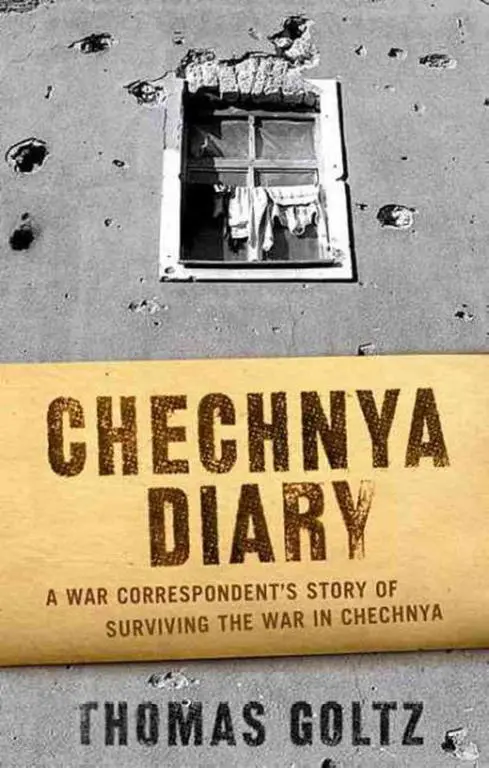
Thomas Goltz - Chechnya Diary
Здесь есть возможность читать онлайн «Thomas Goltz - Chechnya Diary» весь текст электронной книги совершенно бесплатно (целиком полную версию без сокращений). В некоторых случаях можно слушать аудио, скачать через торрент в формате fb2 и присутствует краткое содержание. Город: New York, Год выпуска: 2011, ISBN: 2011, Издательство: Thomas Dunne Books, Жанр: Биографии и Мемуары, military_history, Публицистика, на английском языке. Описание произведения, (предисловие) а так же отзывы посетителей доступны на портале библиотеки ЛибКат.
- Название:Chechnya Diary
- Автор:
- Издательство:Thomas Dunne Books
- Жанр:
- Год:2011
- Город:New York
- ISBN:0-312-26874-2
- Рейтинг книги:3 / 5. Голосов: 1
-
Избранное:Добавить в избранное
- Отзывы:
-
Ваша оценка:
Chechnya Diary: краткое содержание, описание и аннотация
Предлагаем к чтению аннотацию, описание, краткое содержание или предисловие (зависит от того, что написал сам автор книги «Chechnya Diary»). Если вы не нашли необходимую информацию о книге — напишите в комментариях, мы постараемся отыскать её.
is part of a larger exploration of the role (and impact) of the media in conflict areas. And at its heart,
is the story of Hussein, the leader of the local resistance in the small town that bears the brunt of the massacre as it is drawn into war.
This is a deeply personal book, a first person narrative that reads like an adventure but addresses larger theoretical issues ranging from the history of ethnic/nationalities in the USSR and the Russian Federation to journalistic responsibility in crisis zones.
is a crossover work that offers both the historical context and a ground-level view of a complex and brutal war.
Chechnya Diary — читать онлайн бесплатно полную книгу (весь текст) целиком
Ниже представлен текст книги, разбитый по страницам. Система сохранения места последней прочитанной страницы, позволяет с удобством читать онлайн бесплатно книгу «Chechnya Diary», без необходимости каждый раз заново искать на чём Вы остановились. Поставьте закладку, и сможете в любой момент перейти на страницу, на которой закончили чтение.
Интервал:
Закладка:
Another downshift through a puddle, maybe a creek, that splashed dirty water on the shattered windshield of the Kamaz. A left, a right, another left beneath more trees with branches scratching against metal and glass in a way I would not let trees touch my beat-up old Ford in Montana. Then we stopped by a big pit, both the sides and interior overgrown with weeds.
“When I came back from Kazakhstan, I was looking for property around here,” said Hussein, climbing down from the driver’s side. “I had heard about this place—lovely ground, trees, water to build a small mill. My mind was set! Then this is what I found.”
I jumped out of the truck and fiddled with my camera kit, testing the microphone and attaching the tripod.
“Look!” said a voice in the headset that was coming from nowhere in sight. It was Hussein, already deep inside the unnatural pit, clambering down the far side, feeling, touching, tenderly fondling pieces of rough masonry extending at flat angles far down below. Flagstones. Natural building blocks.
Then I got it. The flagstones were actually tombstones. Chechen tombstones used as an easy quarry after Hussein’s ancestors were bundled off to Central Asia.
“Veedish?” breathed Hussein, back up on level ground after having bounded out of the pit, and solemnly, lovingly stroking a new stack of cut stone that passed as a regular wall leading to a sluice gate. “Veedish —do you see?”
The perfect farm, a place replete with a miniature hydroelectric plant and pond was built using the gravestones of his ancestors as building blocks.
“I remember when we first came back, we kids would sneak out to this place. It was already in ruins then; maybe it was never completed,” recalled Hussein. “And there was a metal wheel associated with the generator—ah, here it is!—and we would spin the wheel and get it going as fast as we could and then dare each other to take a leap and seize the edge and sppiinnnnn!”
Hussein spun the groaning metal wheel, and I recalled doing a similar stunt in a grade school playground back home.
“Yes, we were kids. Kids!” breathed Hussein. “How could we know we were playing on the graves of our forefathers, laughing? And I remembered this place, and when I came back I had my mind set on owning it, developing it, because the remarkable thing was that no one else seemed to want it! So then I came back with my heart filled with dreams and memories, and someone had to explain why no Chechen farmer would ever, could ever homestead here. And that is when I began to understand. Really understand. There is no difference in time or space between the Czar’s cannons against Shamil in 1854, the Bolsheviks seducing us to fight against the Whites in 1918, or Stalin deporting us in 1944, or Yeltsin rolling his tanks over our tombstones today. Every fifty years, the Russians attempt to eradicate us, because we have never submitted. And they will never succeed.”
We trundled back to town in a silence enforced by the motor roar, picking up a couple of groups of forest youth on our way back and depositing them at the Assa River bridge checkpoint for guard duty. A knot of frowning elders in their papakhs and formless greatcoats stood to the side, stamping their feet in the cold and muttering darkly. Hussein leaned out the window and called over one of the armed men in the blockade house, exchanged some words in Chechen and then turned to me to explain.
“Ivan is closing the loop,” he said with a frown. The elders had been on their way to a perigavor, or contact meeting with the invisible Russians down the road, but the meeting had been canceled due to a helicopter attack on several village women collecting wild garlic in a nearby forest.
More ominous was the very fact that the elders had called for the contact meeting at all. It was designed, Hussein explained, to neutralize the town.
“This is not just a war of independence, pitting Djohar against Boris, or even the Chechens against the Russians,” he said. “It is also a conflict about control and the nature of Chechen society. It is about rich and poor, believers and nonbelievers—and I do not mean anything religious by my remarks. Mark my words, whatever the result of the current conflict, the one that comes after it will be much worse, because it will be one that pits Chechen against Chechen, and we are the most remorseless people in the world.”
And arguably innovative, as proven by the next stop on our itinerary. This was the courtyard of a blacksmith shop owned by a man named Alkhazur. My presence led to a certain amount of consternation among the other armed men loitering around. A quick discussion in Chechen ensued, but I could follow none of it. Voices were raised, but Hussein had the last word.
Then I found out why my camera caused concern. I was inside the local arsenal. Someone was firing up a welding torch, and in front of my eyes the lowly blacksmith’s shop was converted into a weapons repair and creation depot. A heavy machine gun ripped from a dead armored personnel carrier was now under the torch, the barrel straightened and firefight damage addressed. Then Alkhazur removed the rods from a broken-down tractor in the yard and welded together a mobile platform for the gun, replete with swivel action and a basic shield. Within half an hour Hussein and his men had acquired an antiaircraft gun to ward off helicopters.
We dumped the truck back at headquarters and proceeded on foot on another round of visits to some slit trenches and machine gun nests on the north side of town, and then ambled over to the Samashki cemetery.
“Look around! Look! This is the cemetery of our elders, our brothers and sons!” said Hussein, picking up a piece of tombstone broken off by a random Russian bullet and placing it atop the marker. “The last time Ivan attempted to destroy us, back in 1944, he took every last stone to build that mill I showed you before, grave-robbing from this solemn place in order to erase all memory that we ever lived here.”
Zzzinggg! Zzzinggg! And then the retort of a gun somewhere in the hills west of town. We were getting sniped at in the cemetery. I instinctively ducked behind a larger tombstone, but not Hussein. He marched on, seemingly oblivious to the danger. When I finally caught up with him, he was finishing the Muslim creed of faith, the Fatiha, and wiping his hands over his face.
“Here is the Chechen spirit,” he quietly breathed.
I looked at the hand-painted name on the simple tombstone. The birth and death dates suggested it belonged to a ten-year-old who had died almost exactly two years before.
“My son,” said Hussein, without further explanation. “It is why we are here. We will not let Ivan plow under the graves of our people, ever again.”
Then I noticed the day and month of birth. Hussein’s son had been born on the day of mourning on which Chechens commemorate their Day of Genocide of 1944. He had never been allowed to celebrate a single birthday.
7
DOG OF WAR
Iam starting to feel I have almost taken the Samashki story as far as it can go without getting bombed, meaning really bombed—and that is what I am waiting for. And that is sick. I am standing on rooftops with camera on standby, stinking of bated garlic breath, waiting for some shell to fall close enough that I get a good, solid “bang” but hopefully far enough away that I don’t die in the process. Just the people who have been looking after and feeding me and washing my boots after a hard day’s slog through the mud. Jesus Christ. I am worse than the usual casual voyeur of the death and destruction of strangers. I actively want the death and destruction of my friends because if it does not happen I do not have “a story.” (Diary entry, early March 1995)
Читать дальшеИнтервал:
Закладка:
Похожие книги на «Chechnya Diary»
Представляем Вашему вниманию похожие книги на «Chechnya Diary» списком для выбора. Мы отобрали схожую по названию и смыслу литературу в надежде предоставить читателям больше вариантов отыскать новые, интересные, ещё непрочитанные произведения.





Обсуждение, отзывы о книге «Chechnya Diary» и просто собственные мнения читателей. Оставьте ваши комментарии, напишите, что Вы думаете о произведении, его смысле или главных героях. Укажите что конкретно понравилось, а что нет, и почему Вы так считаете.