Thomas Goltz - Chechnya Diary
Здесь есть возможность читать онлайн «Thomas Goltz - Chechnya Diary» весь текст электронной книги совершенно бесплатно (целиком полную версию без сокращений). В некоторых случаях можно слушать аудио, скачать через торрент в формате fb2 и присутствует краткое содержание. Город: New York, Год выпуска: 2011, ISBN: 2011, Издательство: Thomas Dunne Books, Жанр: Биографии и Мемуары, military_history, Публицистика, на английском языке. Описание произведения, (предисловие) а так же отзывы посетителей доступны на портале библиотеки ЛибКат.
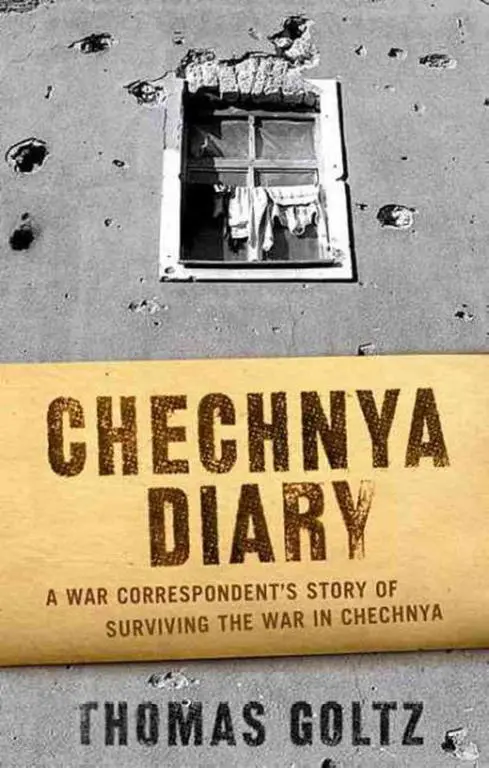
- Название:Chechnya Diary
- Автор:
- Издательство:Thomas Dunne Books
- Жанр:
- Год:2011
- Город:New York
- ISBN:0-312-26874-2
- Рейтинг книги:3 / 5. Голосов: 1
-
Избранное:Добавить в избранное
- Отзывы:
-
Ваша оценка:
Chechnya Diary: краткое содержание, описание и аннотация
Предлагаем к чтению аннотацию, описание, краткое содержание или предисловие (зависит от того, что написал сам автор книги «Chechnya Diary»). Если вы не нашли необходимую информацию о книге — напишите в комментариях, мы постараемся отыскать её.
is part of a larger exploration of the role (and impact) of the media in conflict areas. And at its heart,
is the story of Hussein, the leader of the local resistance in the small town that bears the brunt of the massacre as it is drawn into war.
This is a deeply personal book, a first person narrative that reads like an adventure but addresses larger theoretical issues ranging from the history of ethnic/nationalities in the USSR and the Russian Federation to journalistic responsibility in crisis zones.
is a crossover work that offers both the historical context and a ground-level view of a complex and brutal war.
Chechnya Diary — читать онлайн бесплатно полную книгу (весь текст) целиком
Ниже представлен текст книги, разбитый по страницам. Система сохранения места последней прочитанной страницы, позволяет с удобством читать онлайн бесплатно книгу «Chechnya Diary», без необходимости каждый раз заново искать на чём Вы остановились. Поставьте закладку, и сможете в любой момент перейти на страницу, на которой закончили чтение.
Интервал:
Закладка:
“Go on,” said Isa.
“…then came the application of electrical shocks to the area of sex, the genitals.”
“How…” I asked slowly. “How did you get out?”
“There was an angel,” Vakha said softly. “Not a real angel, of course. But a foreigner. A foreign woman. They were taking us from one place to another, showing us off. I do not know. But, as we walked, this woman from the Washington Red Cross was there and as I passed her she whispered, Run, run—they are going to kill you all!’ So I whispered her message to the others as the Russians were herding us toward a helicopter, and I said to myself, ‘They are going to throw us off.’ Others had heard and spoke of the Russians taking four cars and pulling people apart, attaching ropes to each limb. I have to say I was so frightened that I decided that it was indeed time to run for my life.” [7] There is no such thing as the Washington Red Cross, and I wondered who Vakha’s angel might have been. Rachel Danbar from Human Rights Watch?
Vakha and a small group broke lines, vaulted the security fence, hijacking a bus from Mozdok back to Ingushetia, and then to the safety of war-ravaged Chechnya to nurse their wounds and plot their revenge.
We drove back to Samashki, again without lights, the road again periodically illuminated by distant flares. Isa plunked a tape into the car’s cassette player, and the dirge music silenced any thought of conversation. We did not talk; there was too much to think about: electrodes, cattle-prods, helicopters…
Then someone was shouting from outside the car.
“Stoi!” they screamed. “Stop!”
Isa hit the breaks and the car skidded to a slow halt in the middle of an icy bridge over what I recognized as being the Assa River on the outskirts of Samashki. Lost in the mystical dirge music on the scratchy car speakers, we had just breached another checkpoint. Whether Russian or Chechen was almost a matter of indifference by now. I was getting so very tired of checkpoints. Isa felt the same way I did.
“What a mistake to know you, what a mistake to help you,” he muttered under his breath, and in Russian, so that I could understand.
“Bumaga,” demanded the man at my window, and I pulled out my controversial press pass from Achkoi Martan, hoping it was the right flavor.
“You will follow us,” said the apparent unit commander. Sandwiched between two other vehicles of armed men, we set off from the checkpoint on the bridge and into the labyrinthine muddy lanes of Samashki, eventually stopping in front of an extended brick wall boasting a massive iron gate with a double door for vehicle entry and a single for pedestrians.
“Wait here,” said the gunman, entering the compound. Then the steel door designed for human beings (as opposed to the larger door designed for machines) creaked open. I hoisted myself out of the car and walked through the steel gate to face whatever music awaited, preparing my line in as good Russian as I could muster. “Sir, I am sorry for having violated the security perimeter of your nearly surrounded town. As a completely independent and detached observer of the horrible war in your unrecognized republic I was merely attempting to document the brutality of the Russian campaign and the spirit of the… ” That was the English version anyway.
Then I was inside the courtyard and a dog was yapping at my heel. At the far end, near the steps to the house, stood a stocky man with a Kalashnikov in his hands.
“Sir,” I began. “I am a correspondent and… ”
“So you are the foreigner I have been hearing about,” said the commander.
“Yes, I am he, and I must apologize for any and all inconveniences that my arrival… ”
“I have yet to interrogate a suspect in my courtyard,” said the commander, with a chuckle. “Take off your shoes and enter my home.”
I did so, as did Isa.
“These are my friends,” said the commander, indicating a knot of five or six men squatting in the bare-as-bones, kitchen-loading belt-machine-gun shells.
“Marsh vogil ,” they said, blinking up from their task. “Welcome.”
A young woman busied herself making tea over the stove, while an elderly couple sat, silent and disapproving, in the far corner.
“So who are you?” asked the commander.
“Here are my papers,” I said, handing over my new press pass for inspection.
“So, what sort of pictures have you been taking?” the commander asked.
I started to explain what I had been recording, but realized that I was describing material that amounted to generic visual junk.
A man walking from a shot-up house to a shot-up outhouse; another man standing in a shot-up house framed by a shot-up window frame. Chickens cluck-running in front of the turret of a tank. My host and guide Isa pontificating about Russian-Chechen relations in anecdotal form about something so profound and important that it took him ten minutes to say “and we must be free.” Commander Santa Ali Claus saying much the same thing but looking better in beard and bandolier. The best stuff I had recorded was torture victim Vakha—and even if the content was good, I knew I had shot it all in bad light.
Yes, I could share a detailed shot list with the commander. If he did not believe me when I detailed said shot list, he could take a look at the (limited) material, and erase it all if it pleased him. There was nothing I had shot so far that I could not lose.
“I do not need to see any more pictures of bombed buildings or refugees,” said the commander. “And to speak frankly, there is nothing in this community to conceal, from you or the KGB. We are farmers, and only defending our homes.”
A farmer defending his home.
With a jolt, I understood that the man standing in front of me was exactly the sort of vessel I needed to explain the essence and nature of the Chechen spirit—and I had known him for all of half a minute. But how to broach this subject without getting laughed out of the room? The idea of asking the commander to allow me to tag along with him and his men seemed so utterly ridiculous that it bordered on the criminal. Anyone who truly exemplified the Chechen spirit would likewise have better things to do than burden himself with a stumblebum solo cameraman. The only type of individual who would agree to be my subject was precisely the type of person I did not want.
“Have a chair,” said the commander, sort of suggesting that the formal interrogation that had never really begun was already over. “I’m starving, and so are my boys.”
It was, after all, a Ramadan evening—and none of the men in the room (with the exception of myself) had had a drop to drink or a bite to eat all day.
The commander broke his fast by wetting the little finger of his right hand with his tongue, and then dipping it in a bowl of salt. Dabbing it on his tongue, he then drank a glass of water. The half dozen hard-eyed men in the room did the same. For someone who had lived in the Muslim world for almost twenty years and who had seen many an iftar (or Ramadan breakfast), this was all very strange. While drinking water was normal, ending the daily fast with salt was almost like ending it with chewing on an onion.
Meanwhile, the womenfolk brought out pickled tomatoes, boiled beef soup, and bread. The commander commanded, and I joined his unit squatting on the floor, slurping through two bowls of beef bouillon before cutting the fat on my lips with hot tea.
“Better get down in the cellar,” said my host and captor after a pleasant belch. “Ivan will be starting his symphony in about ten or fifteen minutes.”
I did not at first understand.
Symphony?
Читать дальшеИнтервал:
Закладка:
Похожие книги на «Chechnya Diary»
Представляем Вашему вниманию похожие книги на «Chechnya Diary» списком для выбора. Мы отобрали схожую по названию и смыслу литературу в надежде предоставить читателям больше вариантов отыскать новые, интересные, ещё непрочитанные произведения.







Обсуждение, отзывы о книге «Chechnya Diary» и просто собственные мнения читателей. Оставьте ваши комментарии, напишите, что Вы думаете о произведении, его смысле или главных героях. Укажите что конкретно понравилось, а что нет, и почему Вы так считаете.