Thomas Goltz - Chechnya Diary
Здесь есть возможность читать онлайн «Thomas Goltz - Chechnya Diary» весь текст электронной книги совершенно бесплатно (целиком полную версию без сокращений). В некоторых случаях можно слушать аудио, скачать через торрент в формате fb2 и присутствует краткое содержание. Город: New York, Год выпуска: 2011, ISBN: 2011, Издательство: Thomas Dunne Books, Жанр: Биографии и Мемуары, military_history, Публицистика, на английском языке. Описание произведения, (предисловие) а так же отзывы посетителей доступны на портале библиотеки ЛибКат.
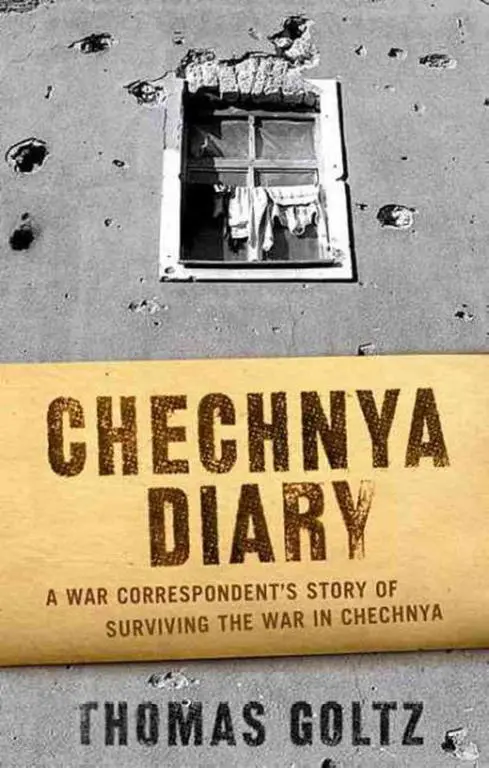
- Название:Chechnya Diary
- Автор:
- Издательство:Thomas Dunne Books
- Жанр:
- Год:2011
- Город:New York
- ISBN:0-312-26874-2
- Рейтинг книги:3 / 5. Голосов: 1
-
Избранное:Добавить в избранное
- Отзывы:
-
Ваша оценка:
Chechnya Diary: краткое содержание, описание и аннотация
Предлагаем к чтению аннотацию, описание, краткое содержание или предисловие (зависит от того, что написал сам автор книги «Chechnya Diary»). Если вы не нашли необходимую информацию о книге — напишите в комментариях, мы постараемся отыскать её.
is part of a larger exploration of the role (and impact) of the media in conflict areas. And at its heart,
is the story of Hussein, the leader of the local resistance in the small town that bears the brunt of the massacre as it is drawn into war.
This is a deeply personal book, a first person narrative that reads like an adventure but addresses larger theoretical issues ranging from the history of ethnic/nationalities in the USSR and the Russian Federation to journalistic responsibility in crisis zones.
is a crossover work that offers both the historical context and a ground-level view of a complex and brutal war.
Chechnya Diary — читать онлайн бесплатно полную книгу (весь текст) целиком
Ниже представлен текст книги, разбитый по страницам. Система сохранения места последней прочитанной страницы, позволяет с удобством читать онлайн бесплатно книгу «Chechnya Diary», без необходимости каждый раз заново искать на чём Вы остановились. Поставьте закладку, и сможете в любой момент перейти на страницу, на которой закончили чтение.
Интервал:
Закладка:
Isa disappeared again that next morning before I could have a word with him about moving on. Muhammad tossed kernels of corn to the poultry in the yard. With him thus distracted, I decided to slip out with my camera and shoot some generic B-roll footage with a focus on the ‘battle zone,’ meaning the shot-up houses and abandoned tank turrets that I had been shown the day before. At least it felt like work. I sallied forth and shot frames of shattered windows and doors and morose-looking people cleaning up shattered brick and broken chairs and sofas, and I asked folks how they felt about having their homes wholly or partially destroyed by Russian bombs. Rotten, said most.
All in all, it was all pretty weak brew compared to what was going on in Grozny a mere twenty miles away.
Meanwhile, the human manifestation of that fight was everywhere apparent, consisting of a long line of refugees moving down the main street through town. People were crammed eight or ten to the four-seat Soviet-style Fiat sedans, roofs half crushed by excess household weight. The refugees also traveled in trucks, buses, and even hay-wagons towed by tractors, the densely packed carriages bearing mothers, children, and the elderly. All wore stoic expressions, and not one shed a single tear.
The refugees’ destination was the town of Slepsovski, a burg of about five thousand people located about thirty kilometers from Samashki down the road toward Chechnya’s “cousin” minirepublic of Ingushetia. The Ingush had elected to remain inside the Russian Federation when Chechnya had gone its own way. Its farm-town capital, Nazran, and second city and airfield, Sernovodsk, was where many of my journalistic colleagues were now based, as well as humanitarian organizations administering the growing tide of refugees washing up in that safe haven. Without a visa for the Russian Federation—much less official press permission to be in the area of conflict, the dubious charms, comforts, companionship, and, most important, communication capabilities of Ingushetia remained off-limits for me.
But then I saw a car coming the other way, traveling in the direction of Grozny, and with a piece of paper pasted to the window with PRESS written on it.
Colleagues? It was my ticket out of Samashki or Sharmalsheiki or whatever they called this dump, and I stepped out into the road to wave down the car, hoping that the people inside might recognize me as a foreigner despite my papakh and generic cold-weather gear. The car was slowing down to see what I wanted when I felt a meaty hand on my shoulder, forcing me to turn around.
“Kto ti!” demanded a huge bear of a man, sporting a beard so long and white he looked like nothing so much as Santa Claus with bandoliers. Flanking him were a pair of identical twins, similarly festooned with weapons and wearing identically suspicious physiognomies. “Who are you!”
I muttered something about being a foreign correspondent and Santa demanded my papers. As I helplessly watched the press car drive on, I handed Santa my new “press pass.”
“These papers are issued by Avtorkhanov! ” growled my most recent captor, referring to the most notorious pro-Russian, anti-Dudayev militia leader. Then he flagged down another car heading in the opposite direction of the refugee stream and forced me in, directing the driver down the road toward Achkoi Martan and the same government building and government office where I had been interrogated the day before.
“Back to see us again, Mister Istanbul?” chortled the man who had issued me the makeshift press pass for the region. “Comrade Ali, ” he continued, referring to Santa. “Why are you abandoning your post to waste our time with an issue we have already dealt with?”
Commander Ali sputtered something in Chechen, no doubt in reference to the need to double check and be ever vigilant. The truth, it appeared, was that he was illiterate, and had not been able to read the signature on my papers.
“Dismissed!” said the security man, and Commander Ali and I returned to Samashki.
“God damn it!” I cursed. “Another completely wasted day!”
“What did you say?” asked a smiling Santa, who now regarded us as the best of friends.
Indeed. I had been coughing up English to express my outrage, and there were not a lot of folks around to understand.
Isa was not so much incensed at my rearrest and release as he was worried that I had disappeared into Grozny. Or worse—that I had been arrested by the Russians after stumbling over a checkpoint.
“They are torturing all the young men they get their hands on!” he said.
“How do you know?”
“One of my cousins told me,” said Isa. “He just escaped from a filtration point.”
“I want to meet him,” I said, insisting that Isa take me to meet the man.
“Why do you have to talk to him? I just told you what happened.”
“Isa—I am trying to make a film!”
No more rumors, no more secondhand stories. I needed facts on tape.
Reluctantly, he agreed, and following the evening meal of fried potatoes, pickles, and tea, we set out for the cousin’s house.
I remember traveling with headlights out, the open fields along the roads we traveled lit by distant, multicolored flares. Eventually, we arrived at a typical Chechen farm—a roomy house partially hidden behind a courtyard wall with dogs and chickens and geese in the yard. Isa knocked on the door and gave the half-embrace handshake to a young man of perhaps thirty. He was introduced to me as the cousin, a man named Vakha.
Isa got straight to the point: The foreign journalist wanted to hear about Vakha’s experiences under detention. And more. The foreign journalist needed to have it all on film, as evidence of Russian war crimes and atrocities against civilians.
“Okay,” said Vakha.
He began to clinically relate how he had been walking down the road minding his own business in between tending the sheep and planting the potatoes when he happened across a Russian checkpoint in the disputed Slepsovski zone and found himself detained along with a dozen other Chechen youth.
“They beat us all as a matter of course,” Vakha related dispassionately. “Then they packed us into a truck like we were sheep and sent us down the road to Mozdok.”
There is little doubt in my mind where Bertoldt Brecht got the name of the judge in his classic play about the Judgment of Solomon, Caucasian Chalk Circle . It was from a map of the Caucasus. But the difference in resonance between Mazdak, the stern but fair Biblical King, and Mozdok, the main Russian military base in the region, could not have been greater. It was a place that sent shivers up the spines not only of Chechens, normally so indifferent to the concept of suffering, but international human rights groups whose representatives repeatedly tried to gain access to the base, only to be turned away.
Mozdok , breathed Vakha. That is where things started to get nasty.
“They pulled us out of the truck and forced us to run through a double line of soldiers, who spit and kicked and hit us with truncheons. They aimed for the kidneys. Feel.”
He pulled up his shirt and guided my hand to feel the bumps and bruises on his back.
“Then they walked—actually stomped—on those who fell; happily, I was not of their number. I heard gunshots. They say there were summary executions, but I did not see such myself. Perhaps they were just playing with their weapons.”
The interrogators did not play around when using other methods, however.
“They bound me to a chair, locking my hands on a table, and then applied electric shocks to my fingers,” Vakha related, showing with one hand how pincers were applied to the other. “Then came… I am embarrassed to say this… ”
Читать дальшеИнтервал:
Закладка:
Похожие книги на «Chechnya Diary»
Представляем Вашему вниманию похожие книги на «Chechnya Diary» списком для выбора. Мы отобрали схожую по названию и смыслу литературу в надежде предоставить читателям больше вариантов отыскать новые, интересные, ещё непрочитанные произведения.




Обсуждение, отзывы о книге «Chechnya Diary» и просто собственные мнения читателей. Оставьте ваши комментарии, напишите, что Вы думаете о произведении, его смысле или главных героях. Укажите что конкретно понравилось, а что нет, и почему Вы так считаете.