Thomas Goltz - Chechnya Diary
Здесь есть возможность читать онлайн «Thomas Goltz - Chechnya Diary» весь текст электронной книги совершенно бесплатно (целиком полную версию без сокращений). В некоторых случаях можно слушать аудио, скачать через торрент в формате fb2 и присутствует краткое содержание. Город: New York, Год выпуска: 2011, ISBN: 2011, Издательство: Thomas Dunne Books, Жанр: Биографии и Мемуары, military_history, Публицистика, на английском языке. Описание произведения, (предисловие) а так же отзывы посетителей доступны на портале библиотеки ЛибКат.
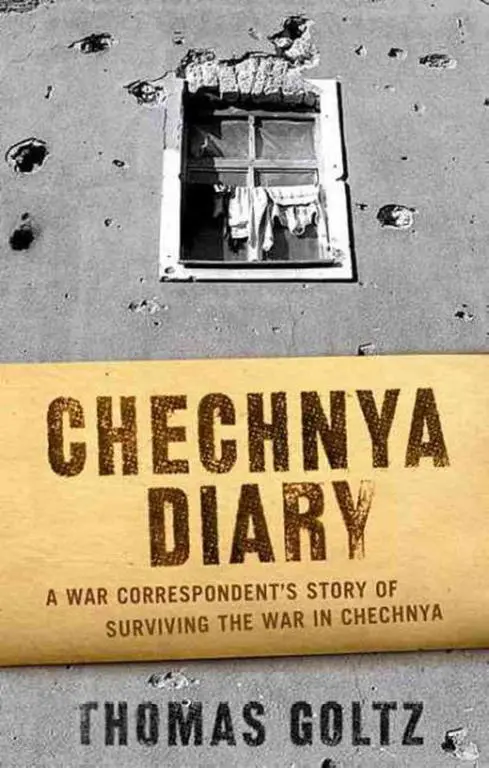
- Название:Chechnya Diary
- Автор:
- Издательство:Thomas Dunne Books
- Жанр:
- Год:2011
- Город:New York
- ISBN:0-312-26874-2
- Рейтинг книги:3 / 5. Голосов: 1
-
Избранное:Добавить в избранное
- Отзывы:
-
Ваша оценка:
Chechnya Diary: краткое содержание, описание и аннотация
Предлагаем к чтению аннотацию, описание, краткое содержание или предисловие (зависит от того, что написал сам автор книги «Chechnya Diary»). Если вы не нашли необходимую информацию о книге — напишите в комментариях, мы постараемся отыскать её.
is part of a larger exploration of the role (and impact) of the media in conflict areas. And at its heart,
is the story of Hussein, the leader of the local resistance in the small town that bears the brunt of the massacre as it is drawn into war.
This is a deeply personal book, a first person narrative that reads like an adventure but addresses larger theoretical issues ranging from the history of ethnic/nationalities in the USSR and the Russian Federation to journalistic responsibility in crisis zones.
is a crossover work that offers both the historical context and a ground-level view of a complex and brutal war.
Chechnya Diary — читать онлайн бесплатно полную книгу (весь текст) целиком
Ниже представлен текст книги, разбитый по страницам. Система сохранения места последней прочитанной страницы, позволяет с удобством читать онлайн бесплатно книгу «Chechnya Diary», без необходимости каждый раз заново искать на чём Вы остановились. Поставьте закладку, и сможете в любой момент перейти на страницу, на которой закончили чтение.
Интервал:
Закладка:
The commander was standing in the courtyard, helping one of his men lift a heavy machine gun into a small cart pulled by a donkey and cover it with hay.
“Good morning!” said the commander as if welcoming me to tea. “Still here?”
“I couldn’t cut and run like that,” I blurted out. “I am here to work.”
“Work?” chuckled the commander. “We are going to work, so just follow us.”
Just like that.
I thought it best to introduce myself formally, and asked the commander for his name.
“Hussein,” he said.
Iwould like to believe myself to be in pretty good shape. While I do not jog, I hunt and track deer, ski, windsurf, and ride a mountain bike with vigor. Friends and foes alike are amazed at the spectacle of my full-body-weight inverted push-ups. But at the end of some five or six hours of stumbling after Hussein as he made his daily inspection tour around the periphery of Samashki, I was wringing wet with sweat and more exhausted than, say, after dragging an elk hindquarter up and over and back down the forests on the south face of the Crazy Mountains of central Montana.
Part of the problem was weight: The camera kit I was lugging around weighed perhaps twenty pounds or so, with the flak jacket and shock plates adding another thirty. But it would have been difficult keeping up with Hussein had my burden been reduced to blue jeans, a T-shirt, and tennis shoes. We were up and over barrier fences and clambering up rickety ladders to the shattered second floors of houses that would never be completed, stopping to chat and say hello to a hidden knot of gunmen with sniper rifles perched in the attic. We waded through muddy cow pastures oozing with goo to discover a line of incredibly narrow slit trenches occupied by half a dozen fifteen-year-old volunteers. Their task was to sit out the day and night waiting for a tank assault and fend off same with plastic bottles filled with kerosene. We doubled back to the town periphery to check on the point position on a secondary road—the farmhouse of an elderly couple and their son Alikhan, who allegedly knocked out two APCs during the original pitched battle over vodka by pin-point shooting at some metallic Achilles’ heel in the enemy’s war-wagon armor plating. Alikhan’s slingshot weapon was a pretty basic if high-powered hunting rifle, perhaps the Russian version of a Remington 30.06 picked up from a pawnshop. The barrel and stock were clamped together with blue electrician’s tape.
“You have to aim just so,” he explained to me on camera. “Then it explodes. ”
“Then it explodes!” echoed his mother, pleased as punch, following her son around the kitchen with an apronfull of what must have been armor-piercing shells.
Another farmhouse HQ, occupied by a group of perhaps ten or fifteen men, ranging in age between fifteen and fifty.
“Allah ul-Akhbar!” shouted Hussein at our approach. “God is the Greatest!”
“Allah ul-Akbar!” replied two sentries, putting down their guns.
“This American correspondent is making a film about the Chechen spirit,” Hussein explained to the assembled. “I am giving him free range to the front.”
I shot videotape of scruffy men on guard duty, kids cleaning their guns, and even several testimonials to bravery and devotion, including some character reciting a poem by the nineteenth-century Russian poet Lermontov about Chechen bravery and devotion. I shot tape of the same men planting and replanting mines in a field across which Hussein anticipated a possible Russian armor attack. Tromping around in the mud with the men was unnerving, to say the least, since the locations of the mine field (the mines themselves purchased from the enemy in exchange for vodka and cash) was only marked in individual memory, and the removal of and relocation of the devices seemed casual in the extreme. The queerest moment came just before sunset, when, in a drizzling rain, Commander Hussein pulled his four-ton Kamaz truck into a naked field, threw out a chain attached to the tailgate, and instructed two of his men to attach the chain to some object hidden beneath a patch of scattered, moldy hay. The truck lurched forward, and out of the ground rolled an octagonal object that was as large as a desk. It was, I realized with just a little shock, horror, and ignorant, knee-jerk fear, the explosive warhead of a surface-to-surface missile, or SCUD.
“If detonated properly, this thing will send an entire armored column into the sky!” chortled Hussein, as he and his five men pushed the monster up a set of thick boards into the back of the truck. In fading light, I filmed them doing so. Then there was a momentary pause, and the warhead began to reassert its command of gravity in the face of human frailty, and started to roll back down the ramp.
“Toms!” shouted Hussein, urgently, mispronouncing my first name. If there are moments when the never-touch-a-weapon-on-either-side rule taught to prospective war correspondents is to be violated, perhaps this was mine. I dropped my camera in the mud and threw my shoulders and legs and back into the task at hand, helping roll the megamissile mine back up the ramp and on to the back of the truck.
“My, you are a strong brute!” roared Hussein as we bounced down the pitted, muddy Samashki perimeter. “Who knows what would have happened if you had not been there!”
The heretofore sour and sullen shepherd introduced to me as Xamid cackled in approval of this assessment, and clapped me on the back. The tall, lanky guy named Shirvani smiled for the first time. The man I thought was the commander’s brother passed me a cigarette, while the doe-eyed kid I had started calling “the kid” kept his eyes down-turned and his thoughts to himself, if he had any at age fifteen. Or, perhaps his thoughts mirrored mine, and mine were focused on one thing alone: that we did not run back over our own handiwork in the darkened fields on the way back to the Ramadan evening breakfast of pickles, potatoes, and bouillon broth that we knew awaited us after our successful mining endeavor.
Was I slipping over some unspoken line? Or just becoming “cuddled ” ?
Cocks crowed. Turkeys gobbled. Dogs barked. Brothers snored. And then a heavy diesel truck engine roared, a horn sounded a sustained blast and a now-familiar voice shouted from beyond the courtyard’s metal door.
“Mishawu Tomas? Ha! Tzigawu!”
It was Hussein, my new friend and, I guess, partner or guide taking advantage of some lull in the action (or nonaction), come to collect me for a little tour of outlying districts he thought I should see. I held off long enough to get a cup of coffee down my non-Muslim hatch, grab my camera kit, and pull myself up in the cab of Hussein’s rig, a four-ton Kamaz truck painted military green.
“Tomas!” shouted Hussein over the motor roar. “Remember that power station and mill I told you about yesterday?”
I didn’t but said I did.
“We are going there, now,” shouted my host while releasing the clutch.
We soon were bouncing down a deeply pitted road beyond the bridge and checkpoint, on the way to Achkoi Martan. The truck had such bad suspension that the frequent blows to my head could kill me if a Russian attack helicopter didn’t blast us first. There was no guarantee that the latter would not happen. The Russian forces made a bit of a game out of arbitrarily blasting cars and trucks on all Chechen roads, and Hussein’s four-ton machine certainly looked like a target to me. Actually, we were no longer even on a road, but a twin path of tread marks leading through sparse trees. Were we in the wild garlic forest that was bombed daily, or some other grove? Had a decision been taken to dispatch this overcurious observer, me, who now knew too much, or what? What was I doing there? How long can one live with casual paranoia before it kills you?
Читать дальшеИнтервал:
Закладка:
Похожие книги на «Chechnya Diary»
Представляем Вашему вниманию похожие книги на «Chechnya Diary» списком для выбора. Мы отобрали схожую по названию и смыслу литературу в надежде предоставить читателям больше вариантов отыскать новые, интересные, ещё непрочитанные произведения.






Обсуждение, отзывы о книге «Chechnya Diary» и просто собственные мнения читателей. Оставьте ваши комментарии, напишите, что Вы думаете о произведении, его смысле или главных героях. Укажите что конкретно понравилось, а что нет, и почему Вы так считаете.