Thomas Goltz - Chechnya Diary
Здесь есть возможность читать онлайн «Thomas Goltz - Chechnya Diary» весь текст электронной книги совершенно бесплатно (целиком полную версию без сокращений). В некоторых случаях можно слушать аудио, скачать через торрент в формате fb2 и присутствует краткое содержание. Город: New York, Год выпуска: 2011, ISBN: 2011, Издательство: Thomas Dunne Books, Жанр: Биографии и Мемуары, military_history, Публицистика, на английском языке. Описание произведения, (предисловие) а так же отзывы посетителей доступны на портале библиотеки ЛибКат.
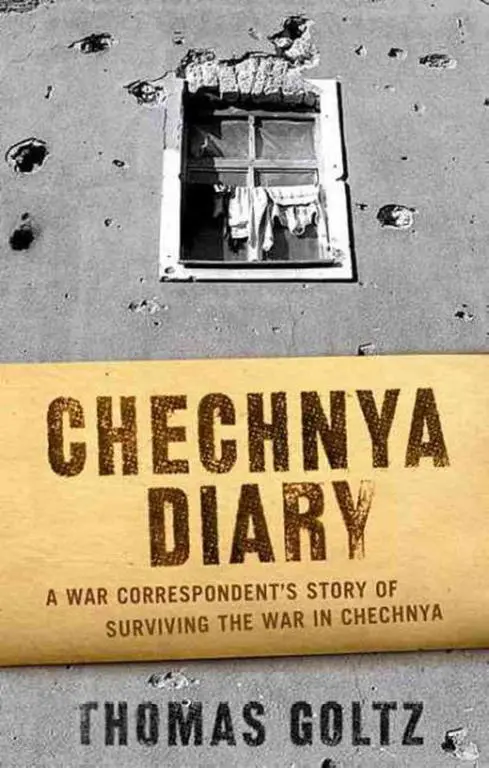
- Название:Chechnya Diary
- Автор:
- Издательство:Thomas Dunne Books
- Жанр:
- Год:2011
- Город:New York
- ISBN:0-312-26874-2
- Рейтинг книги:3 / 5. Голосов: 1
-
Избранное:Добавить в избранное
- Отзывы:
-
Ваша оценка:
Chechnya Diary: краткое содержание, описание и аннотация
Предлагаем к чтению аннотацию, описание, краткое содержание или предисловие (зависит от того, что написал сам автор книги «Chechnya Diary»). Если вы не нашли необходимую информацию о книге — напишите в комментариях, мы постараемся отыскать её.
is part of a larger exploration of the role (and impact) of the media in conflict areas. And at its heart,
is the story of Hussein, the leader of the local resistance in the small town that bears the brunt of the massacre as it is drawn into war.
This is a deeply personal book, a first person narrative that reads like an adventure but addresses larger theoretical issues ranging from the history of ethnic/nationalities in the USSR and the Russian Federation to journalistic responsibility in crisis zones.
is a crossover work that offers both the historical context and a ground-level view of a complex and brutal war.
Chechnya Diary — читать онлайн бесплатно полную книгу (весь текст) целиком
Ниже представлен текст книги, разбитый по страницам. Система сохранения места последней прочитанной страницы, позволяет с удобством читать онлайн бесплатно книгу «Chechnya Diary», без необходимости каждый раз заново искать на чём Вы остановились. Поставьте закладку, и сможете в любой момент перейти на страницу, на которой закончили чтение.
Интервал:
Закладка:
“Praise be to God,” intoned the assembled.
The martyr would have been twenty-four years old in a month.
We rolled out of bed early the next morning, I packed my camera equipment into the trunk of a car provided for our use, and we traveled to the nearby town of Achkoi Martan for the funeral. The ceremony was simple, stark, and as compelling as it was long. In fact it lasted all day. Zaur Bek’s father in the company of a local imam sat with other male members of the family, receiving visitors around a wood-stove set in the backyard of their large house. Each newcomer would stop abruptly at the threshold to the family’s space; the family mourners would rise from their chairs; the imam would call out the word Fatiha, or Muslim Creed; all would turn their palms to heaven and recite the creed, ending it in the universally understood Amen . Then the visitor would walk across the threshold, extend one arm behind the grieving father’s back while accepting the same in the peculiar half-embrace that was the Chechen handshake, pass his condolences in a few terse words, and then retire to the periphery. The next mourner would then approach the threshold, halt until the imam called out the Fatiha —and the process was repeated once again—and again, and again.
Sliding around the periphery among the mourners, I tried to get a picture of the young martyr by asking what the mourners felt about his passing. I did not get far.
“We are all more than happy to die like Zaur Bek,” said his commanding officer. “Our motto is ‘Independence or Death.’”
Zaur Bek’s six brothers echoed that sentiment, swearing they were all ready to go, too. The elders in attendance were even more adamant.
“Let the blessed martyr be a symbol to all of what the Chechen spirit is all about!” crowed one toothless old man. “I call upon the youth here to witness that they will never, ever submit!”
“Praise God!” the youth responded.
“The body that was Zaur Bek returns to the dust, but he is us and we are him! We are his father and he is our brother and our son. Let us die by the grace of God in our time, the time that He declares!”
“Praise God!”
The sermon was interrupted by the arrival of several new mourners. While all set about their formal prayers, I took advantage of the moment to slip down the street and take a look at things free of Isas’s company.
This was an error.
The reader will recall that my mission was to shoot a documentary on Chechnya for television. To do so, I needed lots and lots of video footage—and not just combat scenes. I needed men and women in the streets, buildings, markets, rivers, forests, mountains—in a word, life—in order to emphasize death. I needed images, and the central market place of Achkoi Martan seemed a logical place to start. No sooner had I set down my tripod and focused on a pair of shawldraped matrons selling turnips and cigarettes than I was verbally assaulted.
“Hey!” screamed one woman, dropping negotiations with a customer and wheeling on me. “What do you think you’re doing?”
“Taking some pictures,” I began to explain.
“Pictures of what! Pictures that show how good things are here in Chechnya?”
“Why aren’t you in Grozny taking pictures of the real war!?”
“Erase that tape, or we will take it!”
“Let’s see your permission!”
Instantly, I found myself being trundled over to the prefektura, or government building in downtown Achkoi Martan by an angry knot of elderly ladies from the market.
“Take him!” snarled one of my captors, as the ladies forced me on a couple of guards.
“Spy!” they scowled, and roughly shoved me inside.
My interrogator was a bull of a man draped in bandoleers who described himself as the KGB officer in charge of my case. He began by apologizing for using the old acronym for the Soviet Secret Service from the days of the USSR, explaining that the government he now represented had not yet come up with a suitable alternative. Then he asked me who I was and where I was from, and requested documentation that would prove my claims. I gave him my passport, as well as a couple of less-official but supportive documents, like my Azerbaijani and Turkish press cards.
“These seem to be in order,” admitted my inquisitor. “But where are your visa, press card, and special presidential permit to work in the zone of conflict?”
A visa to enter Chechnya? A press card ? A presidential permit? There was only one place where the authorities were sticky about such things— Russia. A wave of confusion rolled over me. Had I misheard Isa? Maybe it was not Urus Martan that was the center of the pro-Russia, anti-Dudayev opposition, but Achkoi Martan? Lacking the documents, there seemed nothing else to do but tell a version of the truth now and make room for lies later.
“I do not have any of those papers,” I confessed.
“Please explain why you do not.”
“Well, it all began like this,” I said. “This morning, waking up at Urus Martan….”
“Urus Martan? That is the center of the Opposition!”
“I don’t know; it was where I spent the night after coming in from Azerbaijan.”
“You came in through Dagestan from Azerbaijan illegally?”
“I was assured by your foreign minister that it would be okay.”
“Which foreign minister!”
“That of the Chechen Republic, Mr. Shamsettin Yusuf.”
“Why, if you are indeed a friend of Shamsettin, did you need to sneak into Chechnya from Dagestan? And why, then, were you staying in that center of treason, Urus Martan?”
“Because that is where I was brought by my guide!”
“Your guide? And who was he?”
Indeed. Who was Isa? Position or Opposition?
Suddenly the door burst open—and confusion now made a complete masterpiece.
“There you are!” cried Isa. “I’ve been looking everywhere for you!”
“Is this… your guide?” the KGB man asked me, much more polite than before.
“Yes, of course I am his guide!” shouted Isa. “I brought him over from Azerbaijan. He is a Turkish American, or something like that. Now stop this nonsense and let him go!”
“Yes, yes, immediately, Isa Bek,” replied the KGB man with a hint of subservience in his voice. “I am personally sorry for any and all confusion that has been caused.”
“Let’s go,” said Isa, grabbing my passport and other documents from the table.
“Hold on, not so quickly!”
It was the commander, now taking a chair opposite mine.
“You speak Turki?” he asked with a wide smile. “Before the war, I did bizness in Istanbul—it is a fine city. I would like to go back after the war is over.”
“Look me up if you do.”
“Well, give me your address.”
It was time to take advantage of the moment. After writing out my coordinates in the City of the Sultans, I asked a favor of my new friends: a formal pass to work in the area.
“Nothing easier,” said the commander, and scribbled a message in my notebook.
The bearer of this pass is entitled to move freely, with the exception of forward military positions, throughout the county of Achkoi Martan in the Chechen Republic, in order to complete his journalistic duties, Signed—
“Wait,” I said, struck by genius. I dug around in my wallet and found an old ID card, snipped off the picture, and attached it to my new pass with two strips of electrician’s tape. The commander then signed his name over it. The only thing lacking was an embossed stamp and lamination. I was good to go.
The ladies who had performed the citizens’ arrest were filled with remorse as Isa and I walked back across the rickety bridge from the prefektura to the market area, and invited me to shoot as much video as I wanted. I declined.
Читать дальшеИнтервал:
Закладка:
Похожие книги на «Chechnya Diary»
Представляем Вашему вниманию похожие книги на «Chechnya Diary» списком для выбора. Мы отобрали схожую по названию и смыслу литературу в надежде предоставить читателям больше вариантов отыскать новые, интересные, ещё непрочитанные произведения.




Обсуждение, отзывы о книге «Chechnya Diary» и просто собственные мнения читателей. Оставьте ваши комментарии, напишите, что Вы думаете о произведении, его смысле или главных героях. Укажите что конкретно понравилось, а что нет, и почему Вы так считаете.