Thomas Goltz - Chechnya Diary
Здесь есть возможность читать онлайн «Thomas Goltz - Chechnya Diary» весь текст электронной книги совершенно бесплатно (целиком полную версию без сокращений). В некоторых случаях можно слушать аудио, скачать через торрент в формате fb2 и присутствует краткое содержание. Город: New York, Год выпуска: 2011, ISBN: 2011, Издательство: Thomas Dunne Books, Жанр: Биографии и Мемуары, military_history, Публицистика, на английском языке. Описание произведения, (предисловие) а так же отзывы посетителей доступны на портале библиотеки ЛибКат.
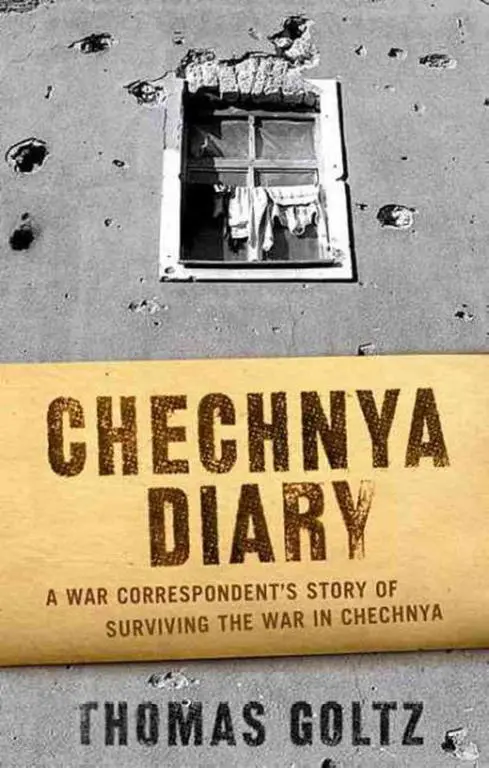
- Название:Chechnya Diary
- Автор:
- Издательство:Thomas Dunne Books
- Жанр:
- Год:2011
- Город:New York
- ISBN:0-312-26874-2
- Рейтинг книги:3 / 5. Голосов: 1
-
Избранное:Добавить в избранное
- Отзывы:
-
Ваша оценка:
Chechnya Diary: краткое содержание, описание и аннотация
Предлагаем к чтению аннотацию, описание, краткое содержание или предисловие (зависит от того, что написал сам автор книги «Chechnya Diary»). Если вы не нашли необходимую информацию о книге — напишите в комментариях, мы постараемся отыскать её.
is part of a larger exploration of the role (and impact) of the media in conflict areas. And at its heart,
is the story of Hussein, the leader of the local resistance in the small town that bears the brunt of the massacre as it is drawn into war.
This is a deeply personal book, a first person narrative that reads like an adventure but addresses larger theoretical issues ranging from the history of ethnic/nationalities in the USSR and the Russian Federation to journalistic responsibility in crisis zones.
is a crossover work that offers both the historical context and a ground-level view of a complex and brutal war.
Chechnya Diary — читать онлайн бесплатно полную книгу (весь текст) целиком
Ниже представлен текст книги, разбитый по страницам. Система сохранения места последней прочитанной страницы, позволяет с удобством читать онлайн бесплатно книгу «Chechnya Diary», без необходимости каждый раз заново искать на чём Вы остановились. Поставьте закладку, и сможете в любой момент перейти на страницу, на которой закончили чтение.
Интервал:
Закладка:
The rest of the weekend was dull, comparatively speaking. President Dudayev hosted a press conference and answered questions about his putative threat to explode a nuclear device in a Moscow subway if the Kremlin tried to impinge on Chechen independence in any way. The next day was the state funeral of Zviad Gamsakhurdia, with much wailing and gnashing of teeth and solemn vows of revenge by exiled Georgians against the KGB stooge Eduard Shevardnadze, the CIA flunky Boris Yeltsin, and the rest of the despicable, uncaring world, generally speaking for the Zviadists, life itself was a conspiracy.
Our host, Djohar Dudayev, had the final eulogy, extolling his friend and fellow president Zviad Gamsakhurdia as a “great son” of the Caucasus, whose example in life and exemplary death would stand as a model for all those seeking freedom from imperialism and the Russian yoke. Clumps of dirt were thrown on the coffin and my extraordinary introduction to the “rogue republic” in the North Caucasus was at an end.
“Djohar,” chuckled Stanley. “The world is going to be a lot less colorful place without the Chechens. I give it six months before the tanks roll.”
Stanley was off by three months.
In August 1994 there was a shootout between government security personnel and members of the well-armed Chechen “opposition.”
In September Dudayev’s forces retaliated and took out henchmen loyal to the “opposition” leader, Umar Avtorkhanov.
In October, a spate of trainjackings and other banditry attributed to the Chechens in the mainstream Russian media had the country up in arms.
Then, in November the “opposition” made a move on Grozny itself. Remarkably, the thugs were in possession of aircraft, which came roaring over the city, dropping bombs.
“‘Opposition?!’” cried Dudayev at a press conference on the eleventh floor of the presidential palace, as MIG-29 fighter-bombers screamed through the sky and strafed the city. “You want evidence of Russian involvement? Look out the window!”
The few journalists there, including my friend Lawrence Sheets, then of Reuters, tried their best to take notes while hiding under the furniture. Still, the Russians attempted to deny involvement—even when Dudayev’s men captured dozens of young men in Russian uniforms in the aftermath of a tank blitz gone bad.
Finally, on December 31st the Russian Minister of Defense, Pavel Grachev, came clean.
“An action has begun in Chechnya to restore constitutional order,” he blithely announced. “It should be completed within a matter of hours.”
War, the expected one, had finally broken out in my patch. But I was thousands of miles away, back in the United States, unable to get an assignment to join the fray.
It was doubly maddening because I was obliged to watch the battle for Grozny unfold in thirty-second news bites on American television, crunched in between diet pill and Dodge commercials, a flashed reference to conflict in a strange, distant, and ultimately unfathomable place. The only thing I could do was wear my papakh, acquired in the Grozny bazaar the year before, and hope that it attracted sufficient interest for rank strangers to stop and ask where the hat was from, and thus allow me the opportunity to rant and proselytize.
Then I got the phone call. A low-budget offer from a small television agency in Philadelphia known as Video News International, that wanted to contract me out to ABC’s Nightline to make a documentary on “the Chechen spirit.” It would be a solo trip behind the lines that required an illegal entry into Russia at war.
I was back in the saddle again.
3
MASTERPIECE OF CONFUSION
She emerged from the evening-fog-mottled ditch by the side of the road, a lone woman dressed in a nightgown, waving at us while walking out into the middle of the highway.
“Slow down,” I said from the back seat, tapping Isa on the shoulder. “That woman—”
“Don’t worry about her,” said Isa. “She’s without intelligence.”
“I beg your pardon?” I started to say—and just then the woman in the nightgown lurched toward our car, an insane grin stretched across her face from ear to ear.
“AaaiiIIIEE!” she screeched.
The driver swung the car to the left and into the far ditch, narrowly avoiding a collision with a stray cow before lurching back up to the right. We regained the road a moment later and turned on the headlights. They illuminated a nightmare landscape; a road that was lined by men and women, old and young, all dressed in rags, and shouting, cheering, and jeering. Behind them I could make out the shape of a long, official-looking two-story building. The front doors were open, as were the outside gates.
“Good God!” gasped Isa. “Someone has opened the cages at the insane asylum!”
There were lunatics literally all over the road.
“HeyyyyyooooUUU!” cackled another patient, lunging at our vehicle with one hand extended while fondling himself with the other. He was dressed in a greatcoat, but naked underneath. Other members of the audience seemed to be throwing things; possibly they were just waving.
“Drive! Drive!” barked Isa at our driver, cranking his head around to look out the back window as we roared away. I did the same—just in time to watch the next car, also running without lights behind us, narrowly avoid running over the wailing woman in the nightgown to the cheers (or jeers) of her peers gathered on the Shali-Grozny road.
That was only the most surreal of a series of encounters Isa and I had that first day in Chechnya at war in mid-February 1995. After crossing the Akchay River near Khazavyurt, that same morning we proceeded on foot across the mud and muck of early spring farmlands. Our destination was an oil derrick set on a small hill that defined the horizon for miles around. The derrick was idle, but a small force of Chechen volunteers had occupied several outlying buildings. Their self-assumed task was to defend the oil installation when the Russians attacked, as all were sure they would.
“I fight with the kinjal, ” said the group leader, a man named Vakha, referring to the traditional Chechen close-combat weapon, a stubby, double-edged swordlike bayonet. “The reason for this is that I prefer slitting Russians throats to wasting ammunition.”
I tried to act like an old hand at the relative aesthetics of killing in the traditional manner, but was quickly brought up short.
“You laugh,” said Vakha. “But this is not a laughing matter. The real reason we kill with the knife is both for revenge and to send the Russians a message.”
“I don’t understand,” I confessed.
“When we take prisoners, we take care of them in private homes and contact their mothers to come and take them away,” he said. “You have seen this on television, so you know it is not a lie. What you have not seen is the state of our fighters who fall into Russian hands. They are beaten, bruised, and buggered. Such humiliations will stop, or we will make sure that no Russian prisoners are ever taken.”
One of Vakha’s men drew his kinjal and pried open a can of Soviet Army spam, sliced it into hash and threw the mess on a stove until it was cooked, or at least hot.
“Eat,” said Vakha. He and his men would not partake, because of the Ramadan fast.
We left the guerrillas in midafternoon, and trudged back over the muddy fields to the main road. We hailed a car and soon began weaving our way westward over a series of highways, cutbacks, dirt paths, village lanes and tractor-gauged flats, toward the small city of Shali. Life seemed decidedly normal and the war far away. Kids played soccer and some baseball-like game in nearby fields, while in the towns and villages through which we passed commerce continued to thrive in lively roadside markets. Grozny, the central market for all of Chechnya, had effectively been destroyed—but the merchants had survived with their merchandise and had simply transferred their businesses elsewhere.
Читать дальшеИнтервал:
Закладка:
Похожие книги на «Chechnya Diary»
Представляем Вашему вниманию похожие книги на «Chechnya Diary» списком для выбора. Мы отобрали схожую по названию и смыслу литературу в надежде предоставить читателям больше вариантов отыскать новые, интересные, ещё непрочитанные произведения.




Обсуждение, отзывы о книге «Chechnya Diary» и просто собственные мнения читателей. Оставьте ваши комментарии, напишите, что Вы думаете о произведении, его смысле или главных героях. Укажите что конкретно понравилось, а что нет, и почему Вы так считаете.