Thomas Goltz - Chechnya Diary
Здесь есть возможность читать онлайн «Thomas Goltz - Chechnya Diary» весь текст электронной книги совершенно бесплатно (целиком полную версию без сокращений). В некоторых случаях можно слушать аудио, скачать через торрент в формате fb2 и присутствует краткое содержание. Город: New York, Год выпуска: 2011, ISBN: 2011, Издательство: Thomas Dunne Books, Жанр: Биографии и Мемуары, military_history, Публицистика, на английском языке. Описание произведения, (предисловие) а так же отзывы посетителей доступны на портале библиотеки ЛибКат.
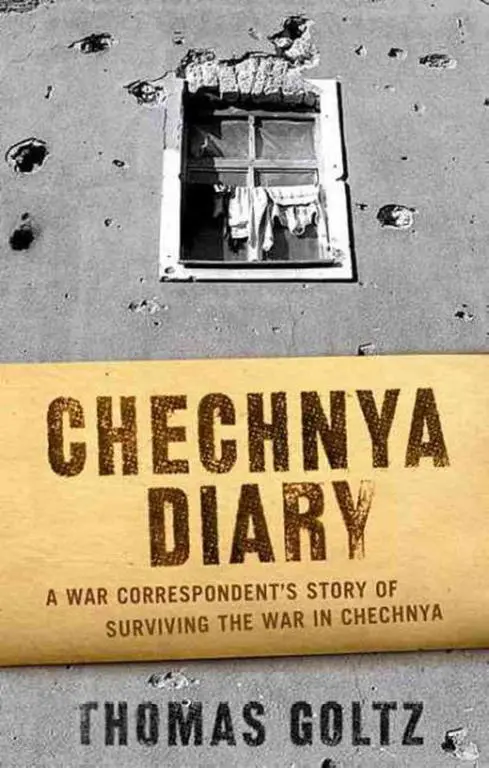
- Название:Chechnya Diary
- Автор:
- Издательство:Thomas Dunne Books
- Жанр:
- Год:2011
- Город:New York
- ISBN:0-312-26874-2
- Рейтинг книги:3 / 5. Голосов: 1
-
Избранное:Добавить в избранное
- Отзывы:
-
Ваша оценка:
Chechnya Diary: краткое содержание, описание и аннотация
Предлагаем к чтению аннотацию, описание, краткое содержание или предисловие (зависит от того, что написал сам автор книги «Chechnya Diary»). Если вы не нашли необходимую информацию о книге — напишите в комментариях, мы постараемся отыскать её.
is part of a larger exploration of the role (and impact) of the media in conflict areas. And at its heart,
is the story of Hussein, the leader of the local resistance in the small town that bears the brunt of the massacre as it is drawn into war.
This is a deeply personal book, a first person narrative that reads like an adventure but addresses larger theoretical issues ranging from the history of ethnic/nationalities in the USSR and the Russian Federation to journalistic responsibility in crisis zones.
is a crossover work that offers both the historical context and a ground-level view of a complex and brutal war.
Chechnya Diary — читать онлайн бесплатно полную книгу (весь текст) целиком
Ниже представлен текст книги, разбитый по страницам. Система сохранения места последней прочитанной страницы, позволяет с удобством читать онлайн бесплатно книгу «Chechnya Diary», без необходимости каждый раз заново искать на чём Вы остановились. Поставьте закладку, и сможете в любой момент перейти на страницу, на которой закончили чтение.
Интервал:
Закладка:
We sat and smoked in silence, watching as car after car pulled up and dislodged a knot of soldiers’ mothers, Buddhist monks, religious pacifists, or Chechen ladies who had attached themselves to the peace action. What quickly became apparent was that the Spesnatz were not turning anyone back, but herding everyone into the general area around Sonia’s car and basically creating a detention camp in the middle of the road.
Reaction varied by group. The Chechen women howled and wailed, their cries falling on deaf ears; the Slavic converts to Buddhism staged a sit-in directly in front of the barricades, chanting softly as their leader, a Japanese activist whose name was so impossible to recall he was simply referred to as “monk,” tapped on his prayer drum. The religious pacifists—Eastern Orthodox, Jewish, and Quaker—tried in vain to reason with the soldiers, attempting to contact the commanding officer for an explanation about why we were detained.
The one uncontrollable element among the detainees, of course, was the mothers. No sooner were they out of their transport and under “field arrest” than they fanned out to make contact with their captors. They pestered the arresting soldiers for information about this boy from Moscow serving in that unit, or that boy from the Komi region whose unit had been dispatched to this place.
“Any of you know Dima Andropovich Alexanderov?” asked one particularly insistent woman from some town in the Maritime Province of the Russian Far East.
A guard attempted to hold her back from breaking through the security perimeter around a knot of BTRs, but in vain. The woman just had to ask that gunner sitting atop the turret who, indeed it turned out, had once gotten drunk with Dima Andropovich a few weeks ago in Grozny.
With one soldier on board, or glad to see some sort of surrogate mother, the wall broke down, and soon the women were swarming all over the road, notebooks out to record sightings of this conscript or that, to take down greetings, or pass along messages from the folks back home.
“They don’t feed you very well around here, do they?” opined one matron, sticking her finger into some draftee’s ribs. You could almost hear him groan, “Aw, Mom! Not in front of the guys!”
“Look at this!” scolded another mother, brushing her hand through the filthy locks of another draftee-captor. “Lice!”
Then a group of about two dozen mothers marched squarely up to the concrete blockade and demanded to see the commander who had imposed this shocking and scandalous delay on the Mothers’ March. Writhing like a schoolboy, he heard the ladies out: “Shame on you! Have you no mother yourself? No son?”
“I cannot guarantee your safety!” he pleaded.
“What do you mean, ‘safety’?” roared an attractive, middle-aged peroxide blonde. “We already have guarantees from the Chechens! If anything should happen to us, it would be at the hands of our own sons—the officers and soldiers of the Russian army!”
It would have been almost funny had it not been growing dark and cold.
Finally, the officer could take no more of the tirade, and called in a wall of men. And they were not conscripts with lice in their hair. They were stern-faced professional soldiers of the OMON forces, the elite (and often motherless) mercenaries known as kontraktni, or “contractors.” The mothers were shoved back into the monks, and all direct contact between marchers and soldiers banned. Maxim, Sonia’s cameraman, tried to clip off a few sequences on the sly—and found himself being manhandled and slapped around by the soldiers who had seemed so friendly moments before.
“Scheisser,” said Sonia. “Shit.”
Now she was as afraid of losing her own tapes as I was afraid of losing mine.
And then it got nastier, especially for the monks.
A soldier walked up to one of the slavic Buddhists and smashed him in the face. Another monk was dragged to his feet and beaten. “Pacifist traitor, conscientious objector faggot scum!” were some of the terms we could hear in the growing darkness. [11] Later I learned that I, too, had allegedly been beaten, tortured, and likely killed in the military detention center at Mozdok. Concern for me was such that Shirvani had breached the lines and traveled to Ingushetia in search of word of my whereabouts and health. Apparently, the shaven pate of one of the monks had been mistaken for my own hairless dome. By further distortion, it is likely that this is how I came to be mistaken for the doomed Fred Cuny, or vice-versa. Cf. Scott Anderson, The Man Who Tried To Save The World: The Dangerous Life and Mysterious Disappearance of Fred Cuny (New York: Doubleday, 1999), p. 320.
A flare shot up, illuminating the surrounding fields in an eerie glow—and allowing us to glimpse another beating in progress. Mothers, tired, hungry, exhausted, and now frightened, began to sob from their places on the highway. A pretty Ukrainian girl associated with the religious peaceniks was dragged away, maybe to be raped.
“I don’t like this at all,” said Sonia.
Neither did I.
Adding to the misery of the moment was the flash, grumble-growl of the seven howitzers, opening up at one-minute intervals in two directions at once: Achkoi Martan and Samashki. We became captive, long-distance witnesses to the slow, methodic destruction of both communities. Sonia Mikich remembered it this way:
“We watch fire destroy the houses where we were met so graciously but hours before. Signal flares rise red and white, expose individual people huddled on the ground. Plumes of smoke rise into the sky. For six hours, until deep into the middle of the night, the soldiers hold us in the bitter ice cold while Samashki is mercilessly bombed and strafed. A brutal tactic. They are terrorizing the civilians because they know so precisely that there are so few fighters inside. The goal is to root out all resistance. A couple of dead and wounded every day, a couple of destroyed houses—exactly enough war as is psychologically required. They are the victors, with overwhelming force. Forty thousand men in an occupied country. Forty thousand victors.
“But tonight, fear comes to the victors. We have overheard how the Russians have ordered up buses and trucks over the radio because they now truly fear that the Chechens will attempt to free the soldiers’ mothers. No one is allowed to leave the encircled camp. We are their captives. Two huge bastards beat my cameraman Maxim to the ground and forbid him to film anything more. They seize the notebooks of the other journalists present. Happily, it is so dark that no one gets very interested in the suspicious Thomas Goltz. Maxim tapes up all the red lights on his camera and continues to record what he can, motivated by fury. Myself I am so livid with rage that I have to creep over to a tank in the darkness and vomit next to its treads. Around midnight it is over. The mothers will not reach Grozny. We are shuttled away in a convoy through minefields.” [12] Cf. Mikich, op. cit. p. 132. Translation from the German is mine.
I don’t have a lot to add, save a few tiny corrections and a couple of personal notes. We were not watching Samashki houses go up in flames, but those in Achkoi Martan. Samashki was out of sight five kilometers back behind the forest. And as for the business of the Russians being afraid of a Chechen operation to free us, my understanding was quite different and even more menacing (or perhaps just more paranoid). The members of the march—the monks, mothers, Mikich and me—were to be killed, with the deed blamed on Chechen fighters like Hussein and his men. The worst that occurred, however, was the continued beating of the Russian Buddhist monks before we were all trundled off in convoy out of Chechnya.
Читать дальшеИнтервал:
Закладка:
Похожие книги на «Chechnya Diary»
Представляем Вашему вниманию похожие книги на «Chechnya Diary» списком для выбора. Мы отобрали схожую по названию и смыслу литературу в надежде предоставить читателям больше вариантов отыскать новые, интересные, ещё непрочитанные произведения.










Обсуждение, отзывы о книге «Chechnya Diary» и просто собственные мнения читателей. Оставьте ваши комментарии, напишите, что Вы думаете о произведении, его смысле или главных героях. Укажите что конкретно понравилось, а что нет, и почему Вы так считаете.