Gary Rivlin - Broke, USA
Здесь есть возможность читать онлайн «Gary Rivlin - Broke, USA» весь текст электронной книги совершенно бесплатно (целиком полную версию без сокращений). В некоторых случаях можно слушать аудио, скачать через торрент в формате fb2 и присутствует краткое содержание. Город: New York, Год выпуска: 2010, ISBN: 2010, Издательство: HarperCollins Publishers Inc., Жанр: Старинная литература, на английском языке. Описание произведения, (предисловие) а так же отзывы посетителей доступны на портале библиотеки ЛибКат.
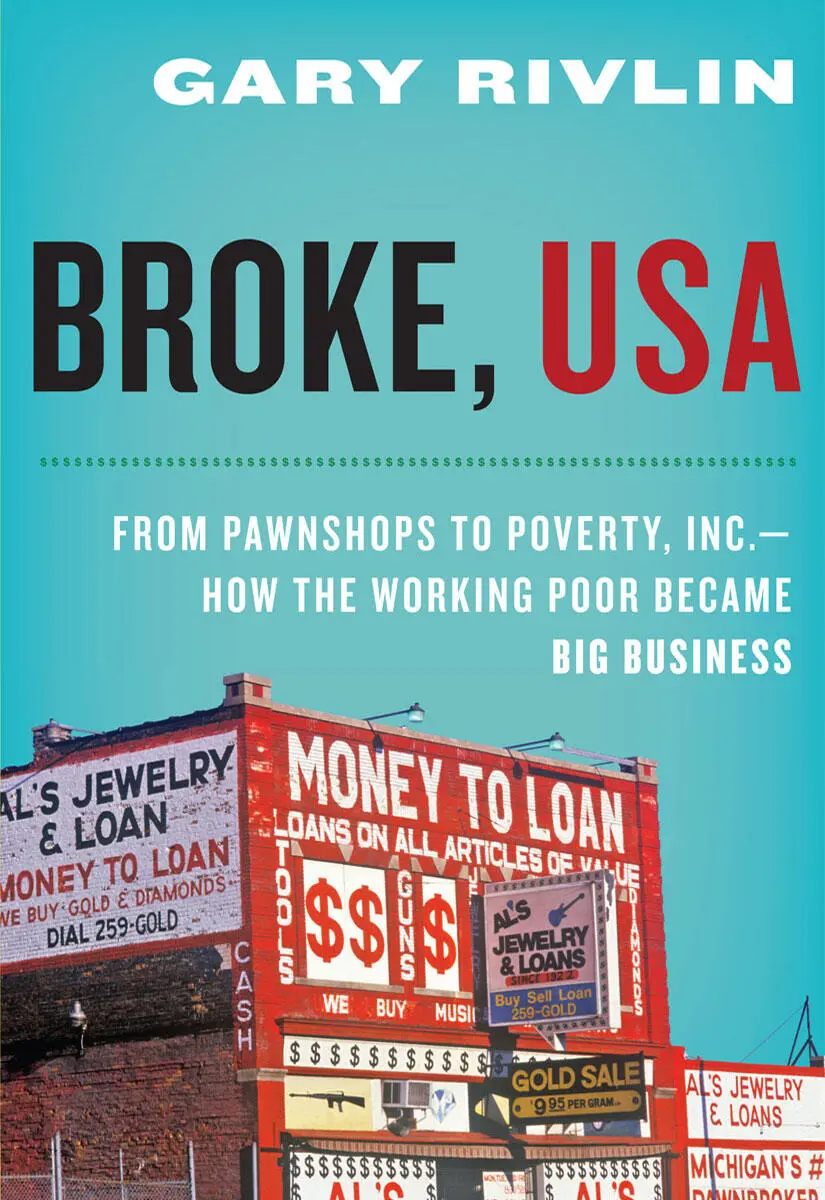
- Название:Broke, USA
- Автор:
- Издательство:HarperCollins Publishers Inc.
- Жанр:
- Год:2010
- Город:New York
- ISBN:978-0-06-199794-5
- Рейтинг книги:3 / 5. Голосов: 1
-
Избранное:Добавить в избранное
- Отзывы:
-
Ваша оценка:
Broke, USA: краткое содержание, описание и аннотация
Предлагаем к чтению аннотацию, описание, краткое содержание или предисловие (зависит от того, что написал сам автор книги «Broke, USA»). Если вы не нашли необходимую информацию о книге — напишите в комментариях, мы постараемся отыскать её.
Broke, USA — читать онлайн бесплатно полную книгу (весь текст) целиком
Ниже представлен текст книги, разбитый по страницам. Система сохранения места последней прочитанной страницы, позволяет с удобством читать онлайн бесплатно книгу «Broke, USA», без необходимости каждый раз заново искать на чём Вы остановились. Поставьте закладку, и сможете в любой момент перейти на страницу, на которой закончили чтение.
Интервал:
Закладка:
Elizabeth Warren, a Harvard Law School professor who has written extensively about consumer debt, would learn firsthand about the financial value of the customer who is barely making ends meet. When she was talking with a group of senior executives from Citigroup about how the bank where they worked might lower its default rate by more accurately determining which customers could least afford to carry credit card debt, a man at the back of the room interrupted her. Cutting off our most marginal customers, he told her, is out of the question because it would mean giving up a large portion of the bank’s profits. Warren quotes a MasterCard executive who described for her the perfect credit card customer. It’s someone who has recently emerged from bankruptcy protection because it will be years before they are permitted under the law to file for bankruptcy again yet they also have what he described as a “taste for credit.” (At the end of 2008, Warren would be named chairwoman of the five-person oversight committee Congress created to oversee spending of the $700 billion TARP bailout money.)
The tax preparation business has followed a similar arc. For years those running H&R Block, which was founded in 1955 and went public in 1962, were happy to stick to the core business of preparing tax returns for the middle class. As long as there was still a long list of cities and towns to conquer, they could simply open more storefronts each year to reliably post the double-digit growth revenues that Wall Street expected. But by 1978, confronting a map of the country that was more or less filled in, Block tried moving into the temp agency business (their logic being that a corporation that earned virtually all of its revenues during a four-month period was already in the temporary employee business) and then in 1980 purchased CompuServe, at the time a computer time-share company. Block even tried getting into the legal services business in a short-lived partnership with Joel Hyatt. But it wasn’t until the second half of the 1980s that the company wowed Wall Street with the refund anticipation loan. Block’s long-stagnant stock price soared by 118 percent over the next four tax seasons.
The subprime mortgage market, however, followed the opposite trajectory. It proved so successful among the working poor that it was reinvented and repurposed for middle-class borrowers. These borrowers, because they had deep scars in their credit records, or because they were self-employed and could not produce the W-2s needed to verify their income, or simply because they wanted more house than their income could justify, were offered mortgages on less favorable terms than conventional borrowers. A problem once isolated on Dayton’s black west side spread to the white east side and first-ring suburbs and quickly climbed up the hills in search of people living in higher tax brackets. By 2007, every county in the Miami Valley experienced a triple-digit increase in foreclosure filings since 1995—except Warren County, an exurb to the south that saw a four-digit increase of more than 1,000 percent in foreclosure filings.
The cast of companies making these loans changed as well. Subprime pioneers like Household Finance didn’t drop out of the game but they weren’t the same powerhouses that reigned during the 1990s. Most of the big consumer finance companies, for instance, no longer sold credit insurance, and if they did, they no longer folded it into the principal of a loan and financed it at shocking rates. And while the middle class might be perfectly happy to use a subprime product to buy the house they coveted, they certainly weren’t visiting some make-believe banker in a box in a strip mall as Tommy Myers had done. The era that Kathleen Keest would call the “third wave” of subprime finance was dawning, and the early years of the new century would see the mortgage broker emerge as a central player in the home loan business, selling to a new crop of companies.
Any list of the most successful third-wave companies would have to include Ameriquest Mortgage, the lender that so aggressively fought Vincent Fort and Roy Barnes in Georgia and the outfit that the Wall Street Journal would single out when looking at the role lobbying money played in the subprime meltdown. Ameriquest’s founder was Roland Arnall, an Eastern European Jew born in 1939 to a family that survived the war by pretending to be Roman Catholic. In Los Angeles after the war, a young Arnall got his start in business selling flowers on the street and eventually had enough money to start buying real estate. He pounced when Congress eased the restrictions on savings and loans in the early 1980s and then jumped on the mortgage lending boom in the mid-1990s. In 1996, Arnall paid a $4 million fine to the U.S. Justice Department to settle a lawsuit accusing his company of exploiting minority borrowers and the elderly. He declared that he was a changed man and promised that Ameriquest would serve as a model for the industry. In 2006, after raising $12 million on behalf of George Bush and other Republican causes, the president named Arnall the American ambassador to the Netherlands. By that point he had a net worth of $3 billion. He owned a $30 million estate in Los Angeles and a $46 million ranch in Aspen but also proved a generous philanthropist, making large donations to local animal shelters and hospitals and serving as co-founder of the Simon Wiesenthal Center in Los Angeles.
Like Household and the other consumer finance companies that preceded them into the subprime field, Ameriquest and rivals like New Century, Option One, and Countrywide Financial did not have depositors like a traditional bank would. Instead these operations arranged what in the trade are called “warehouse lines”—outsized lines of credit for businesses needing access to tens of millions of dollars in ready cash that Ameriquest used to make home loans to individual borrowers. But unlike the consumer finance shops, Ameriquest and its ilk did not hold these loans but immediately sold them at a quick profit to big investment banks like Bear Stearns, Lehman Brothers, or Merrill Lynch. (Sometimes they sold them to middlemen who put together big pools of these loans on behalf of its Wall Street brethren.) Bear, Lehman, Merrill, or other big investment houses on Wall Street would in turn sell pieces of these repackaged mortgages to pension funds, state and municipal entities, and other clients who thought they were buying something safe and reliable, as the A ratings bestowed on them by the big rating agencies implied. No subprime mortgage lender proved more proficient at this game than Arnall. In 2004, Ameriquest made $55 billion in subprime loans, topping the league tables published by Inside B&C Lending . The company would again rank first in 2005 with $54 billion in subprime loans, $15 billion better than Countrywide Financial, its closest competitor, and two or three times the loan volume of Household or CitiFinancial.
“Associates, Household, CitiFinancial, and the Money Store proved to be very good at subprime lending,” Jim McCarthy said. “But Ameriquest became the experts at it.” Where the old-line companies focused primarily on refinancings and home equity lines of credit, Ameriquest included new financings in its offering.
The three hundred retail offices that Ameriquest maintained in thirty-eight states might have been better appointed than those of Household or CitiFinancial, but Ameriquest at its core seemed familiar to McCarthy and his fellow housing advocates. Early in 2005, three years before personalities on the cable news networks started talking about mortgage-backed securities and credit default swaps, the Los Angeles Times ran a story by E. Scott Reckard and Mike Hudson revealing the darker side of this huge lender in its backyard. Ameriquest, the paper reported, seemed little more than a collection of “boiler rooms” scattered across the country, each stuffed with loan agents cold calling borrowers and then burdening them with higher rates than promised and fees they never bothered to disclose in loan agreements. In a suburban Minneapolis office, an agent named Mark Bomchill told of colleagues so eager to cross into six-figure salary territory that they forged documents. They were spurred along, Bomchill said, by a “little Hitler” of a manager who hounded them to sell more loans—in between reminders of how easily they could be replaced. Other former sales people told much the same story. It didn’t matter to Ameriquest’s bottom line whether customers could afford the high-cost loans they were being sold, because they would be off the books long before a borrower defaulted. “Proud sponsor of the American dream” was the Ameriquest motto but Ameriquest paid $325 million in 2005 to settle actions against it taken by forty-nine states and the District of Columbia, suggesting that for many its financings proved to be nightmarish.
Читать дальшеИнтервал:
Закладка:
Похожие книги на «Broke, USA»
Представляем Вашему вниманию похожие книги на «Broke, USA» списком для выбора. Мы отобрали схожую по названию и смыслу литературу в надежде предоставить читателям больше вариантов отыскать новые, интересные, ещё непрочитанные произведения.










Обсуждение, отзывы о книге «Broke, USA» и просто собственные мнения читателей. Оставьте ваши комментарии, напишите, что Вы думаете о произведении, его смысле или главных героях. Укажите что конкретно понравилось, а что нет, и почему Вы так считаете.