Gary Rivlin - Broke, USA
Здесь есть возможность читать онлайн «Gary Rivlin - Broke, USA» весь текст электронной книги совершенно бесплатно (целиком полную версию без сокращений). В некоторых случаях можно слушать аудио, скачать через торрент в формате fb2 и присутствует краткое содержание. Город: New York, Год выпуска: 2010, ISBN: 2010, Издательство: HarperCollins Publishers Inc., Жанр: Старинная литература, на английском языке. Описание произведения, (предисловие) а так же отзывы посетителей доступны на портале библиотеки ЛибКат.
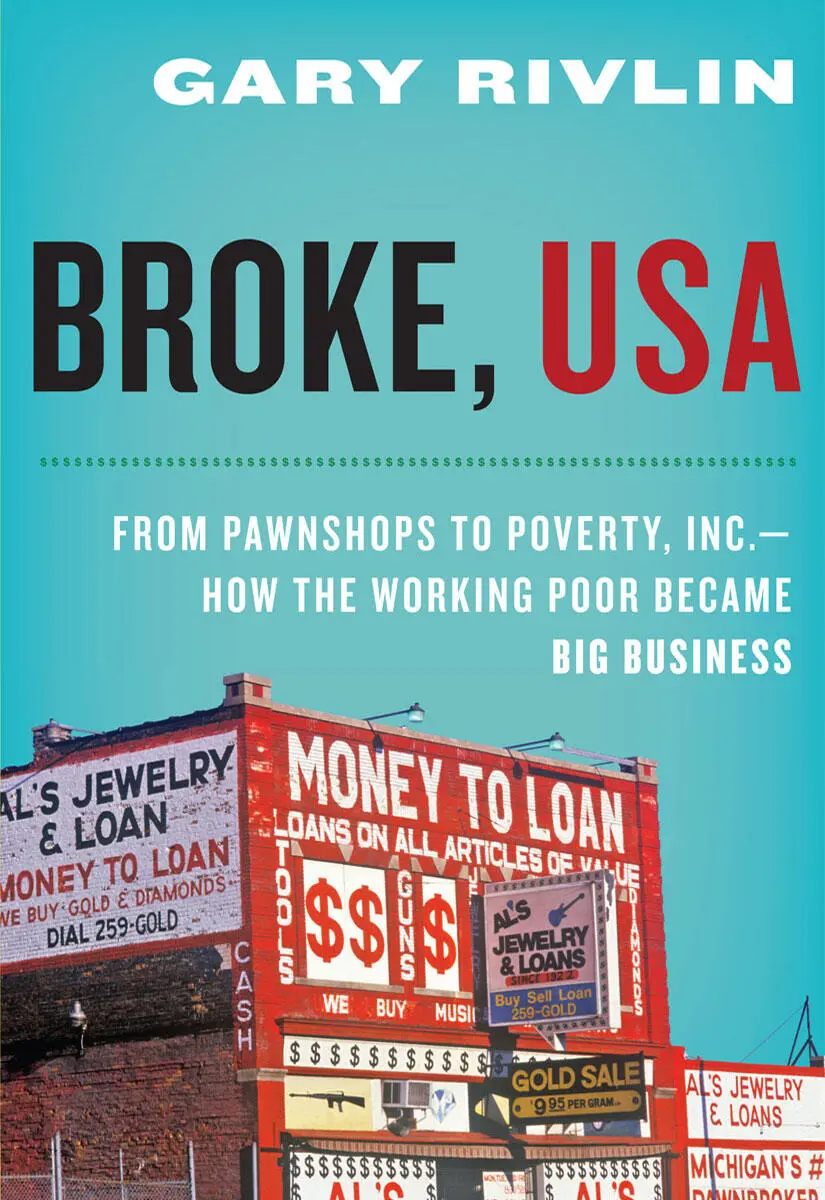
- Название:Broke, USA
- Автор:
- Издательство:HarperCollins Publishers Inc.
- Жанр:
- Год:2010
- Город:New York
- ISBN:978-0-06-199794-5
- Рейтинг книги:3 / 5. Голосов: 1
-
Избранное:Добавить в избранное
- Отзывы:
-
Ваша оценка:
Broke, USA: краткое содержание, описание и аннотация
Предлагаем к чтению аннотацию, описание, краткое содержание или предисловие (зависит от того, что написал сам автор книги «Broke, USA»). Если вы не нашли необходимую информацию о книге — напишите в комментариях, мы постараемся отыскать её.
Broke, USA — читать онлайн бесплатно полную книгу (весь текст) целиком
Ниже представлен текст книги, разбитый по страницам. Система сохранения места последней прочитанной страницы, позволяет с удобством читать онлайн бесплатно книгу «Broke, USA», без необходимости каждый раз заново искать на чём Вы остановились. Поставьте закладку, и сможете в любой момент перейти на страницу, на которой закончили чтение.
Интервал:
Закладка:
Yet that number grew even more elastic as the campaign wore on. “We’re fighting to keep 10,000 good-paying jobs in the state,” Kim Norris told an Associated Press reporter in the final weeks of the campaign. And from that point on, 10,000 became the new 6,000.
It was eleven days before the election, and Bill Faith was sick—he always catches a cold during these big campaigns, people around him told me—and he slurped and sneezed through this first interview. He fiddled with a pen on his desk and also paper clips and random papers. He rocked back and forth in his chair and then bent forward to peek at his BlackBerry. Sometimes he leaned in, it seemed, just to twirl it around. I wanted to hear about the campaign but he was curious to hear from me what it’s like to chat with Allan Jones.
“They’re evil,” he said of the payday lenders. “They’re Orwellian evil people. They are people without principles. They deserve to be beaten and jailed. They’re thieves.” Later he described them as the “new Mafia.” They might not break kneecaps, he said, but they charge a higher vig.
Faith didn’t have much of a rationale for how the executive director of a group called the Coalition on Homelessness and Housing in Ohio came to devote so much of his time—and his organization’s time—to fighting the short-term cash advance business. “People were telling us some seniors were having a hard time paying their rent because they’re taking out payday loans to help their kids make ends meet,” he said. “People were at risk of losing their housing because of these things.” But then he doesn’t need to explain to anyone but his board of directors. COHHIO, a nonprofit, receives state and federal monies to help the homeless but those funds are earmarked for specific programs. It’s the discretionary money he raises from foundations and wealthy individuals that he uses to pay for COHHIO’s crusades, whether it’s the fight against predatory mortgage lending or a two-year battle to cap the rates that a payday lender can charge. Over the years everyone from the IRS and HUD to various state agencies have audited him but he’s never worried about what they may find. “I have an accounting guy to make sure we carefully segregate all our funds,” he said.
In the end, there was no money for a last-minute advertising blitz. The opposition had spent a lot of time talking about Martin Eakes but the Center for Responsible Lending’s presence in the campaign boiled down to the part-time help of a sole Durham-based CRL staffer. He proved an invaluable source for data and intelligence on the various payday companies but he hardly served as the campaign’s mastermind. “None of the credit unions gave us a nickel,” Faith said. “Zero.” In the final days of the campaign, the Yes on 5 campaign had only enough money for a single statewide mailing.
But none of that mattered. NEARLY 2 MILLION OHIOANS STAND UP FOR PAYDAY, read the headline over an Advance America press release posted the day after the election. Unfortunately for the payday lenders, Faith’s side collected more than 3 million votes for a landslide 64 percent.
The Friday after the election the Dayton Daily News ran a recap story quoting a seventy-year-old Social Security recipient named Evelyn Reese who was disheartened to hear that Issue 5 had lost. “This is a terrible mess for people who live from week to week,” Reese said.
Down in Cincinnati, Jared Davis and Jeff Kursman shook their heads over the News article. “The media finally quotes one of our customers talking about the value of our product,” Kursman said.
“Once it’s too late,” Davis interjected.
“We never stood a chance,” Kursman said.
Sixteen
Dayton after Dark
On a sunny and crisp autumn day, Jim McCarthy and I were on a driving tour of Dayton. Weeks earlier I had phoned McCarthy to talk about the impact of the poverty industry in one typical midwestern city, and McCarthy, an upbeat forty-three-year-old with bright blue eyes and a raucous Nathan Lane laugh, graciously offered to show me around. At that point I was new to Dayton, so he veered a few blocks out of his way to show me the preserved, pristine bicycle shop where the Wright Brothers built the first airplane to successfully take flight. He made sure I saw the broad lawns and handsome red brick buildings of the University of Dayton and, for a food break, he chose a revitalized neighborhood that would have felt familiar to anyone living in a regentrified section of Brooklyn, Chicago, or Oakland. McCarthy, who was born and raised in nearby Cincinnati, does his best to present his adopted hometown in the most favorable light, but block after block of boarded-up homes and a seemingly endless chain of strip malls dominated by the companies I had been writing about left my head whirling.
I had been forewarned. That morning I had pored over local maps with a woman in McCarthy’s office named Anita Schmaltz, plotting possible routes. This was in October 2008 and Ohioans had yet to vote on Issue 5, by which the future of payday lending would be decided. I had told Schmaltz I was looking for neighborhoods thick with payday lenders, check cashers, instant tax companies, and consumer finance shops. She shrugged. If that were my criteria, she said, I might as well spin a dial because it made no difference in what direction we headed.
Schmaltz’s finger traced the snakelike path of the Miami River, which bisects Dayton. Heading west meant passing through the city’s black neighborhoods and, just over the city line, entering Trotwood, whose population in recent years had shifted from nearly all white to majority black. The poverty industry, she said, was particularly well represented in this suburb named, appropriately enough, after a character from a Dickens novel. A single street in Trotwood was home to no less than six payday shops, along with a Rent-A-Center and a Jackson Hewitt. The prospect of including Trotwood on our tour caused Schmaltz to sigh. That’s where she and her husband owned a home.
Heading south would bring us to a set of first-ring suburbs that had fallen on hard times, starting with Kettering. Not long ago, Kettering was a nice middle-class community that many within Dayton aspired to. But that was before the metropolitan area experienced seven straight years of job losses, starting in 2001 and culminating with the June 2008 decision by General Motors to shut down the giant truck plant it operated in Moraine, directly to Kettering’s west. “There’s lots of payday in Kettering,” Schmaltz said—and also in Moraine and West Carrollton and several more first-ring suburbs she named. But it doesn’t stop there even as one proceeds farther south and begins the climb out of the Miami Valley. Allan Jones may have been the first payday lender to open a store in a newer, more prosperous-looking suburb called Miamisburg but he had hardly been the last. Eight competitors opened outlets in Miamisburg, along with Rent-A-Center and Aaron’s. Jackson Hewitt and Liberty Tax each had two stores in town.
We ended up sticking mainly to the eastern half of the city and a sampling of predominantly white suburban towns. In recent years, the Center for Responsible Lending has released a pair of studies claiming that there is a racial bias to the placement of payday stores. These reports enraged the likes of Billy Webster and Allan Jones and I can’t say I blame them. They are hardly the most progressive group you’ll ever meet. After the end of a long day with Allan Jones, I commented that Cleveland seemed a very white town. “That’s why I can leave my keys in the car with the door unlocked,” he answered. I started to muster a response but he interrupted me. “I’m just telling you the way it is,” he said. “We have just enough so that our football and basketball teams are good.” But the payday industry as a whole seems no more racist in its approach to business than a great white shark deciding between different shades of fish. A few years back, Policy Matters Ohio studied the geography of payday lending in Ohio. They thought they were going to show that lenders target black communities, but in fact the group found almost no correlation between race and store placement, researcher David Rothstein said. “The big surprise was in how payday had really taken off out in the suburbs and rural areas,” he said.
Читать дальшеИнтервал:
Закладка:
Похожие книги на «Broke, USA»
Представляем Вашему вниманию похожие книги на «Broke, USA» списком для выбора. Мы отобрали схожую по названию и смыслу литературу в надежде предоставить читателям больше вариантов отыскать новые, интересные, ещё непрочитанные произведения.








Обсуждение, отзывы о книге «Broke, USA» и просто собственные мнения читателей. Оставьте ваши комментарии, напишите, что Вы думаете о произведении, его смысле или главных героях. Укажите что конкретно понравилось, а что нет, и почему Вы так считаете.