Gary Rivlin - Broke, USA
Здесь есть возможность читать онлайн «Gary Rivlin - Broke, USA» весь текст электронной книги совершенно бесплатно (целиком полную версию без сокращений). В некоторых случаях можно слушать аудио, скачать через торрент в формате fb2 и присутствует краткое содержание. Город: New York, Год выпуска: 2010, ISBN: 2010, Издательство: HarperCollins Publishers Inc., Жанр: Старинная литература, на английском языке. Описание произведения, (предисловие) а так же отзывы посетителей доступны на портале библиотеки ЛибКат.
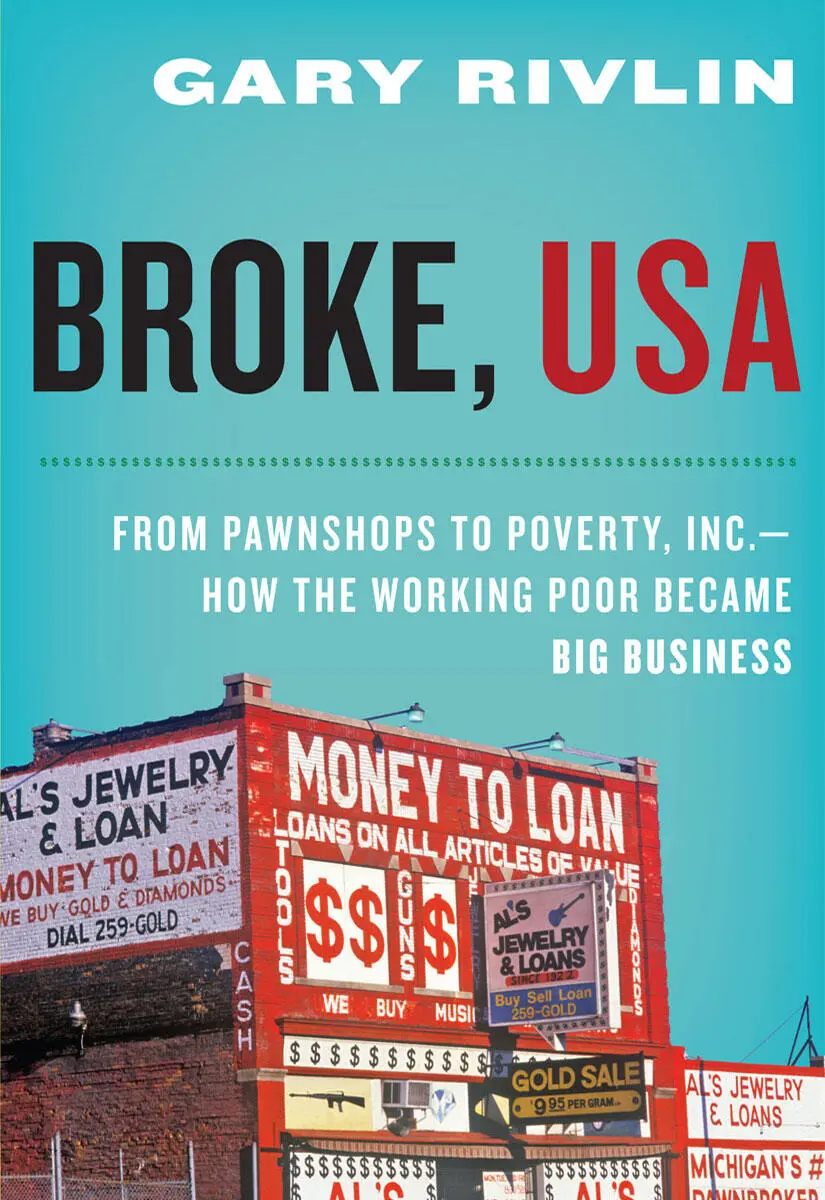
- Название:Broke, USA
- Автор:
- Издательство:HarperCollins Publishers Inc.
- Жанр:
- Год:2010
- Город:New York
- ISBN:978-0-06-199794-5
- Рейтинг книги:3 / 5. Голосов: 1
-
Избранное:Добавить в избранное
- Отзывы:
-
Ваша оценка:
Broke, USA: краткое содержание, описание и аннотация
Предлагаем к чтению аннотацию, описание, краткое содержание или предисловие (зависит от того, что написал сам автор книги «Broke, USA»). Если вы не нашли необходимую информацию о книге — напишите в комментариях, мы постараемся отыскать её.
Broke, USA — читать онлайн бесплатно полную книгу (весь текст) целиком
Ниже представлен текст книги, разбитый по страницам. Система сохранения места последней прочитанной страницы, позволяет с удобством читать онлайн бесплатно книгу «Broke, USA», без необходимости каждый раз заново искать на чём Вы остановились. Поставьте закладку, и сможете в любой момент перейти на страницу, на которой закончили чтение.
Интервал:
Закладка:
The payday lenders tried looking for friends among the state’s newspaper editorial boards, but without much luck. Allan Jones may “still have a lot of hillbilly in him,” Jared Davis told me, but it was Jones whom they sent to the Cleveland Plain Dealer to represent the industry in a sit-down with that paper’s editorial board. Perhaps no one had explained to Jones that by design an editorial endorsement meeting generally means facing a small squad of editors and writers peppering a visitor with pointed questions, because Jones, fed up with what he described as “the most hostile questions I’ve ever heard,” exploded partway through the meeting. “Y’all are the most biased group I’ve ever seen,” he yelled at them, and then added for good measure that he thought the whole lot of them were full of shit. “Those people would not listen to reason, that’s how antibusiness they are,” Jones told me when we met in Cleveland, Tennessee.
In Cincinnati, Jared Davis and Jeff Kursman, Check ’n Go’s spokesman, were no less disappointed in their hometown newspaper. The Cincinnati Enquirer may be the most conservative large daily in the state but the reception they received was hardly warm. “We’ve been a business leader in this city for nearly twenty years, a major employer,” Kursman said.
“Three thousand employees,” Jared Davis interrupted.
“Three thousand employees. And what does the editor of the editorial page tell Mr. Davis? ‘Look, you can show me all the statistics you want, you can show me all the numbers in the world, but we’ve made up our minds.’” The two of them shook their heads ruefully. “The whole experience made me wonder about the future of American journalism,” Davis said.
“Journalism doesn’t exist in the state of Ohio,” Kursman sighed. The one newspaper of any size to endorse the industry’s referendum was in Lima, a town of forty thousand in the state’s northwest corner. “If someone is willing to accept the terms of these loans,” the Lima News wrote archly, “that person ought to be free of government interference to do so.” So inside the No on 5 campaign, they crossed their fingers and hoped that the Yes campaign wouldn’t have enough money in the final weeks to afford even a decent mailer, let alone television money to trumpet their endorsements.
Ted Saunders is no one’s idea of a charismatic speaker. Saunders will tell you that much himself. “I’m a numbers guy,” he said when we met in CheckSmart’s offices. He’s someone who feels more at home poring over a spreadsheet than sitting opposite a foe in a political debate. “I didn’t even run for student council,” he said. “I was a total neophyte.”
But the question was, if not him, who?
The payday ranks were depleted, to say the least. Angry that they had been so soundly defeated in the state legislature, Schlein’s organization fired its longtime lobbyist. The head of the Ohio Association of Financial Service Centers, whom Jared Davis claimed had done more to bring payday to Ohio than anyone else, also dropped out of sight, presumably another casualty of their loss. Jared Davis proved willing to do as many radio shows as they threw at him, but no TV. “I don’t like to do TV because of my Tourette’s,” he confessed. “My wife says get over it, but I don’t like the way it looks so I don’t do it.” And the rest? Like most other business people in the second half of 2008, they were preoccupied navigating the worst economic crisis since the Great Depression. Ohio was important but it was only one of dozens of states where the big chains had a presence. CheckSmart, in contrast, had its headquarters just outside Columbus and half of its stores were in the state.
So it fell to this mild-mannered technocrat who had only recently taken over as chief executive to square off against Bill Faith and his minions.
“Maybe I’m just a glutton for punishment,” Saunders offered with a rueful smile. “I was willing.”
Saunders is a slim man with thinning brown hair and the drab look of an accountant who has already spent twenty years on the job. Surprisingly, he was only thirty-five years of age. He in fact had worked as an accountant before taking a job at Stephens, Inc., the investment bank in Little Rock that had carved out a specialty in subprime businesses. While at Stephens, Saunders started doing work for Diamond Castle, a New York–based private equity firm that had raised $1.9 billion and announced in 2004 its intention to pursue “companies which serve the very large ‘unbanked’ or ‘underbanked’ population of the United States, estimated at approximately 70 million people.” After Diamond Castle paid $268 million for CheckSmart in 2006, Saunders jumped when the new management offered him the job of chief financial officer. “This was going to be our vehicle,” Saunders told me. With the purchase of CheckSmart, Diamond Castle wasn’t just buying 175 payday and check-cashing stores; it was securing a platform on which to build.
“Fundamentally you have an entire sector of the population, whether people like it or not, living outside the American banking system,” Saunders said. “And so long as those people are not welcome in the conventional banking system, and they’re not served by the conventional banking system, there’s going to be alternatives. That’s just what America is.” Using CheckSmart, Diamond Castle would snap up smaller chains as fast as they could, wring out redundancies, and eventually grow into an efficiently run giant of the poverty business. That at least was the theory.
The first challenge Diamond Castle faced in its plan to dominate this corner of the financial universe was that people were generally reluctant to sell because they too saw that there was still big money in the poverty business. “If you went through all our files, you’d see we tried quite diligently to expand this business,” Saunders said. “But it was like the Wild West out there among the payday lenders and check cashers and pawnbrokers. These are people who have no fear and never had any fear.” Saunders and his cohorts tried explaining that the industry was approaching a saturation point and, as a consequence, the better-funded, better-managed companies would crush the smaller players. But pretty much everyone they spoke with saw themselves as playing the role of the alpha company in that scenario. “Getting any of them to the point where they thought it made good economic sense to sell the business was next to impossible,” Saunders said. By the time the global credit crunch put a sudden stop to their expansion plans, CheckSmart had grown to only around 250 stores, and most of those additional seventy-five stores were built rather than bought.
“It would be a fair statement that in retrospect we didn’t have the greatest timing in the world,” he said.
Saunders barely paid any attention when the state legislature was holding hearings about payday lending. “We were heading into this terrible economy, which meant more people were going to need this service, not less,” he said. “I was thinking [the legislature] couldn’t be so clueless as to cut people off just when the need was greatest.” His promotion to CEO came at around the time the governor was signing the payday rate cap into law. So Saunders would need to navigate his company through the choppy waters of both a recession and a new regulatory environment at the same time he would take time to tape a segment for Fox News or argue for the industry’s survival at small forums around the state.
“The combination of good employees who want to deliver a valued service and a customer who appreciates that service ought to be enough to create a business in America,” he said. “But I don’t know what’s happened to our country.” He brought up the new rule that dictated that no Ohioan could take out more than four payday loans in a year. “What if government in their infinite wisdom said you couldn’t swipe your Visa card more than four or six times in a year? Well, that’s what the legislature did to these other people over here,” he said.
Читать дальшеИнтервал:
Закладка:
Похожие книги на «Broke, USA»
Представляем Вашему вниманию похожие книги на «Broke, USA» списком для выбора. Мы отобрали схожую по названию и смыслу литературу в надежде предоставить читателям больше вариантов отыскать новые, интересные, ещё непрочитанные произведения.









Обсуждение, отзывы о книге «Broke, USA» и просто собственные мнения читателей. Оставьте ваши комментарии, напишите, что Вы думаете о произведении, его смысле или главных героях. Укажите что конкретно понравилось, а что нет, и почему Вы так считаете.