Gary Rivlin - Broke, USA
Здесь есть возможность читать онлайн «Gary Rivlin - Broke, USA» весь текст электронной книги совершенно бесплатно (целиком полную версию без сокращений). В некоторых случаях можно слушать аудио, скачать через торрент в формате fb2 и присутствует краткое содержание. Город: New York, Год выпуска: 2010, ISBN: 2010, Издательство: HarperCollins Publishers Inc., Жанр: Старинная литература, на английском языке. Описание произведения, (предисловие) а так же отзывы посетителей доступны на портале библиотеки ЛибКат.
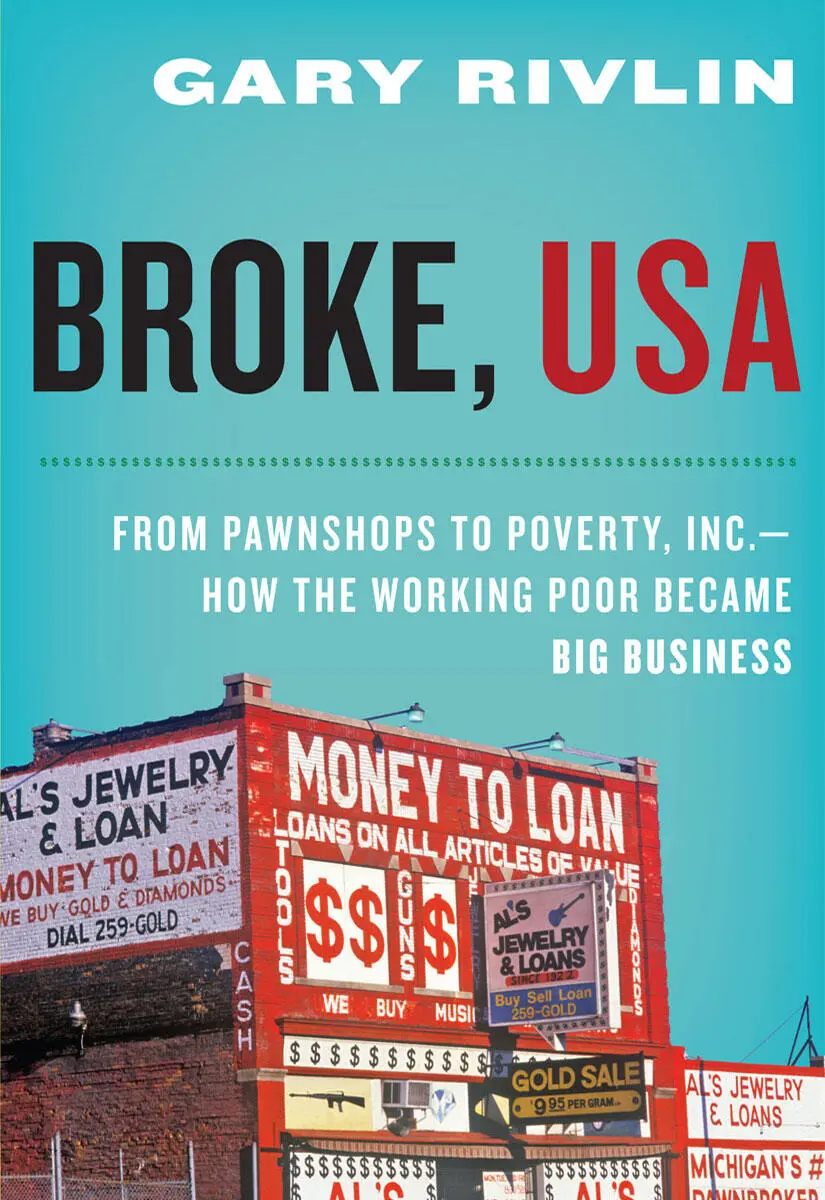
- Название:Broke, USA
- Автор:
- Издательство:HarperCollins Publishers Inc.
- Жанр:
- Год:2010
- Город:New York
- ISBN:978-0-06-199794-5
- Рейтинг книги:3 / 5. Голосов: 1
-
Избранное:Добавить в избранное
- Отзывы:
-
Ваша оценка:
Broke, USA: краткое содержание, описание и аннотация
Предлагаем к чтению аннотацию, описание, краткое содержание или предисловие (зависит от того, что написал сам автор книги «Broke, USA»). Если вы не нашли необходимую информацию о книге — напишите в комментариях, мы постараемся отыскать её.
Broke, USA — читать онлайн бесплатно полную книгу (весь текст) целиком
Ниже представлен текст книги, разбитый по страницам. Система сохранения места последней прочитанной страницы, позволяет с удобством читать онлайн бесплатно книгу «Broke, USA», без необходимости каждый раз заново искать на чём Вы остановились. Поставьте закладку, и сможете в любой момент перейти на страницу, на которой закончили чтение.
Интервал:
Закладка:
Saunders felt he owed it to his investors, his employees, and his customers to take to the stump. “If someone marched in tomorrow and took the company away, I could go do something else,” he said. “I can’t say that about everybody who works for me. I can’t say what would happen to a lot of our customers.” Like Billy Webster, Saunders had spent time working behind the counter before deciding to get into the business. “You spend three or four hours, without any cameras around, really talking to the people, and you become one hundred percent convinced that those people wanted the service and needed the service,” he said. “But when people hear the word ‘payday,’ they immediately shut down. They become instantly closed-minded. They think, ‘That’s toxic, that’s bad, that’s awful.’
“If you’ve never had to use the product, it’s easy to turn your nose up to it. People think, ‘Only a fool. Only an uneducated person.’” And of course the media reinforced those negatives, he said, as did those “supposedly independent consumer organizations.”
Saunders asked me if I knew the name Martin Eakes. I told him I did. “Then you understand what’s really going on here,” he said. I told him I wasn’t sure I did. “You’ve got this group, CRL, which is supposed to be for what it sounds. Consumer protection. But it’s funded by this credit union started by Martin Eakes, who just happens to be the head of the CRL. And it’s this very same credit union that chased payday out of North Carolina in order to increase their fee revenues.”
Saunders was hardly alone in making this argument. I was no more than two minutes into my first conversation with Kim Norris, the woman the payday lenders hired to run the No on 5 campaign, when she brought up the Center for Responsible Lending. “This is an attack on a very young industry that doesn’t have the sophistication against this well-organized lobbying effort promoted by the credit unions and their front organization, the Center for Responsible Lending, which will say anything to get their way,” Norris said. At the Ohioans for Financial Freedom website, sponsored by the No on 5 campaign, there was an entire section dedicated to “credit unions lies,” which concluded: “It’s pretty simple: credit unions see payday lenders as competition, and they have been spending millions on lobbyists to get their way.”
And Bill Faith? To Norris he was “CRL’s proxy in Ohio,” a tool of the “credit unions who are trying to put their competitors out of business.” To Saunders he was a hypocrite who had no right to call himself an advocate for the homeless. “This is a man who spent more money”—$200,000—“on one TV campaign about his pet issue than he’s spent helping the homeless over the last two years,” Saunders said. (According to Faith, COHHIO actually spent a combined $2.7 million in 2007 and 2008 on projects aimed at helping the homeless.) Later in our talk Saunders described Faith as “nothing more than a lobbyist who is very good at his job.”
Payday lending operators might have seen their industry as young and overmatched, but they were certainly not without resources. The No on 5 campaign paid Strategic Public Partners Group, a Columbus-based political consultancy firm, nearly $1 million for its services and it spent tens of thousands more on State Street Consultants, which the Columbus Dispatch would describe as a “high-powered Columbus lobbying firm that…ruled Capitol Square.” They would also pay Fleishman-Hillard, the giant communications consultancy, another $35,000 a month for Kim Norris’s services. Through the end of September, they had already spent $1.6 million on mailings and purchased some $7 million in television ads.
Faith, in contrast, paid Sandy Theis, a former Cleveland Plain Dealer reporter, a flat fee of $7,500 for the campaign, and relied on the pro bono services of his longtime friend and media consultant, Greg Haas. He had the part-time services of the COHHIO staff, just as the payday lenders had their teams, but where the payday lenders spent hundreds of thousands of dollars on polling, Haas had to beg to convince Faith to spend a bit of their limited cash on a focus group.
That single focus group meeting held during the summer would prove critical. For starters they learned that Ohioans had paid extraordinarily close attention to the legislative debate over payday. “We were all basically stunned by how much people knew,” Haas said. But most important, it drove home the polarizing power of the triple-digit APR. Any number of the participants hated this idea that limiting the number of payday loans a person could take out in a year meant maintaining a database that tracked loans by name. “The ‘nanny government’ stuff really bothered people—until you mentioned the 391 percent,” Haas said. “People were suddenly, ‘That’s theft!’” It was after the focus group meeting, Haas said, that the Yes on 5 campaign changed its name to the “Is 391 Percent Too High? Vote YES on 5 Committee” so that the 391 percent would automatically be stamped on anything the campaign produced.
“Bill decided we just have to keep pounding and pounding on that 391 percent,” Haas said.
The payday lenders took more of a scatter shot approach. Sandy Theis saw that as a sign of weakness. “They’re changing topics every few days,” Theis told me a few weeks before election day, “which tells me they’re still searching for a message that has traction.” Alternatively, it also could have indicated that their polling revealed any number of weaknesses in the anti-payday argument. As Greg Haas could have predicted, the payday lenders hammered away at the database issue. As written, the referendum wouldn’t do anything to change what Ted Saunders called the “Big Brother aspect” of the bill: The state would still keep track of the number of loans people took out in a given year even if the “no” side won. But it was also a potent issue, and so the lenders incessantly ran a television commercial reminding viewers of a few of the state’s more infamous data breaches. The industry also played to antigovernment sentiments by slyly making fun of this idea that the law required them to express the terms of a two-week loan as an APR. Imagine, the ad asked, if the authorities required rental car companies to advertise their rates as an annual rate: $10,585 a year for a compact rather than $29 a day. “Maybe they just think we’re all stupid,” the ad’s tag line sneered.
But mainly the payday lenders played to people’s fears. “Our polling shows that seventy percent of people are afraid of losing jobs,” Ted Saunders had told his fellow payday lenders in Las Vegas. “So we’re running a whole lot of ads about jobs.” Set to ominous music, one showed a set of grainy black-and-white photos of what at quick glance looked like a kind of postapocalyptic Ohio. Ohio had lost hundreds of thousands of jobs in recent years, a narrator intones. “Is this the time to shut down an Ohio industry and eliminate another 6,000 jobs?” For a time, the No campaign took to calling Issue 5 the “job killing initiative.”
That 6,000 number was a fabrication. Ohio had roughly 1,500 stores in the fall of 2008. Some had one employee; most of the rest employed two. Even accounting for an extra 150 roving district and regional managers, it didn’t add up to anywhere near 6,000 Ohio jobs. And a restrictive rate cap wouldn’t necessarily mean that every payday employee lost his or her job. By August, the state’s consumer finance department had received nearly 1,100 license applications from existing payday stores looking to offer alternative loan products should Yes on Issue 5 prevail. People would lose jobs, no doubt, but nowhere near 6,000.
Читать дальшеИнтервал:
Закладка:
Похожие книги на «Broke, USA»
Представляем Вашему вниманию похожие книги на «Broke, USA» списком для выбора. Мы отобрали схожую по названию и смыслу литературу в надежде предоставить читателям больше вариантов отыскать новые, интересные, ещё непрочитанные произведения.









Обсуждение, отзывы о книге «Broke, USA» и просто собственные мнения читателей. Оставьте ваши комментарии, напишите, что Вы думаете о произведении, его смысле или главных героях. Укажите что конкретно понравилось, а что нет, и почему Вы так считаете.