Gary Rivlin - Broke, USA
Здесь есть возможность читать онлайн «Gary Rivlin - Broke, USA» весь текст электронной книги совершенно бесплатно (целиком полную версию без сокращений). В некоторых случаях можно слушать аудио, скачать через торрент в формате fb2 и присутствует краткое содержание. Город: New York, Год выпуска: 2010, ISBN: 2010, Издательство: HarperCollins Publishers Inc., Жанр: Старинная литература, на английском языке. Описание произведения, (предисловие) а так же отзывы посетителей доступны на портале библиотеки ЛибКат.
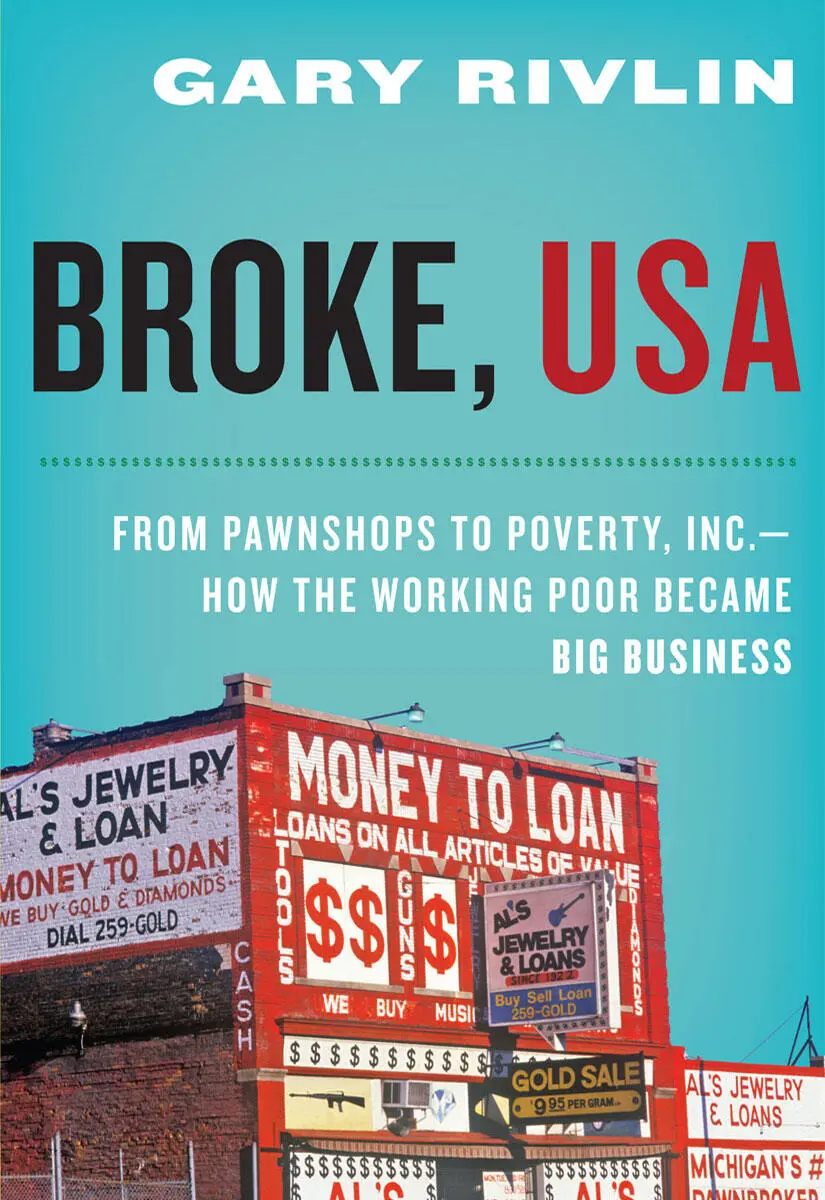
- Название:Broke, USA
- Автор:
- Издательство:HarperCollins Publishers Inc.
- Жанр:
- Год:2010
- Город:New York
- ISBN:978-0-06-199794-5
- Рейтинг книги:3 / 5. Голосов: 1
-
Избранное:Добавить в избранное
- Отзывы:
-
Ваша оценка:
Broke, USA: краткое содержание, описание и аннотация
Предлагаем к чтению аннотацию, описание, краткое содержание или предисловие (зависит от того, что написал сам автор книги «Broke, USA»). Если вы не нашли необходимую информацию о книге — напишите в комментариях, мы постараемся отыскать её.
Broke, USA — читать онлайн бесплатно полную книгу (весь текст) целиком
Ниже представлен текст книги, разбитый по страницам. Система сохранения места последней прочитанной страницы, позволяет с удобством читать онлайн бесплатно книгу «Broke, USA», без необходимости каждый раз заново искать на чём Вы остановились. Поставьте закладку, и сможете в любой момент перейти на страницу, на которой закончили чтение.
Интервал:
Закладка:
Bill Faith doesn’t walk into an office so much as he bursts through the door. He is a gale-force wind blowing through the corridors. Sitting in the office of one of his staff members while waiting for him to arrive, I heard Faith before I saw him. “We’re going to do it!” a gravelly voice boomed as if amplified by a megaphone. “This is David versus Goliath!” he bellowed, talking to no one in particular. With election day a few weeks away, political junkies across the country were weighing the relative strengths of the Obama versus McCain get-out-the-vote efforts but Faith was preoccupied by Issue 5, the Ohio state referendum sponsored by the payday lenders. Everybody in the office had stopped working, taking in the show. “David is going to beat Goliath,” Faith roared happily. “We’re taking these giants down.”
It seemed an odd day for Faith to be feeling optimistic. That morning, the office of Ohio’s secretary of state released the most recent campaign disclosure forms. In the previous few months, the payday lenders had spent $13.8 million, compared to the $260,000 spent by the “Yes on Issue 5” side. (Confusingly, though Issue 5 was paid for by the payday lenders, a yes vote was a vote in favor of imposing a 28 percent rate cap on the industry.) Worse, Faith and his allies had only $4,000 left in the bank with election day a few weeks away. But to Faith this glaring imbalance represented an occasion to score points—to cast a stone when the media would be paying attention to their down-ballot fight. He repeated his David-versus-Goliath line, tinkering with the phrasing, listening to how it sounded. A few hours later, “Yes on Issue 5” put out a press release telling reporters and editors that they could attribute the following quote to Faith: “This is a David versus Goliath battle. Voters need to know that a ‘yes’ vote on 5 lowers outrageous interest rates. It’s the stone that stops the giant industry.”
Before Faith’s happy entrance, I had been talking with Suzanne Gravette Acker, the communications director for COHHIO, Faith’s advocacy group. Gravette Acker, in contrast to her boss, was feeling jumpy about the payday ballot initiative. “They’ve hired really good lawyers,” she said. “They’ve got really good strategists.” She worried over the wording of the referendum (“it’s so vague and confusing you don’t know if you’re supposed to vote yes or no”), and she fretted over the latest series of pro-payday television ads, which mentioned jobs and raised privacy issues but never mentioned the 391 percent APR. “They’ve done a great job of muddying the water,” Gravette Acker said—and meanwhile the Yes side had spent all of $200,000 on a limited cable TV buy.
But Faith was having none of it. “Suzanne just needs a day off,” Faith said, and then jokingly ordered her home. What more did they need to do, he asked, aside from reminding voters that those who were least able to afford it were paying triple-digit interest rates? “These people, they’re vultures picking on the bones of working people,” Faith said of the payday lenders. “And I don’t see voters saying, ‘Yeah, that’s right, let’s let these vultures continue to prey on hardworking people and seniors living on Social Security. Let them charge them 391 percent.’” He gave his head a shake and grunted out a phlegmy laugh. “Ya know?”
The industry enjoyed the element of surprise, of course. Even before the final vote in the Ohio Senate, those on the payday side were quietly reaching out to the big signature-gathering firms and lawyers and a couple of the state’s better-known political operatives. But payday’s advocates only learned that much sooner how much of an uphill climb they faced.
The lenders’ first task was to gather the 250,000 signatures needed to get their referendum on the ballot. Normally that’s a matter of writing a few big checks, but these were hardly normal circumstances, said CheckSmart CEO Ted Saunders: “Basically we had just been kicked out of the state. The Columbus Dispatch and Plain Dealer for months were telling people we’re loan sharks, we’re scumbags, we’re just these awful people.” Was it any wonder, then, that at least some of the low-wage people who were hired to pass their petitions sometimes resorted to fibbing?
Sandy Theis thought she had died and gone to heaven that day when she was shopping with her teenage son in a mall near Columbus and happened upon a man trying to convince passersby to sign a petition that would put the payday referendum on the ballot. Faith had hired Theis to handle the press for the Yes on 5 campaign and also help run the day-to-day operations. After listening to the petition carrier’s pitch, she rushed home to grab a tape recorder. She captured two petition circulators on tape that day, both of whom utilized the same ready-made argument: We’re here to shut down the payday lenders. The petition passers were being paid by the payday lenders, but they were giving the anti-payday argument. “These guys are legal loan sharks and we want to regulate them,” one told Theis.
“But I thought it’s the payday lenders using the ballot so they can keep charging 391 percent.”
“No, ma’am,” the man answered politely.
Ours is now a world in which taping someone is as simple as hitting the record button on a cell phone. That’s what Robert Hagan did when he encountered a pair of circulators in his hometown of Youngstown. They too were claiming that the proposed initiative, if placed on the ballot, would lower the rates the state’s beleaguered working class would pay for a payday loan, not raise them. Hagan, the state rep who had co-sponsored the original payday bill with Bill Batchelder, certainly knew better. So did his son, a student at Oberlin College, who claimed he had come across a trio of circulators spinning the same fabrications. Others told a similar story, including a city councilman from Toledo and a Columbus-area man named Peder Johanson, who was so incensed at the deception that he launched an “I Want My Name Back” campaign on YouTube.
The payday lenders would turn in more than 400,000 signatures, and after the secretary of state rejected 56 percent of those signatures (including undoubtedly “I’mGoingToFuckYou,” which is how former Check ’n Go manager Chris Browning signed a petition being passed near her home), they gathered 200,000 more. In its campaign disclosure forms, the payday lenders reported spending $3.4 million to qualify their referendum for the ballot. Presumably that included the costly television ads the industry felt compelled to run asking people to at least keep an open mind and allow the voters of Ohio to decide on the future of payday in the state.
“That’s how out of hand this all got,” the payday trade association’s Steven Schlein said. “We’re spending money on ads just to get people to sign a petition.”
At first, Schlein had been feeling optimistic about payday’s chances with the voters. He had lived in California, and time and again had watched better-funded referendum campaigns swamp the opposition no matter what the issue. If we have the money, Schlein asked at an early campaign strategy meeting, what was there to worry about? He didn’t like the answer he heard. We can run television ads for months. We can do weekly mailings. We can set up phone banks and do robo-calls. But if the other side has the endorsements of the leading politicians and its top newspapers, they can trump our efforts with one or two good television ads in the final week.
Wooing the state’s political establishment was out. The payday lenders were in a bind because they had already failed so miserably on that front. The industry could only watch helplessly as the Yes on 5 campaign trotted out its big political endorsements, starting with the first press event of the campaign, when two of the state’s top Republicans, Jon Husted, the Speaker of the House, and Bill Harris, the Senate president, joined Ted Strickland, the Democratic governor, to endorse a Yes vote on 5. Later in the campaign, Faith and his allies would again show off their bipartisan muscle by convincing the Democratic and Republican candidates for attorney general to call a temporary truce in their campaign and join former AGs who were gathering to condemn the payday lenders and their practices. The payday lenders would win an endorsement from the Congress of Racial Equality, but though they played that up in press releases and in campaign materials, there was some question about the relevance of this once venerable civil rights organization, whose director, Roy Innis, had joined the Libertarian party in 1998 and endorsed fringe candidate Alan Keyes for president in 2000.
Читать дальшеИнтервал:
Закладка:
Похожие книги на «Broke, USA»
Представляем Вашему вниманию похожие книги на «Broke, USA» списком для выбора. Мы отобрали схожую по названию и смыслу литературу в надежде предоставить читателям больше вариантов отыскать новые, интересные, ещё непрочитанные произведения.





Обсуждение, отзывы о книге «Broke, USA» и просто собственные мнения читателей. Оставьте ваши комментарии, напишите, что Вы думаете о произведении, его смысле или главных героях. Укажите что конкретно понравилось, а что нет, и почему Вы так считаете.