Gary Rivlin - Broke, USA
Здесь есть возможность читать онлайн «Gary Rivlin - Broke, USA» весь текст электронной книги совершенно бесплатно (целиком полную версию без сокращений). В некоторых случаях можно слушать аудио, скачать через торрент в формате fb2 и присутствует краткое содержание. Город: New York, Год выпуска: 2010, ISBN: 2010, Издательство: HarperCollins Publishers Inc., Жанр: Старинная литература, на английском языке. Описание произведения, (предисловие) а так же отзывы посетителей доступны на портале библиотеки ЛибКат.
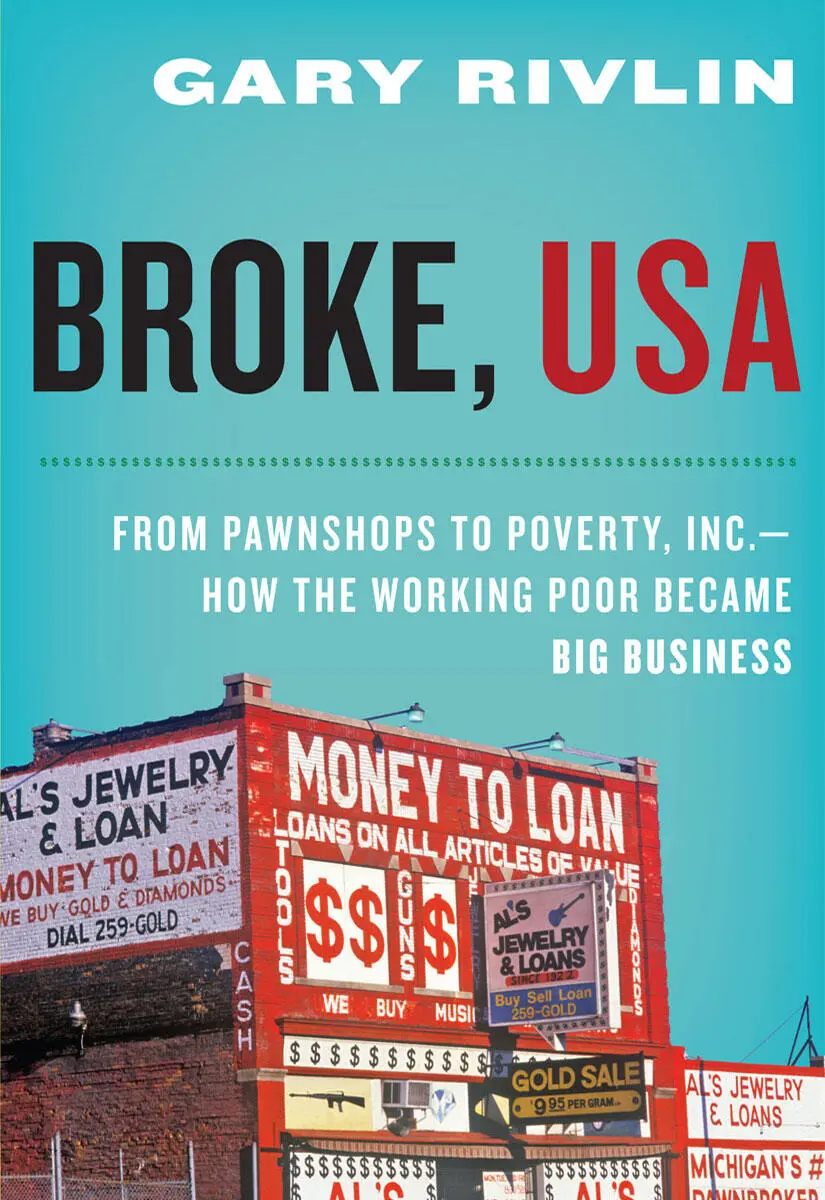
- Название:Broke, USA
- Автор:
- Издательство:HarperCollins Publishers Inc.
- Жанр:
- Год:2010
- Город:New York
- ISBN:978-0-06-199794-5
- Рейтинг книги:3 / 5. Голосов: 1
-
Избранное:Добавить в избранное
- Отзывы:
-
Ваша оценка:
Broke, USA: краткое содержание, описание и аннотация
Предлагаем к чтению аннотацию, описание, краткое содержание или предисловие (зависит от того, что написал сам автор книги «Broke, USA»). Если вы не нашли необходимую информацию о книге — напишите в комментариях, мы постараемся отыскать её.
Broke, USA — читать онлайн бесплатно полную книгу (весь текст) целиком
Ниже представлен текст книги, разбитый по страницам. Система сохранения места последней прочитанной страницы, позволяет с удобством читать онлайн бесплатно книгу «Broke, USA», без необходимости каждый раз заново искать на чём Вы остановились. Поставьте закладку, и сможете в любой момент перейти на страницу, на которой закончили чтение.
Интервал:
Закладка:
Over the years there have been plenty of companies to do just that, starting with Western Union decades ago. As if intent on strutting its central place in the check-cashing industry, Western Union occupied a stretch of real estate in the middle of the convention floor so large that it would have been impossible to miss, even if the company hadn’t bothered to hire an Elvis impersonator. Squadrons of sales people dressed in the company’s familiar yellow and black didn’t talk to visitors to the booth one-on-one so much as they swarmed them in threes or fours. Western Union may be synonymous with the telegram, one explained to me, but the company had exited that business altogether a couple of years ago. Nowadays, the company, a global powerhouse that booked $5.3 billion in revenues in 2008 and $1.2 billion in pretax profits, makes nearly all its money wiring money across borders, primarily through deals with third parties. “We’ll cut franchise deals with anyone who’ll have us,” another of the buzz team told me. “We’ve got deals with the big discount drugstore chains, with grocery stores, with clothing stores.” But Western Union’s best partners have been the country’s check cashers and other Poverty, Inc. businesses, all of which earn a small amount of the $50 or so Western Union charges for every $1,000 a customer wires overseas. And that’s only the start of the benefits, according to a Western Union brochure I took with me. Supposedly, three in every four people walking into a store to wire money spend money on a second product at that store.
Diversification has been the watchword of the forward-looking fringe financier in recent years, and any number of companies were in Las Vegas to help conference goers enhance their bottom line by broadening their offering of products. There were about a half-dozen tax preparers on the exhibit floor pitching the instant tax refund as the perfect way to goose annual revenues (“CHARGE to prepare returns and CHARGE to cash their check”). There were companies pitching prepaid phone cards and also several pushing gold buying as the ideal side business (“add significant income to your financial service center’s bottom line at virtually no cost”) in hard economic times, when more people would be needing access to quick cash. The largest crowds, though, seemed to be drawn to the booths of those peddling the debit cards that help Wichita’s Tim Thomas live the good life.
Debit or prepaid credit cards have become a sensation inside the industry in recent years. A price sheet I picked up when visiting the booth of a company called CashPass, which sells a prepaid MasterCard, spelled out why. Sell more than 500 CashPass debit cards in a month and the enterprising check casher earns a 25 percent cut of all the charges that card generates. That includes an $11.95 setup fee, a $6.95 monthly fee, and more fees when a customer puts more cash on the card. Sell more than 1,000 and your cut is 30 percent. A CashPass representative was happy to translate those numbers into dollar figures for me: 1,000 cards on average means an extra $10,700 per month added to an entrepreneur’s bottom line. The advantage to the customer is that with what in effect serves as a portable bank account, he or she has taken a step forward into the mainstream, albeit a stunningly pricey one.
Listening to speeches that weekend in Las Vegas meant hearing about any number of bogeymen. In his welcoming speech, the group’s chairman, Joseph Coleman, singled out the FDIC and its hand-wringing over those 17 million or so Americans without a bank account, the so-called “unbanked.” From the FDIC’s point of view, the people who could least afford it were paying a surcharge on their wages—the Brookings Institution found that a worker bringing home $22,000 who doesn’t have a bank account spends an average of $800 to $900 a year on check-cashing fees, or more than $1,000 annually if factoring in fees on money orders and bill-paying services—and the agency in recent years had been using its bully pulpit to pressure the banks under its charge to do more to reach moderate-income customers. Coleman couldn’t bring himself to even use the term “unbanked.” Banks charge noxiously high bounced-check fees and they revealed themselves to be so greedy they practically took down the global economy. His preferred term, to the delight of the crowd, was “the bank free.”
Several speakers spoke about competitive threats posed by Walmart, which was moving aggressively into both the check-cashing and debit card businesses with a pair of low-priced products. It cost $3 to cash a payroll or government check at a Walmart and the retail giant was offering better terms on Visa debit cards as well. Other giant retailers were also starting to nibble around the edges of the market, and for those in the cash advance business there were the online payday lenders that charged considerably more than their brick-and-mortar counterparts but had nonetheless been gaining in popularity, accounting for roughly $3 billion of the $44 billion in payday loans made in 2007.
Maybe the weekend’s gloomiest speaker was Bill Sellery, the group’s top lobbyist. The news out of Washington wasn’t good, Sellery told the crowd. Dick Durbin, the assistant majority leader in the U.S. Senate and, not incidentally, the senior senator representing Barack Obama’s home state, had introduced a bill capping the national interest rates on subprime loans at 36 percent. That would affect the payday lenders and also auto title lenders and those in the pawn business. Several congressmen were working on similar legislation in the House. The only good news was that there had been so much bad news in the previous year, Sellery said, and so Congress probably wouldn’t have much time for worrying about a group of industries on the economic fringes.
The news from state capitals around the United States was no less ominous. There were small threats to the industry, such as the occasional community voting to impose a moratorium on new check-cashing stores, payday lenders, and pawnshops, and larger threats like those in Ohio. So great was the unease over Ohio that when Ted Saunders, the chief executive of CheckSmart, the Columbus-based chain that had recently been sold to a private equity firm, appeared on a panel about mergers and acquisitions, he spent as much time talking about the election in his home state as he did his assigned topic.
The polls offered mixed news, Saunders told the group. “People out there have a very negative impression of our industry,” he said. “It’s really scary. Our data shows that we rank just below prostitutes and politicians in terms of popularity.” But the problem—that people don’t understand the value proposition we offer customers—could also prove the industry’s saving grace. Focus groups showed their side “slightly ahead among people who have seen our commercials and understand our message,” Saunders said. The key was raising enough money to deluge Ohioans with television ads. He reminded people that on the convention’s first night there had been an appeal for every operator to donate $1,000 per store to help in Ohio and also Arizona, where there was a second, less pressing referendum on the ballot. (On the convention’s second day, a different speaker suggested that every chain donate $50 per store to a FiSCA Scholarship Fund.) They were planning on spending “in the high $30 million range,” Saunders said, over the last ninety days of the campaign in the hopes Ohio would serve as their Maginot Line. “If we can beat back this attack, we take away this notion it’d be easy to put us out of business,” Saunders said. “This can be our line in the sand.”
Fifteen
Payday, the Sequel
Интервал:
Закладка:
Похожие книги на «Broke, USA»
Представляем Вашему вниманию похожие книги на «Broke, USA» списком для выбора. Мы отобрали схожую по названию и смыслу литературу в надежде предоставить читателям больше вариантов отыскать новые, интересные, ещё непрочитанные произведения.







Обсуждение, отзывы о книге «Broke, USA» и просто собственные мнения читателей. Оставьте ваши комментарии, напишите, что Вы думаете о произведении, его смысле или главных героях. Укажите что конкретно понравилось, а что нет, и почему Вы так считаете.