Gary Rivlin - Broke, USA
Здесь есть возможность читать онлайн «Gary Rivlin - Broke, USA» весь текст электронной книги совершенно бесплатно (целиком полную версию без сокращений). В некоторых случаях можно слушать аудио, скачать через торрент в формате fb2 и присутствует краткое содержание. Город: New York, Год выпуска: 2010, ISBN: 2010, Издательство: HarperCollins Publishers Inc., Жанр: Старинная литература, на английском языке. Описание произведения, (предисловие) а так же отзывы посетителей доступны на портале библиотеки ЛибКат.
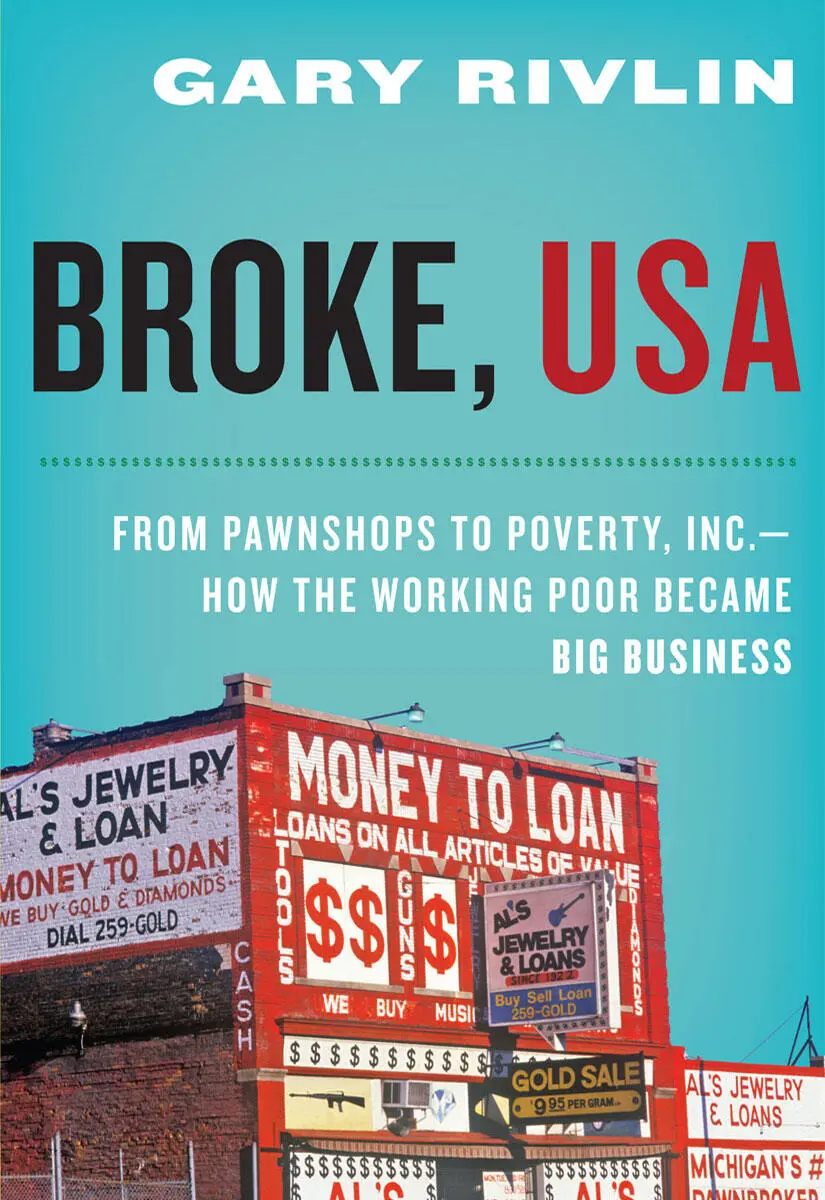
- Название:Broke, USA
- Автор:
- Издательство:HarperCollins Publishers Inc.
- Жанр:
- Год:2010
- Город:New York
- ISBN:978-0-06-199794-5
- Рейтинг книги:3 / 5. Голосов: 1
-
Избранное:Добавить в избранное
- Отзывы:
-
Ваша оценка:
Broke, USA: краткое содержание, описание и аннотация
Предлагаем к чтению аннотацию, описание, краткое содержание или предисловие (зависит от того, что написал сам автор книги «Broke, USA»). Если вы не нашли необходимую информацию о книге — напишите в комментариях, мы постараемся отыскать её.
Broke, USA — читать онлайн бесплатно полную книгу (весь текст) целиком
Ниже представлен текст книги, разбитый по страницам. Система сохранения места последней прочитанной страницы, позволяет с удобством читать онлайн бесплатно книгу «Broke, USA», без необходимости каждый раз заново искать на чём Вы остановились. Поставьте закладку, и сможете в любой момент перейти на страницу, на которой закончили чтение.
Интервал:
Закладка:
The phone rang constantly during the hour I spent with Roedersheimer. He took several calls, from a judge and from opposing counsel, but that only gave me more time to behold the veritable skyline of paper that dominated his office. Stacks of folders were piled high on his desk and there were more sitting on a credenza behind him. One reached so high I feared Roedersheimer would be lost in an avalanche if it fell. There were files stacked on the floor next to him and more piled behind me and on every chair in the room except his and mine. There were more mentions of Ameriquest in those stacks than any other lenders, Roedersheimer said, but Option One and CitiFinancial were also well represented. He seemed to hold American General Finance, AIG’s subprime mortgage division, with a special contempt but that might be because AIG played so hideous a role in the subprime mess through its sale of a subprime insurance product (the so-called “credit default swaps”) that didn’t come close to covering the losses when disaster hit.
Roedersheimer is a slight man with short gray hair and pouchy Fred Basset eyes. He walks with a slight slouch as if carrying his client’s collective burdens on his back. For twenty-six years he oversaw procurement contracts for the U.S. Defense Department, and though he had risen to assistant regional counsel, he left because he couldn’t take the commute anymore, 170 miles roundtrip to Columbus five days a week. In 2001 he took a job with the local legal aid office in Dayton, hoping to carve out a specialty in subprime mortgage loans, but the funding for that project lasted only a few years. Among those clients he took with him when he left legal aid was an elderly couple from Kettering (he had worked as a bricklayer; she had retired from the phone company) who had been talked into so many refinancings that they owed $126,000 on a house that was worth maybe $80,000. “One of the things you look for when you deal with predatory lending is can the person afford the loan when all is said and done,” Roedersheimer said. Because this couple couldn’t, he was able to get the woman (her husband had since passed away) some money from their mortgage broker and also another $5,000 from an appraiser who had worked on her mortgage application.
But such outcomes are depressingly rare, Roedersheimer said. “Unless there’s out-and-out fraud, if people signed the papers, there’s not much I can do for them,” he said. He gets people the bankruptcy that brought the client to the office and that’s about it. Sometimes, he said, he can’t believe the shamelessness of lenders, but often he can’t fathom how little people understand basic finances, his more middle-class clientele included. Clients took out home equity loans not appreciating that they were risking their home on their ability to pay. He shook his head over all those who used payday loans to try to forestall the inevitable, not recognizing that they were only digging a deeper hole for themselves. But if he’s learned anything in his five-plus years handling bankruptcies, it’s that people will use whatever they have at their disposal—a rich brother, a credit card, the corner pawnbroker—if it means holding on for one more month.
Before someone can complete bankruptcy proceedings, he or she must first attend a short financial education course taught by people like Ken Binzer, a retired military educator working for Dayton’s Consumer Credit Counseling Services. To Binzer, the requirement that people endure at least two hours of class time so they can better handle their finances is about the only good thing to come out of the otherwise pro-lender Bankruptcy Abuse Prevention and Consumer Protection Act that George W. Bush signed into law early in his second term. Even people who theoretically have nothing are vulnerable, he said, because of those who might be the ultimate financial vultures of the poverty business: those who view a declaration of personal bankruptcy as a profit opportunity. The worst, Binzer said, are the car dealerships that comb the legal records for the names of those who have recently filed.
Binzer asked his class how many had received an offer from an auto dealer since initiating bankruptcy proceedings. “Almost always one hundred percent of the hands go up,” he said. Often people emerge from a bankruptcy without a vehicle but a ready market of prospective customers needing transportation is only one reason the dealers are so eager for their business. There are solicitations from new car companies and solicitations from those selling used cars but invariably the come-ons are all the same. “They’ll offer them a loan at eighteen to twenty-two to twenty-five percent but make it sound affordable by giving a person eight years to pay back the loan,” he said. Interestingly, Binzer said, eight years is precisely the amount of time a person must wait before filing for another Chapter 7.
Late in the afternoon of my Dayton drive-along with Jim McCarthy, he asked if I would “indulge him” and visit a neighborhood not on our tour. I had asked him to show me the city’s white working-class neighborhood but he wanted me to see at least a small patch of the predominantly African-American west side. Later, Fesum Ogbazion, the CEO of Dayton’s Instant Tax Service, would tell me that if it weren’t for the instant-tax mills and the payday lenders, the check cashers, and the occasional pawnbroker, there would be no businesses operating in poor minority communities other than a few convenience stores and the ubiquitous hair and nail shops. His claim was an exaggeration but only a slight one. It was on the black side of town where all these low-rent credit shops had first taken root and it seemed every major payday chain had at least one outlet on the west side of the river, and most seemed to have two. Cashland operated no less than five payday stores in west Dayton. Even the Sunoco station we passed shortly after crossing the river sported a sign advertising its check-cashing services, allowing the proprietor to charge up to 3 percent of the face value of a check.
McCarthy drove slowly through a west side neighborhood called University Row (the streets have names like Harvard and Amherst). Many of the homes are magnificent, or at least they were not that long ago: wooden beauties with leaded glass and architectural touches like turrets and gables and wraparound porches. I had gasped earlier in the day when I saw three or four boarded-up houses clumped near one another and there were those few blocks in a row in Santa Clara where nearly half the homes had been foreclosed. Here, however, it seemed that half the homes on every block had been abandoned. Paint was peeling, exteriors were crumbling, multiple windows were broken, lawns were overgrown, and the occasional roof had buckled in. This is a place, McCarthy said, that not so long ago he would have described as a stable, solidly working-class community. No longer. “We’re seeing the sex trade here,” McCarthy said as he drove. “There’s drug stuff going on inside a lot of these boarded-up properties.”
And there are similar communities elsewhere in the country. One, South Ozone Park, a predominantly black neighborhood near New York’s Kennedy Airport, is populated by postal workers, bus drivers, teachers, and clerks. These people were solidly middle class and yet it was South Ozone Park and several other black enclaves in the southeast corner of Queens that the New York Daily News declared the “ground zero of New York’s subprime mess.” For decades the story of neighborhoods like these was their stability; houses weren’t sold so much as passed down from generation to generation. But that was before the mortgage brokers set up shop in the early 2000s. In South Ozone Park, the Neighborhood Housing Services of New York City, an organization that offers financial education and affordable lending products, started to see changes in South Ozone Park and several of the neighborhoods around it. Soon, Sarah Gerecke, the group’s CEO, told me, where less than 5 percent of the homes in South Ozone Park would change hands in a given year, that number rose to 20 percent. By 2008, she said, the turnover rate on some blocks was approaching 50 percent.
Читать дальшеИнтервал:
Закладка:
Похожие книги на «Broke, USA»
Представляем Вашему вниманию похожие книги на «Broke, USA» списком для выбора. Мы отобрали схожую по названию и смыслу литературу в надежде предоставить читателям больше вариантов отыскать новые, интересные, ещё непрочитанные произведения.








Обсуждение, отзывы о книге «Broke, USA» и просто собственные мнения читателей. Оставьте ваши комментарии, напишите, что Вы думаете о произведении, его смысле или главных героях. Укажите что конкретно понравилось, а что нет, и почему Вы так считаете.