Gary Rivlin - Broke, USA
Здесь есть возможность читать онлайн «Gary Rivlin - Broke, USA» весь текст электронной книги совершенно бесплатно (целиком полную версию без сокращений). В некоторых случаях можно слушать аудио, скачать через торрент в формате fb2 и присутствует краткое содержание. Город: New York, Год выпуска: 2010, ISBN: 2010, Издательство: HarperCollins Publishers Inc., Жанр: Старинная литература, на английском языке. Описание произведения, (предисловие) а так же отзывы посетителей доступны на портале библиотеки ЛибКат.
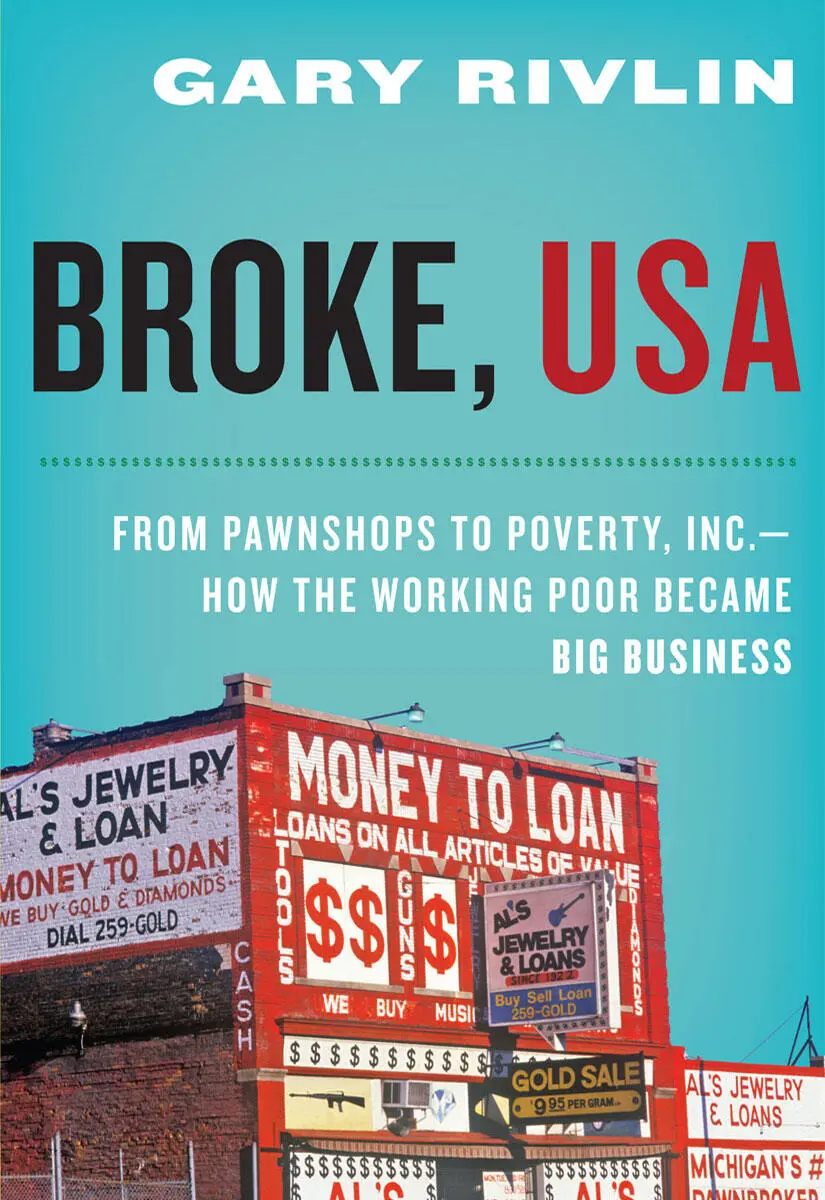
- Название:Broke, USA
- Автор:
- Издательство:HarperCollins Publishers Inc.
- Жанр:
- Год:2010
- Город:New York
- ISBN:978-0-06-199794-5
- Рейтинг книги:3 / 5. Голосов: 1
-
Избранное:Добавить в избранное
- Отзывы:
-
Ваша оценка:
Broke, USA: краткое содержание, описание и аннотация
Предлагаем к чтению аннотацию, описание, краткое содержание или предисловие (зависит от того, что написал сам автор книги «Broke, USA»). Если вы не нашли необходимую информацию о книге — напишите в комментариях, мы постараемся отыскать её.
Broke, USA — читать онлайн бесплатно полную книгу (весь текст) целиком
Ниже представлен текст книги, разбитый по страницам. Система сохранения места последней прочитанной страницы, позволяет с удобством читать онлайн бесплатно книгу «Broke, USA», без необходимости каждый раз заново искать на чём Вы остановились. Поставьте закладку, и сможете в любой момент перейти на страницу, на которой закончили чтение.
Интервал:
Закладка:
“With that case it started to become clear that lenders are not afraid to loan more than a house was worth,” Deutscher said. “It became all about maximizing the up-front profit and then moving on to the next loan, with no conscience about how that was going to play out.”
The big rating agencies would play similarly destructive roles as well—and not out of ignorance, Kevin Byers told me when I visited him in Atlanta. To make his point he grabbed a stack of reports he keeps handy in a desk drawer. One is from Moody’s and is dated May 2005. It explores what its analysts called the “payment shock risk” associated with the 2/28s as lenders continued to lower the teaser rates to make loans seem more affordable. “The resulting differences in potential payment increase,” the analysts note, will have a “meaningful” impact on the financial soundness of these loans. Another, written by two Standard & Poor’s analysts in April 2005, explores what the pair describe as the “continuing quest to help keep the loan origination flowing.” Lenders are resorting to any number of new products to keep loan volume up, they wrote, including mortgages that mean people will own less of their home over time rather than more and the repurposing of interest-only loans for the subprime market, a product that really only made sense for a rich client who can afford the balloon payment on the other end. “There is growing concern around the increased usage of these mortgages,” they wrote.
“It’s not like they didn’t know that all this was going on,” Byers said. “They just didn’t want to do anything about it because they had a vested interest.” The institutions putting together these packages loaded with toxic loans were the very ones paying the credit agencies to evaluate the creditworthiness of the loans, and so the agencies would liberally hand out top ratings while relegating their concerns to the occasional research report. “I think they saw their role as ending once they put the investor community on notice that there are structural issues that they need to watch out for,” Byers said. The attorney general of Ohio was among those suing the major credit rating agencies, claiming their stamping of a triple-A rating on high-risk and wobbly securities cost state retirement and pension funds more than $450 million in losses.
Alan Greenspan shares some of the blame—a lot of the blame, according to some. Congress had deputized the Federal Reserve to enforce a sense of fair play inside the subprime market but the Fed chair steadfastly maintained a hands-off approach even as subprime grew from 5 percent of the mortgage market in 2001 to a 29 percent share by 2006. Worse, Greenspan kept interest rates historically low through the first half of the decade—at 1 percent in 2003, the lowest rate in half a century. “I’m sitting there watching Greenspan continuing to lower interest rates,” Kathleen Keest said, “and I’m going, ‘I thought your job was to take the punch bowl away and you’re pouring more rum into it.’” Federal Reserve Governor Edward Gramlich would rebuke Greenspan for showing no interest in investigating the predatory behavior of the subprime lenders.
There were those who said Wall Street was primarily responsible. Their insatiable appetite for these loans—the New Yorker ’s Connie Bruck called it Wall Street’s “addiction”—kept everyone motivated. But then one can also fault those wanting to buy small tranches of a mortgage-backed bond for keeping demand high. And to say “Wall Street” is to miss out on a broader range of culprits. In the mid-2000s, it seemed every major financial institution in the world had a hand in this dirty business. By 2006, Wells Fargo, through its Wells Fargo Home Mortgage unit, ranked as a top-ten subprime lender, as did Citigroup, which ranked fourth. Washington Mutual placed eleventh on that same list and Chase Home Financial, a division of JPMorgan Chase, seventeenth. HSBC, the London-based financial giant that had purchased Household Finance, was number one on the list in 2006 after its subsidiary, Household Finance, regained the top spot with $53 billion in subprime loans. A chastened Ameriquest, which paid a $325 million settlement earlier that year, fell to seventh.
And the big financial conglomerates were hardly the only major corporations to aggressively jump into the subprime mortgage business. The money H&R Block made offering refund anticipation loans had apparently given the tax preparation giant a taste for subprime profits because in 1997 it paid $190 million for Option One and in short order transformed it into a top-tier subprime lender. General Motors aggressively entered the subprime market through its GMAC unit, which bundled together nearly $26 billion in mortgage-backed securities in 2006, and General Electric owned WMC, a subprime lender that made $33 billion in mortgage loans in 2006, ranking it fifth on the Inside B&C Lending list.
Glen Pizzolorusso, a WMC sales manager, gave a sense of what life was like in the middle of the credit cyclone when he agreed to an interview in 2008 with the radio show This American Life . Pizzolorusso, in his mid-twenties, seemed to be living the life of a mini-celebrity. He bought $1,000 bottles of Cristal champagne at bottle clubs in Manhattan and rubbed shoulders with the likes of Christina Aguilera and Cuba Gooding, Jr. He bought a penthouse on Manhattan’s Upper East Side and a $1.5 million house in Connecticut and owned a Porsche and two Mercedes to get him back and forth. He was making between $75,000 and $100,000 per month and suspected something might be seriously wrong in his life when one month he was paid $25,000 and that wasn’t enough to cover his expenses. “I did what YOU do every day, try to be the best at my job,” he wrote on a blog he created to defend himself after his story appeared on the radio. He didn’t create the rules, he said, and the corporation he worked for had stayed within the law. His sole regret, he wrote, was that he had spent his money so foolishly.
The first overt sign of trouble came in February 2007, when HSBC announced that it was writing down its subprime mortgage holdings by more than $10 billion. The housing market had peaked in 2006 and began its inexorable decline, and in short order HSBC would not be the only large institution to announce a loss in the double-digit billions. By the time the banks were lining up for TARP handouts from the federal government in the fall of 2008, the U.S. stock markets had lost more than $8 trillion in value. Finally, the country woke up to the problem that Bill Brennan, Martin Eakes, Jim McCarthy, and others had been warning about for years.
In Dayton, it fell to people like McCarthy and Beth Deutscher and Deutscher’s old employer, Consumer Credit Counseling Services, to handle the fallout. The civil courts also absorbed much of the burden; by 2006, foreclosures represented 49 percent of the civil caseload in Montgomery County. Bankruptcy attorneys like Chuck Roedersheimer worked to sort out the mess.
Roedersheimer worked at Thompson & DeVeny, located a few miles from downtown on a street crowded with insurance agents, medical professionals, and fast-food purveyors. There a basic bankruptcy could be had for a couple of thousand dollars. Business in recent months had been very good at Thompson & DeVeny, Thompson told me prior to my arrival in December 2008, but that turned out to be a major understatement. I entered the waiting area in a low-slung bunkerlike building and found no seats. A loud-voiced receptionist called out people’s names as if we were all crowded in a bus terminal. The firm has three lawyers, Roedersheimer told me, and they were seeing as many as two hundred new people a month and taking on forty to fifty as clients. He figured he saw two or three clients a day but the other two lawyers (the firm has since added two young associates), well versed in the intricacies of bankruptcy law and unburdened by the complexities of the subprime loans that were his specialty, were seeing ten a day.
Читать дальшеИнтервал:
Закладка:
Похожие книги на «Broke, USA»
Представляем Вашему вниманию похожие книги на «Broke, USA» списком для выбора. Мы отобрали схожую по названию и смыслу литературу в надежде предоставить читателям больше вариантов отыскать новые, интересные, ещё непрочитанные произведения.









Обсуждение, отзывы о книге «Broke, USA» и просто собственные мнения читателей. Оставьте ваши комментарии, напишите, что Вы думаете о произведении, его смысле или главных героях. Укажите что конкретно понравилось, а что нет, и почему Вы так считаете.