Gary Rivlin - Broke, USA
Здесь есть возможность читать онлайн «Gary Rivlin - Broke, USA» весь текст электронной книги совершенно бесплатно (целиком полную версию без сокращений). В некоторых случаях можно слушать аудио, скачать через торрент в формате fb2 и присутствует краткое содержание. Город: New York, Год выпуска: 2010, ISBN: 2010, Издательство: HarperCollins Publishers Inc., Жанр: Старинная литература, на английском языке. Описание произведения, (предисловие) а так же отзывы посетителей доступны на портале библиотеки ЛибКат.
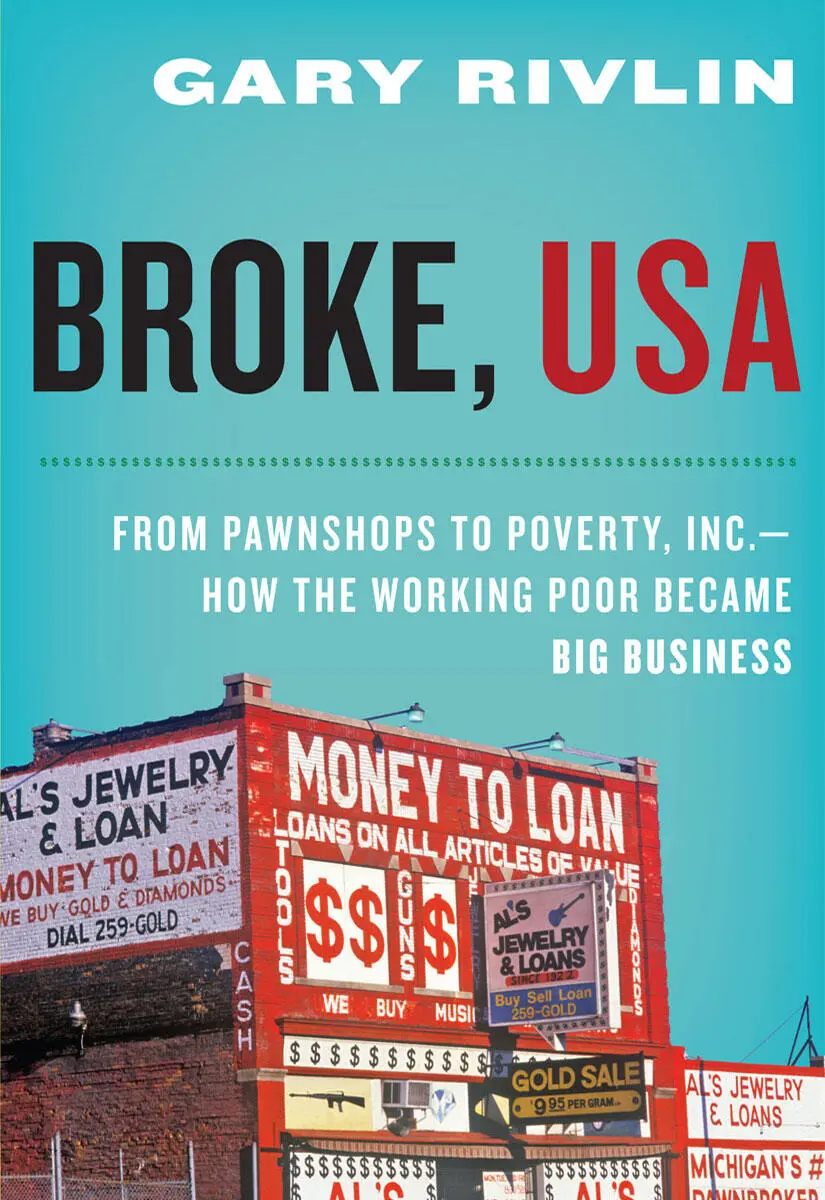
- Название:Broke, USA
- Автор:
- Издательство:HarperCollins Publishers Inc.
- Жанр:
- Год:2010
- Город:New York
- ISBN:978-0-06-199794-5
- Рейтинг книги:3 / 5. Голосов: 1
-
Избранное:Добавить в избранное
- Отзывы:
-
Ваша оценка:
Broke, USA: краткое содержание, описание и аннотация
Предлагаем к чтению аннотацию, описание, краткое содержание или предисловие (зависит от того, что написал сам автор книги «Broke, USA»). Если вы не нашли необходимую информацию о книге — напишите в комментариях, мы постараемся отыскать её.
Broke, USA — читать онлайн бесплатно полную книгу (весь текст) целиком
Ниже представлен текст книги, разбитый по страницам. Система сохранения места последней прочитанной страницы, позволяет с удобством читать онлайн бесплатно книгу «Broke, USA», без необходимости каждый раз заново искать на чём Вы остановились. Поставьте закладку, и сможете в любой момент перейти на страницу, на которой закончили чтение.
Интервал:
Закладка:
Ben Bernanke took over as chairman of the Federal Reserve in February 2006. A Republican who had served as chairman of President Bush’s Council of Economic Advisers just prior to his promotion to the top spot at the Fed, Bernanke was no one’s idea of a consumer champion. Yet he was a vast improvement over Alan Greenspan, at least in the fight against predatory lending. His campaign against what he ultimately called “unfair and deceptive” loans began with a series of public hearings into mortgage lending the Fed held in the summer of 2006. At the end of 2007, the Fed issued a new set of rules governing any mortgage carrying an interest rate just 1.5 percent higher than the average rate paid by prime borrowers—its new definition of a “higher-priced” loan. Under the new rules, lenders can no longer make a higher-priced mortgage without regard for a borrower’s ability to pay. The Fed restricted the use of prepayment penalties in higher-priced mortgages and banned the use of “stated income” loans—the so-called liar loans that required no proof of income. The Fed also prohibited lenders and mortgage brokers from advertising only the lower teaser rates on an adjustable rate mortgage.
The Center for Responsible Lending and other consumer groups praised the Fed for what the CRL dubbed a return to “common-sense business practices” in subprime lending—and then castigated the Fed board of governors for not going far enough. Mike Calhoun, CRL’s president, criticized the Fed for failing to rein in option ARMs—the very product that had made Herb and Marion Sandler billionaires—and called on the Fed governors to do something about yield spread premiums. It was hard to justify these payments that were nothing but kickbacks lenders paid mortgage brokers to put borrowers in costlier loans. North Carolina had banned yield spread premiums. It was time for the Fed to do the same, Calhoun said.
In time, the Fed would propose such a ban (the comments period ended on New Year’s Eve 2009, clearing the way for action). Its governors would announce new rules for the overdraft fees banks charge (in particular the overdraft protection plans in which banks automatically enroll people) and also the credit cards they issue. Again, the CRL would criticize the Fed for not going far enough on these last two issues. The failures of the Fed on credit card reform would be moot as Congress would take on the issue with passage of a credit cardholders’ “bill of rights” in 2008. The new law, which went into effect in early 2010, protects cardholders from capricious interest rate increases and clamps down on the fees card issuers can charge. “The Fed’s overdraft rules were a small step but at least a bank now has to ask if someone wants this expensive small-loan product,” the CRL’s Kathleen Day said.
Even Alan Greenspan would provide a bit of pleasure to people inside the CRL when he appeared before Congress to talk about the subprime meltdown. As far back as 2000, Greenspan showed he recognized that there was something amiss in the mortgage business. “Of concern,” he said in a speech he gave in March of that year in front of the National Community Reinvestment Coalition, “are abusive lending practices that target specific neighborhoods or vulnerable segments of the population and can result in unaffordable payments, equity stripping, and foreclosures.” Yet as a young man, Greenspan had sharpened his political philosophy in the living room of Ayn Rand, and he believed deeply in a hands-off approach to the market. “I have found a flaw” in my thinking, Greenspan confessed when appearing in front of the House Committee on Oversight and Government Reform. His free-market ideology, he acknowledged, ended up being the wrong one for the circumstances. The market didn’t self-correct, as he had assumed it would, a humbled Greenspan said in his testimony. “I was shocked,” he admitted. Kathleen Keest had been so ecstatic to see the former Fed chairman, once hailed as the world’s greatest central banker, taken down a peg or two that she had taped to her office door news articles reporting on Greenspan’s testimony.
The payday lenders, the check cashers, and others catering to those on the economic fringes had been worried that somehow a crackdown on subprime mortgage lenders could threaten the way they conduct business. They were right to worry. The centerpiece of the Obama administration’s financial reform package was an idea that Elizabeth Warren of Harvard first proposed in mid-2007: a Consumer Financial Protection Agency, or CFPA. The impetus behind this new regulatory body may have been the need to rein in abusive mortgage practices and complex products such as collateralized debt obligations that Warren Buffett had dubbed “financial weapons of mass destruction.” But this proposed, new consumer protection agency for financial products would also have jurisdiction over payday loans, the pawn business, subprime credit card companies, and pretty much any Poverty, Inc. enterprise. The CFPA consolidated enforcement into a single, stand-alone agency that would have broad authority to investigate and react to abuses. The agency would also promote better financial education. Predictably, virtually every business in this sector lined up against the Obama proposal. How could they not in the face of a new federal agency that would suddenly be poking into their business? The CFPA was “redundant,” a “waste of money” (actually, under Obama’s plan, the businesses being regulated would be assessed a fee to pay for the agency), and an “extra layer of bureaucracy.” Lynn DeVault, the Allan Jones lieutenant heading up the payday lender trade organization, told Cheklist that her group had quadrupled its federal lobbying budget.
The scope of this proposed new regulatory body was made plain by the breadth of interests aligned against it, a roster that included banks and payday lenders, of course, but also pawnbrokers, car dealers, real estate developers, the U.S. Chamber of Commerce, and even utility companies. By the time the debate over the agency began in mid-October, the financial services industry had already spent more than $220 million lobbying against Obama’s proposed agency.
FEDERAL AGENCY A NEW THREAT—that was the headline in the fall 2009 issue of Cheklist . The author of the article checked in with the check cashers, a pawn chain, and a payday proprietor. There may have been a time when the poverty industry wasn’t a single entity so much as splintered, competing interests fighting over the same clusters of customers. But the pawnbrokers became check cashers and the check cashers ventured into payday, as did rent-to-own. And more recently the payday lenders started getting into check cashing, money orders, refund anticipation tax loans, and any other business that might bring in additional revenues. They all learned the same tricks for maximizing revenues from the same sources, each category of business grew plump with profits due to the same set of broader economic factors: stagnating wages while home and health prices soared, the loss of good-paying manufacturing jobs, the widening gap between the wealthy and those on the bottom half of the wage pyramid that economists have been observing for thirty years. If nothing else, the fight against a new consumer agency underscored the unified nature of the country’s Poverty, Inc. sector—and its clout. JPMorgan Chase underwrites the loans for a large share of the instant tax market, the country’s biggest banks funded the growth of the payday industry, and pretty much every large investment bank has had its hand in one of these businesses or another. And what are overdraft fees, which generated $24 billion for the banks in 2008 according to the CRL, but another way a business is feasting off those living on the financial margins?
Читать дальшеИнтервал:
Закладка:
Похожие книги на «Broke, USA»
Представляем Вашему вниманию похожие книги на «Broke, USA» списком для выбора. Мы отобрали схожую по названию и смыслу литературу в надежде предоставить читателям больше вариантов отыскать новые, интересные, ещё непрочитанные произведения.






Обсуждение, отзывы о книге «Broke, USA» и просто собственные мнения читателей. Оставьте ваши комментарии, напишите, что Вы думаете о произведении, его смысле или главных героях. Укажите что конкретно понравилось, а что нет, и почему Вы так считаете.