Gary Rivlin - Broke, USA
Здесь есть возможность читать онлайн «Gary Rivlin - Broke, USA» весь текст электронной книги совершенно бесплатно (целиком полную версию без сокращений). В некоторых случаях можно слушать аудио, скачать через торрент в формате fb2 и присутствует краткое содержание. Город: New York, Год выпуска: 2010, ISBN: 2010, Издательство: HarperCollins Publishers Inc., Жанр: Старинная литература, на английском языке. Описание произведения, (предисловие) а так же отзывы посетителей доступны на портале библиотеки ЛибКат.
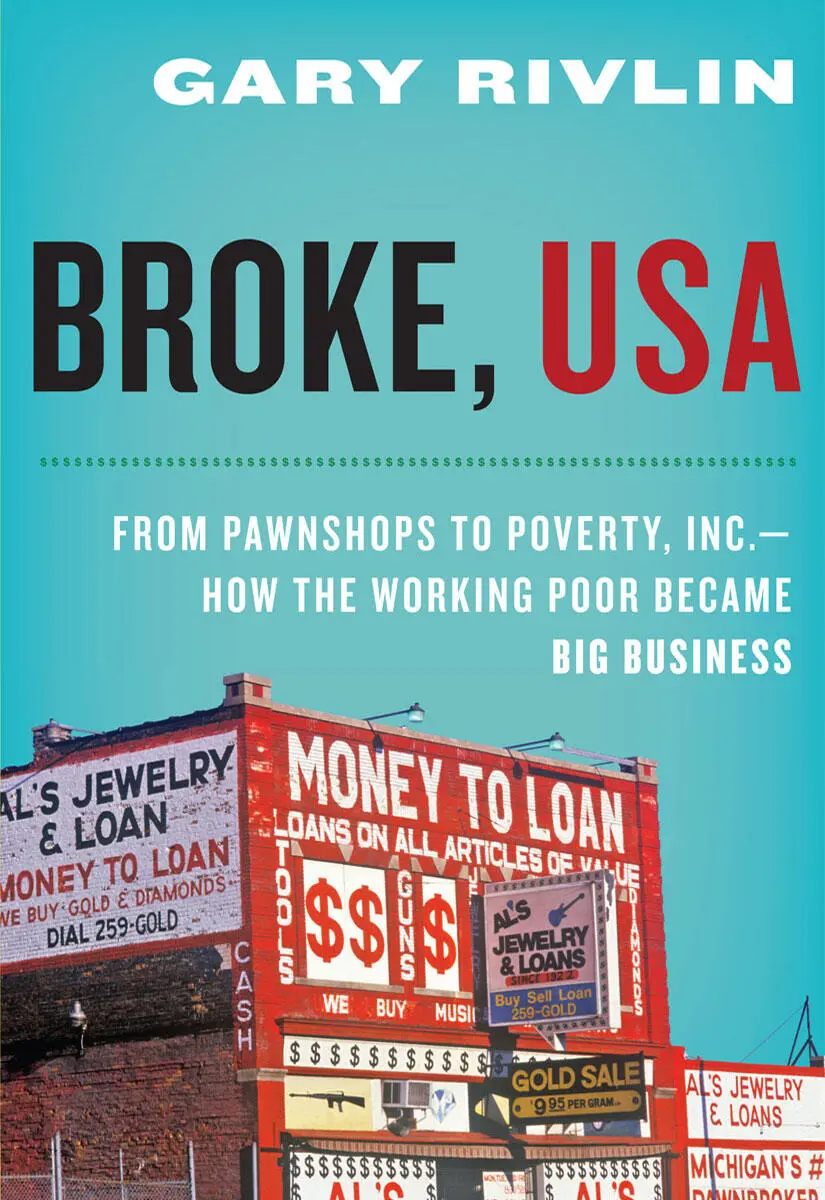
- Название:Broke, USA
- Автор:
- Издательство:HarperCollins Publishers Inc.
- Жанр:
- Год:2010
- Город:New York
- ISBN:978-0-06-199794-5
- Рейтинг книги:3 / 5. Голосов: 1
-
Избранное:Добавить в избранное
- Отзывы:
-
Ваша оценка:
Broke, USA: краткое содержание, описание и аннотация
Предлагаем к чтению аннотацию, описание, краткое содержание или предисловие (зависит от того, что написал сам автор книги «Broke, USA»). Если вы не нашли необходимую информацию о книге — напишите в комментариях, мы постараемся отыскать её.
Broke, USA — читать онлайн бесплатно полную книгу (весь текст) целиком
Ниже представлен текст книги, разбитый по страницам. Система сохранения места последней прочитанной страницы, позволяет с удобством читать онлайн бесплатно книгу «Broke, USA», без необходимости каждый раз заново искать на чём Вы остановились. Поставьте закладку, и сможете в любой момент перейти на страницу, на которой закончили чтение.
Интервал:
Закладка:
“If it was just us, we’d get killed here,” payday spokesman Steven Schlein said of Obama’s proposal for a consumer agency. But the interests of his clients and the country’s largest financial institutions are aligned. “Our hope is that the banks will beat this bill back,” Schlein said. As written, the Consumer Financial Protection Agency Act of 2009 didn’t give this new agency the power to cap interest rates. But it was Schlein’s great worry, and the worry of many within the Poverty, Inc. field, that an interest rate cap will be slipped in at the last minute or tacked on to a completely unrelated piece of legislation.
Obama said he wanted a financial reform package signed by the end of 2009 but that deadline came and went—and with it the Democrats’ filibuster-proof majority in the Senate. The House had done its part, authorizing the CFPA in legislation it dubbed the Wall Street Reform and Consumer Protection Act. Barney Frank, the liberal congressman from Massachusetts and chair of the House Financial Services Committee, had angered consumer activists by granting the federal government the power to preempt the states from regulating the national banks in some circumstances, but President Obama, anxious to see legislation pass by year’s end, immediately issued a press statement lauding the committee for its swift action.
The House bill passed without a single Republican vote. A rival proposal passed out of the Senate Banking Committee, chaired by Connecticut’s Christopher Dodd, but with health-care reform taking center stage and other issues crowding out the agenda, the full Senate failed to vote on the measure by year’s end. Then, shortly into 2010, Dodd announced he would not be running for reelection, introducing another X factor into the debate. Early in 2009, the Los Angeles Times had reported that Dodd had raised more than $44,000 in campaign funds from high-interest lenders like payday and pawn, and later that spring there were news accounts of the senator eating dinner with members of the industry group representing the online payday lenders. Despite a reputation for being too cozy with the banks and other financial institutions under his committee’s jurisdiction, or perhaps because of it, Dodd announced his support for a consumer regulatory agency shortly thereafter. What the lame-duck senator might do now that he wasn’t worried about raising more money or winning votes—and whether Obama’s proposed new agency could survive a filibuster threat—was anyone’s guess.
Ameriquest would be the first big subprime lender to flop. Its ignoble end in mid-2007 came when the company posted a curt message on its website informing people it would be taking no new applications for loans. Its assets would be sold, fittingly, to Citigroup. JPMorgan sold off much of its subprime mortgage holdings at the start of 2007 and, not long afterward, H&R Block and General Electric put its subprime mortgage units up for sale. But, finding no buyers, the two companies shut them down and absorbed the losses. Wells Fargo made a similar announcement, and New Century, which made $37 billion in loans in 2006, declared bankruptcy the next year. In 2008, Bank of America purchased Countrywide and JPMorgan Chase bought Washington Mutual. What was left of the subprime lenders boiled down to billions of dollars in debts and a raft of legal cases, including the lawsuit the city of Baltimore filed against Wells Fargo accusing the bank of steering black customers into subprime loans even when they qualified for lower-rate mortgages and home equity lines of credit. (A federal judge dismissed the charges against Wells at the start of 2010.) Perhaps the most shocking news of all came when HSBC announced, in March 2009, that it was shutting down Household Finance, despite the $14 billion it had paid for the company just a half-dozen years earlier.
Yet no bank seemed to take it on the chin as hard as Citigroup. Citi would remain on government life support longer than most of its competitors, and the stock price of this once-mighty global institution that as recently as May 2007 traded for more than $50 a share dropped to $1.02 a share—a 98 percent plunge. Citigroup’s primary problem was that it had full exposure on both sides of the subprime debacle: Through CitiFinancial, it was one of the country’s leading subprime mortgage originators and on the investment banking side its people had aggressively pursued a derivative product called a collateralized debt obligation that was based on underlying portfolios of mortgages. Citigroup wrote off tens of billions of dollars in bad mortgages and a new CEO split the company in two: those units they would keep and those they would sell once there was money back in the system. This second category included any number of divisions (insurance, the brokerage business) that Sandy Weill had brought to Citigroup. Citi would cut 110,000 jobs (around one-third of its workforce) and sell off $350 billion in assets by the start of 2010.
Yet there was little joy inside the Center for Responsible Lending over the demise of the predatory subprime lender. The value of real estate in the United States had shrunk by $1 trillion in a matter of months, and there was more bad news coming as the rates would reset on all those explodable ARMs written in 2006 and early 2007. There was another new foreclosure every thirteen seconds through the early months of 2009, the Mortgage Bankers Association reported, and while the Obama administration promised help, it was slow in coming. Under its $75 billion Home Affordable Modification Program, created in March 2009, the government announced that it would pay mortgage companies $1,000 for each loan they modified and then another $1,000 a year for up to three years. But as 2009 was coming to a close, the institutions controlling these loans had renegotiated the home loans for only a tiny fraction of the 4 million eligible homeowners—66,000 in ten months. The CRL estimated that homeowners in neighborhoods with a high ratio of subprime loans saw the collective worth of their homes drop $500 billion in value because of nearby foreclosures.
“In the last twenty-five years, the United States made tremendous progress integrating poor families into the middle class, largely through home ownership,” Martin Eakes told me. “But now we’ll lose about half of that progress because of subprime abuses that were permitted to continue despite the best efforts of a lot of people. The subprime lenders have basically destroyed the communities that we were targeting. It’s a tragedy.” Compounding that tragedy, Eakes said, were the likes of Rush Limbaugh, Dick Cheney, and editorial writers for the Wall Street Journal repeatedly blaming the Community Reinvestment Act, or CRA, which required banks to make loans in any neighborhood where they had branches, as the cause of the crisis. It was absurd to blame a law that was written more than thirty years ago and didn’t apply to many of the biggest subprime lenders, including Ameriquest, Countrywide, and Household Finance. Yet Neil Cavuto declared on the Fox Business Network in the middle of the subprime meltdown in the second half of 2008, “Loaning to minorities and risky folks is a disaster.”
“If the extremists succeed in putting forward this view, then we’ll lose all hope for the next generation,” Eakes said. Equally disconcerting were those blaming the poor for the financial woes facing both Fannie Mae and Freddie Mac. Fannie and Freddie both played a big role in helping to cause the Great Recession of 2008. In September of that year, the federal government felt obliged to announce a $200 billion rescue of the two government-sponsored mortgage finance companies. But its true motivation for buying up all those home mortgages and either holding them in a portfolio or reselling them to Wall Street investors seemed less about helping those of modest means purchase a home—a large portion of those subprime loans, after all, involved middle-class and upper-middle-class borrowers—and more about profits and remaining relevant. Both Fannie and Freddie had gone public in 1989 and the seemingly unquenchable appetite for subprime loans in the 2000s seemed primarily about justifying the hefty salaries and even bigger bonuses the executives paid themselves.
Читать дальшеИнтервал:
Закладка:
Похожие книги на «Broke, USA»
Представляем Вашему вниманию похожие книги на «Broke, USA» списком для выбора. Мы отобрали схожую по названию и смыслу литературу в надежде предоставить читателям больше вариантов отыскать новые, интересные, ещё непрочитанные произведения.








Обсуждение, отзывы о книге «Broke, USA» и просто собственные мнения читателей. Оставьте ваши комментарии, напишите, что Вы думаете о произведении, его смысле или главных героях. Укажите что конкретно понравилось, а что нет, и почему Вы так считаете.