Gary Rivlin - Broke, USA
Здесь есть возможность читать онлайн «Gary Rivlin - Broke, USA» весь текст электронной книги совершенно бесплатно (целиком полную версию без сокращений). В некоторых случаях можно слушать аудио, скачать через торрент в формате fb2 и присутствует краткое содержание. Город: New York, Год выпуска: 2010, ISBN: 2010, Издательство: HarperCollins Publishers Inc., Жанр: Старинная литература, на английском языке. Описание произведения, (предисловие) а так же отзывы посетителей доступны на портале библиотеки ЛибКат.
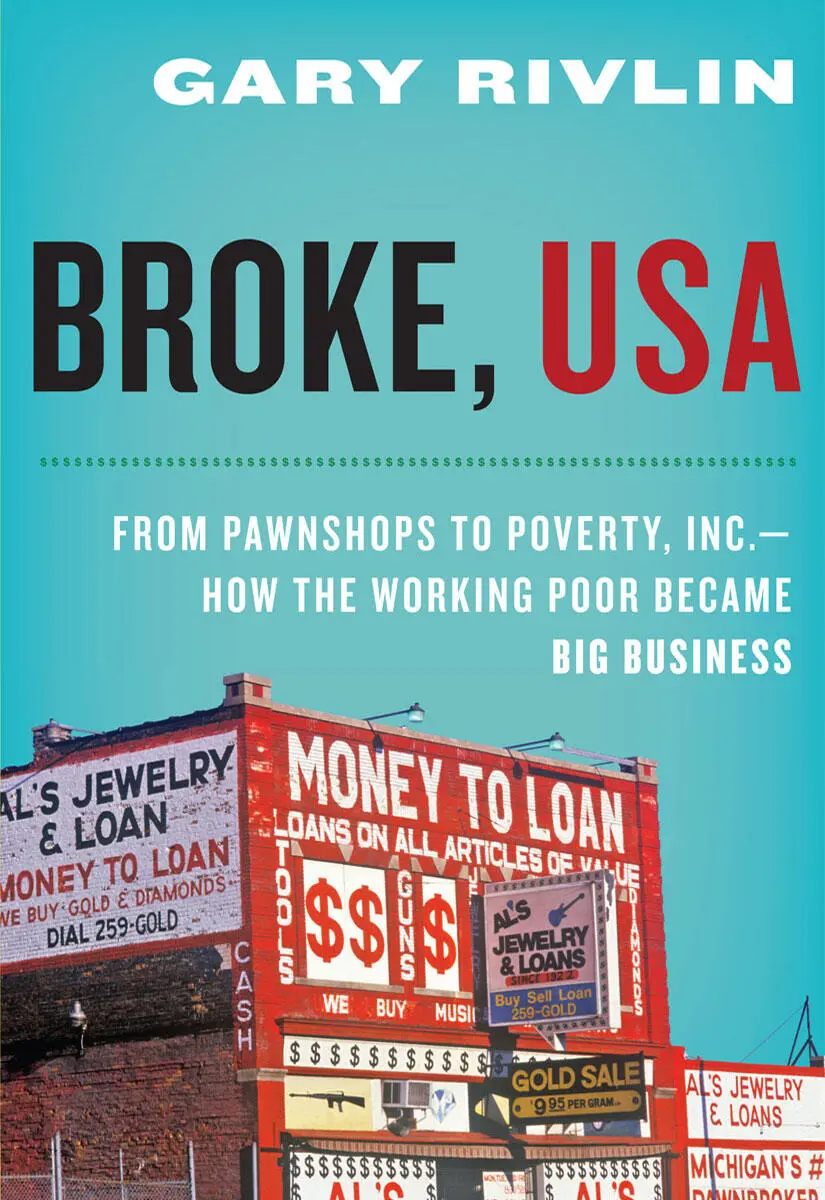
- Название:Broke, USA
- Автор:
- Издательство:HarperCollins Publishers Inc.
- Жанр:
- Год:2010
- Город:New York
- ISBN:978-0-06-199794-5
- Рейтинг книги:3 / 5. Голосов: 1
-
Избранное:Добавить в избранное
- Отзывы:
-
Ваша оценка:
Broke, USA: краткое содержание, описание и аннотация
Предлагаем к чтению аннотацию, описание, краткое содержание или предисловие (зависит от того, что написал сам автор книги «Broke, USA»). Если вы не нашли необходимую информацию о книге — напишите в комментариях, мы постараемся отыскать её.
Broke, USA — читать онлайн бесплатно полную книгу (весь текст) целиком
Ниже представлен текст книги, разбитый по страницам. Система сохранения места последней прочитанной страницы, позволяет с удобством читать онлайн бесплатно книгу «Broke, USA», без необходимости каждый раз заново искать на чём Вы остановились. Поставьте закладку, и сможете в любой момент перейти на страницу, на которой закончили чтение.
Интервал:
Закладка:
There was at least one subprime lender still in business: Self-Help. Its own loan portfolio was performing blessedly well despite the global financial meltdown. By September 2009, roughly 4 percent of the country’s prime borrowers were delinquent on their mortgage payments compared to 20 percent of subprime borrowers. At Self-Help, that figure was 8 percent. The mortgages Self-Help bought on the secondary market it created in the mid-1990s were also faring much better than the typical subprime loan, in no small part because of the standards the organization used when evaluating a portfolio. Self-Help, Eakes said, would only buy portfolios where the points and fees were in line with conventional loans and would avoid writing mortgages that included onerous terms, such as a prepayment penalty. “We’ve always been about creating sustainable loans,” Eakes said.
There are still people, and not just Allan Jones, who blame Eakes and Self-Help at least in part for the subprime meltdown. Self-Help, after all, created the first subprime market and it was Self-Help who pushed Wachovia so hard to enter subprime lending (the bank ultimately hit bottom because of subprime). One problem with that argument is that Self-Help ended up being dwarfed by the larger subprime market. Over fifteen years, Self-Help bought $6 billion worth of subprime loans on the open market—or what Ameriquest, Countrywide, or Household Finance wrote individually in two months in 2005. “We were just a flea on this giant elephant,” Eakes said. Self-Help’s David Beck also disputed the notion that Self-Help’s secondary market served as a kind of gateway drug, giving established banks a taste for subprime. “The dirty little secret about subprime was already out there,” Beck said. “We didn’t have to give banks any idea of the obscene profits they could be making because they already knew.”
Despite its successes, Self-Help’s allies weren’t universal in their praise of the group. “They told me when we were fighting to save the Georgia Fair Lending Act, ‘We’ll negotiate to one iota of something just to be able to say we have a victory,’” Bill Brennan said of the role the CRL played in Georgia after the defeat of Roy Barnes. “We ended up dropping out of negotiations way before them. To be honest about it, we were appalled they were continuing to negotiate long after the bill had been gutted beyond recognition.”
Vincent Fort was even harsher in his assessment of CRL. “I’m down here dealing with people every day talking about foreclosures and predatory lending,” Fort said, “but here this group flies in here, they’ve received tens of millions of dollars from some predatory lenders, and they’re working on a bill with Republicans that’s a total piece of shit because they want to go back and say ‘We’ve accomplished this.’ I wasn’t very happy with the CRL.”
Then there’s the perspective of those who are part of a group that Newsweek dubbed the “ethical subprime lenders”: community development financial institutions and other nonprofits mainly. These lenders expose as overly simplistic the claim that the CRA was to blame for the global financial meltdown of 2008 or Neil Cavuto’s line that lending to minorities or those with blemished credit is a “disaster.” “Even amid the worst housing crisis since the 1930s,” Newsweek ’s Daniel Gross wrote near the end of 2008, “many of these institutions sport healthy payback rates. They haven’t bankrupted their customers or their shareholders. Nor have they rushed to Washington begging for bailouts.” One person quoted in the article, Cliff Rosenthal, the head of an organization representing more than two hundred credit unions that lend primarily in low-income communities, said that delinquent loans were about 3.1 percent of assets in the middle of 2008 compared to a national delinquency rate at the time of 18.7 percent among subprime loans. The article also quoted Mike Loftin, the head of Homewise, a Santa Fe, New Mexico–based nonprofit that lends exclusively to first-time, working-class homebuyers. Of the five hundred loans on Homewise’s books in the fall of 2008, only 0.6 percent were ninety days late, Loftin said, compared with 2.4 percent of all prime mortgages nationwide.
Loftin is a good friend and I’ve been hearing about his group since the early 1990s, when he took over as its executive director. Technically, Homewise is not a subprime lender. His group focuses on potential homeowners with blemished credit scores but rather than put them in loans with a higher interest rate, Homewise provides prospective homebuyers financial counseling and also helps them get into the habit of setting aside some savings each month. (The Home Ownership Center of Greater Dayton, Beth Deutscher’s group, has the same approach as Homewise.) Typically it takes six months to a year for the serious homebuyer to boost his or her credit score and also scrape together the 2 percent down payment his organization wants to see before making a loan. “If customers build a savings habit to save that money on a modest income,” Loftin told Newsweek , “it says a lot about them and their financial discipline.”
Loftin thinks the world of Martin Eakes. I’ve heard him describe Eakes as having a rare moral clarity in a jaded world and he expresses great admiration for Eakes’s effectiveness, his creativity, and his integrity. He’ll hear Eakes speak and he’ll feel invigorated. “He has this ability to remind us why we do what we do,” he said. The two have often been featured speakers at the same conferences and usually find themselves on the same side of an issue. The exception is the use of subprime loans. Through the subprime boom, Loftin watched as more than a few nonprofits embraced such loans. Colleagues confessed to him that they were moving into subprime because that’s where the action was and boasted about the fees they were earning writing those loans. He saw groups he had respected profoundly lose their way as they accepted money from Ameriquest, Citigroup, and other large lenders. Eakes never did so but it was Eakes who had been an inspiration for many and Eakes who served as the pied piper for responsible subprime lending. “Martin has to take some of the blame for giving credence to this notion that the best or only way to serve lower-income households is to charge them more,” Loftin said. From his perspective, the real shame of it was that all the energies of a group as talented and creative as Self-Help went into the development and growth of the subprime home loan.
Loftin trained as community organizer, and seems to have a preternatural ability to pose the kind of fundamental questions that get you thinking differently about an issue that had been settled in your mind. “Risk-based pricing” is supposed to be one of the great innovations in finance. Where in the old days, only those with good credit could secure a loan, risk-based pricing meant the extension of credit to everyone—so long as you’re willing to pay more to cover the greater risk in lending money to you. “The underlying logic of subprime mortgages and payday loans is the same: that the only way to expand credit to minorities and lower-income people is to dumb-down credit standards and charge them more for the added risk,” Loftin said. “But there are other tools in the box”—including financial literacy. “No one is born with poor credit,” he continued, “and teaching people how to manage their finances is a tool that has proven itself to work and to work over the long haul.” But it’s easier and quicker to charge people more than to go through the hard work of teaching people good habits.
“To the extent that ‘responsible subprime lenders,’ including Martin, gave credence to the notion that the best or only way to serve lower-income households is to charge them more, they have to take some of the blame for what happened,” Loftin said.
Читать дальшеИнтервал:
Закладка:
Похожие книги на «Broke, USA»
Представляем Вашему вниманию похожие книги на «Broke, USA» списком для выбора. Мы отобрали схожую по названию и смыслу литературу в надежде предоставить читателям больше вариантов отыскать новые, интересные, ещё непрочитанные произведения.









Обсуждение, отзывы о книге «Broke, USA» и просто собственные мнения читателей. Оставьте ваши комментарии, напишите, что Вы думаете о произведении, его смысле или главных героях. Укажите что конкретно понравилось, а что нет, и почему Вы так считаете.