Gary Rivlin - Broke, USA
Здесь есть возможность читать онлайн «Gary Rivlin - Broke, USA» весь текст электронной книги совершенно бесплатно (целиком полную версию без сокращений). В некоторых случаях можно слушать аудио, скачать через торрент в формате fb2 и присутствует краткое содержание. Город: New York, Год выпуска: 2010, ISBN: 2010, Издательство: HarperCollins Publishers Inc., Жанр: Старинная литература, на английском языке. Описание произведения, (предисловие) а так же отзывы посетителей доступны на портале библиотеки ЛибКат.
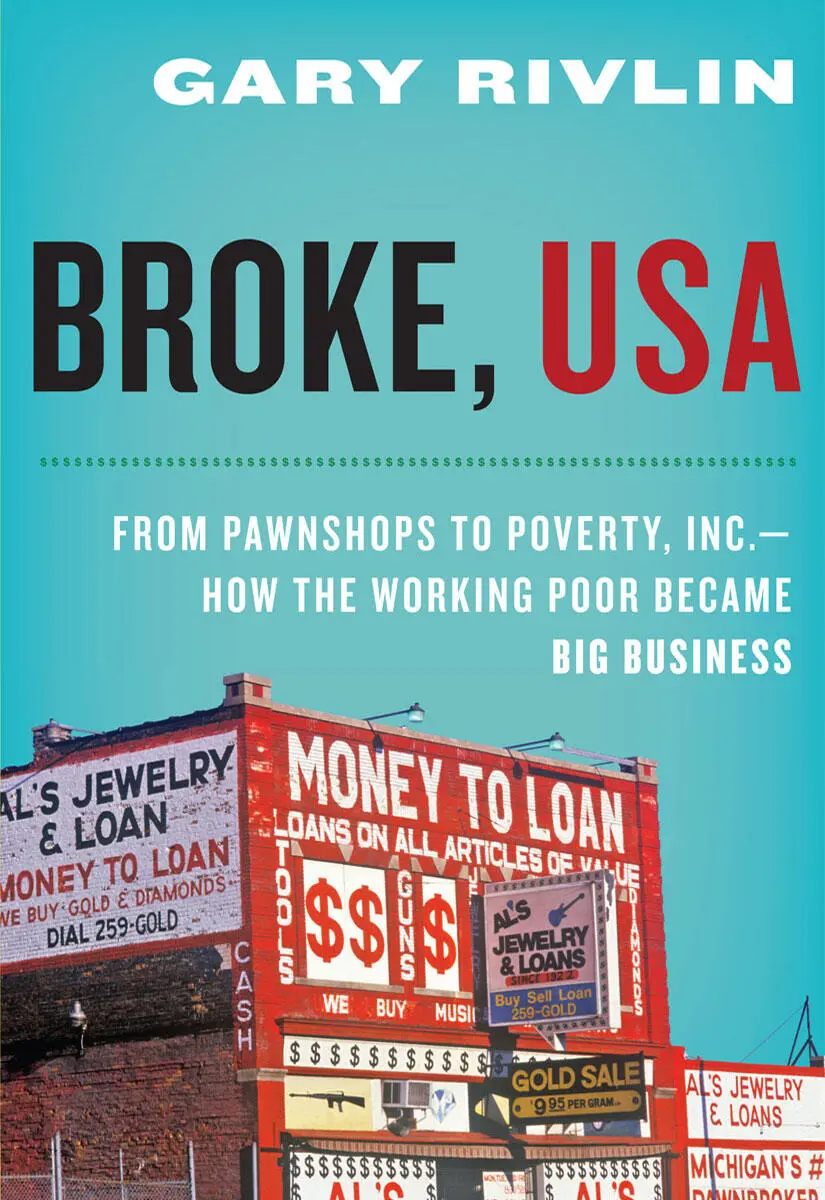
- Название:Broke, USA
- Автор:
- Издательство:HarperCollins Publishers Inc.
- Жанр:
- Год:2010
- Город:New York
- ISBN:978-0-06-199794-5
- Рейтинг книги:3 / 5. Голосов: 1
-
Избранное:Добавить в избранное
- Отзывы:
-
Ваша оценка:
Broke, USA: краткое содержание, описание и аннотация
Предлагаем к чтению аннотацию, описание, краткое содержание или предисловие (зависит от того, что написал сам автор книги «Broke, USA»). Если вы не нашли необходимую информацию о книге — напишите в комментариях, мы постараемся отыскать её.
Broke, USA — читать онлайн бесплатно полную книгу (весь текст) целиком
Ниже представлен текст книги, разбитый по страницам. Система сохранения места последней прочитанной страницы, позволяет с удобством читать онлайн бесплатно книгу «Broke, USA», без необходимости каждый раз заново искать на чём Вы остановились. Поставьте закладку, и сможете в любой момент перейти на страницу, на которой закончили чтение.
Интервал:
Закладка:
The number of loans the average payday consumer took out in a year was another point of contention. Industry sources tended to say seven or eight loans per year while payday’s critics claimed those numbers lowballed the problem. The Woodstock Institute, an advocacy group based in Chicago, concluded that the average payday user in Illinois took out thirteen loans in a year. Policy Matters, a liberal research group based in Cleveland, would reach the same conclusion about borrowers in Ohio. John Caskey, a sociology professor at Swarthmore College and the author of Fringe Banking , studied payday lending in Wisconsin in 2000. He found that 49 percent of the state’s payday borrowers had taken out eleven or more loans over a twelve-month period and that nearly one in five borrowers had taken out twenty or more loans during that time. There was no dispute over the size of the average payday loan, however: $325.
The industry tended to cite one of two studies. One was by Donald Morgan, a researcher at the New York branch of the Federal Reserve who sought to test the thesis put forward by CRL and others that a payday advance was a “predatory debt trap.” According to his research, people in North Carolina and Georgia, two states that had recently banned payday loans, bounced more checks and filed for Chapter 7 bankruptcy at a higher rate than people in states where payday loans were available. Studies by researchers inside academia, though, have shown precisely the opposite, at least on the issue of bankruptcies; relying on payday loans, several studies have found, accelerates the chances that a person will declare bankruptcy. The CRL also cast doubts on the bounced-check claim by noting that Morgan used data from large stretches of the South as a proxy for Georgia and North Carolina.
The other study that advocates of payday lending quote was written by an economics professor at Indiana Wesleyan University named Thomas Lehman. “You cannot read Dr. Lehman’s work without walking away thinking payday lending is absolutely necessary and, if used responsibly, an absolute Godsend,” said Larry Meyers, a former screen-writer turned pro-payday blogger ever since he and a partner started investing in budding payday chains. Yet while journalists regularly quote the CRL in articles about payday, Meyers complained, they never quote Lehman. While testing that hypothesis I came across Lehman’s name in BusinessWeek . He wasn’t mentioned in an article about payday, however; it was about seemingly independent voices who are in fact “quietly financed by powerful interests.” Lehman served as BusinessWeek ’s poster boy for the practice after he confessed to the magazine that in fact the industry had paid him to do his study.
Martin Eakes figured he must be doing something right. He had enough critics throwing mud at him to convince him the CRL was having an impact. One of the sillier attacks came from a group that called themselves the Consumers Rights League, a name chosen presumably so they could appropriate the CRL acronym. They dubbed the original CRL a “predatory charity” that contributed to the world’s economic woes in 2008 by promoting “public panic” about the subprime meltdown.
One of the nastier assaults has come at the hands of a group called the Capital Research Center, a D.C.-based think tank that keeps tabs on liberal advocacy groups. Eakes’s longtime friend Tony Snow, a conservative stalwart, compared his old running buddy to Jack Kemp, an active combatant in the war on poverty while serving as a Republican representing the Buffalo area in Congress. Eakes even uses the same term to describe his politics—he calls himself a “bleeding-heart conservative”—as did Kemp, a former vice presidential candidate and the director of HUD under the first President Bush. Yet Eakes was more liberal and therefore a foe. “A Leftist Crusader Wants to Dictate Financial Options to Consumers” was the headline over the first of several unflattering pieces about Eakes that the Capital Research Center published. Among Eakes’s various crimes: He uses Self-Help to “form political coalitions with radical left-wing groups whose purpose is to bully banks into changing their lending practices” despite Self-Help’s stated mission of helping the disadvantaged, it has loaned millions to its own executives and officers over the years; and its borrowers have delinquency rates seven to ten times higher than their credit union peers. A second article made fewer personal charges but instead criticized Eakes, among others, for “demonizing” the practices of some of the country’s leading subprime lenders. In that article, Capital Research lauded Countrywide, New Century, and other subprime lenders for increasing “home ownership opportunities for minorities and low-income borrowers” while ripping “left-wing advocacy groups” like Self-Help that “oppose consumer choice.”
In Durham, people didn’t know whether to laugh or cry. Capital Research was accusing Eakes of enriching himself at the hands of the poor yet Self-Help’s salary cap meant their boss and the other top staff were getting paid no more than $69,000 a year. Still, they earned too much to join the credit union they ran and therefore were ineligible for loans. For his part, Eakes was relieved that the Raleigh News & Observer had recently named him its 2005 “Tar Heel of the Year.” To ensure they hadn’t chosen wrong, the paper had a reporter check Capital Research’s charges. “It was bad luck for them that the News & Observer had already picked me for this thing,” Eakes said. “They had to get to the bottom of this and investigate.” Making insider loans and reckless lending “would be worrisome,” the News & Observer wrote in an editorial appearing shortly after Capital Research’s first attack, “if there was a word of truth to them.”
At least one of Capital Research’s charges was true: More of Self-Help’s borrowers were thirty or sixty days late in their mortgage payments when compared to the typical credit union. But that was to be expected given Self-Help’s role as a self-styled bank of last resort. “Our customers don’t have the same cushion that middle-class borrowers have,” Eakes said. “So if they lose a job or someone gets sick, they’re more likely to fall behind a month or two. But then they catch up because keeping a home means that much.” Through the economic turmoil of 2008, Self-Help, despite its low-income clientele, had consistently maintained a loan default rate of less than 1 percent.
Bonnie Wright, Eakes’s wife, believes the attacks on her husband help to sustain him. Longtime Self-Help colleagues say the same, but on some level the assault on his character seems to bother Eakes. He cracked jokes about some of the more personal charges foes have leveled at him but back at his office, he wanted to read me a quote from Eric Dezenhall, Steven Schlein’s boss. It took him less than thirty seconds to find it: “Modern communication isn’t about truth, it’s about a resonant narrative. The myth about PR is that you will educate and inform people. No. The public wants to be told in a story who to like and who to hate.”
“They don’t understand idealism,” Eakes said of the payday lenders and other businesses aligned against him. “They can’t believe idealism exists. So they think, ‘You have to be doing this because you want our business.’ They have the most cynical motives so they conclude everyone else has cynical motives.”
Eakes, Ralph Nader–like in his asceticism, hardly offered a fat target for those looking to tarnish the CRL. The same could not be said of all of its donors, though, starting with its top two funders, Marion and Herb Sandler, former owners of the World Savings Bank in Oakland, California. It was Herb Sandler who had first approached Eakes about starting a group like the Center for Responsible Lending, and the Sandlers proved generous benefactors. Mike Calhoun told me the couple had given the CRL roughly $20 million in its first half dozen years but Herb Sandler said the actual dollar figure was “well over” that amount.
Читать дальшеИнтервал:
Закладка:
Похожие книги на «Broke, USA»
Представляем Вашему вниманию похожие книги на «Broke, USA» списком для выбора. Мы отобрали схожую по названию и смыслу литературу в надежде предоставить читателям больше вариантов отыскать новые, интересные, ещё непрочитанные произведения.








Обсуждение, отзывы о книге «Broke, USA» и просто собственные мнения читателей. Оставьте ваши комментарии, напишите, что Вы думаете о произведении, его смысле или главных героях. Укажите что конкретно понравилось, а что нет, и почему Вы так считаете.