Gary Rivlin - Broke, USA
Здесь есть возможность читать онлайн «Gary Rivlin - Broke, USA» весь текст электронной книги совершенно бесплатно (целиком полную версию без сокращений). В некоторых случаях можно слушать аудио, скачать через торрент в формате fb2 и присутствует краткое содержание. Город: New York, Год выпуска: 2010, ISBN: 2010, Издательство: HarperCollins Publishers Inc., Жанр: Старинная литература, на английском языке. Описание произведения, (предисловие) а так же отзывы посетителей доступны на портале библиотеки ЛибКат.
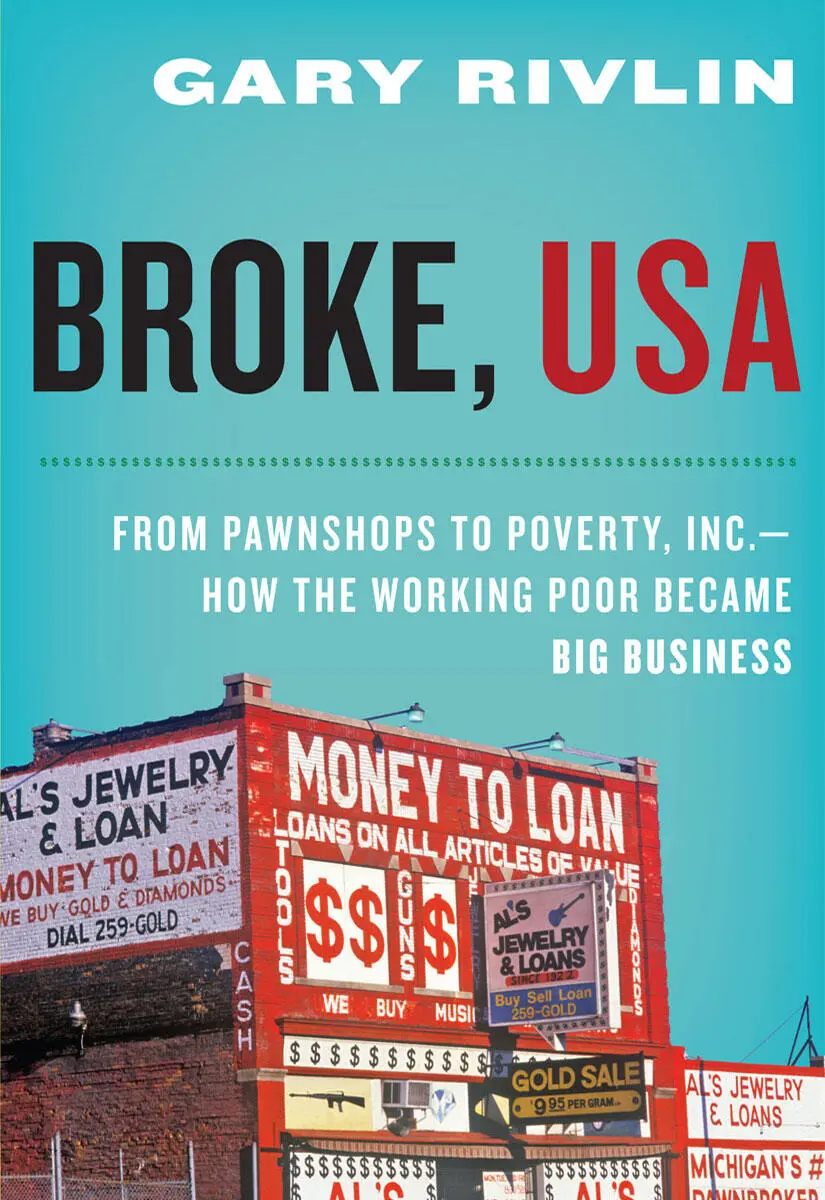
- Название:Broke, USA
- Автор:
- Издательство:HarperCollins Publishers Inc.
- Жанр:
- Год:2010
- Город:New York
- ISBN:978-0-06-199794-5
- Рейтинг книги:3 / 5. Голосов: 1
-
Избранное:Добавить в избранное
- Отзывы:
-
Ваша оценка:
Broke, USA: краткое содержание, описание и аннотация
Предлагаем к чтению аннотацию, описание, краткое содержание или предисловие (зависит от того, что написал сам автор книги «Broke, USA»). Если вы не нашли необходимую информацию о книге — напишите в комментариях, мы постараемся отыскать её.
Broke, USA — читать онлайн бесплатно полную книгу (весь текст) целиком
Ниже представлен текст книги, разбитый по страницам. Система сохранения места последней прочитанной страницы, позволяет с удобством читать онлайн бесплатно книгу «Broke, USA», без необходимости каждый раз заново искать на чём Вы остановились. Поставьте закладку, и сможете в любой момент перейти на страницу, на которой закончили чтение.
Интервал:
Закладка:
Eakes had never heard of World Savings or the Sandlers when Herb Sandler first phoned him proposing a meeting, but he asked around and liked what he had heard about the couple and their bank. They were stand-up lenders, he was told, who concentrated on writing mortgages for middle-class borrowers. They had testified before Congress about sound lending practices and feature articles generally heralded them as humane and socially conscious—old-fashioned bankers succeeding in a modern world. World Savings held on to its loans rather than selling them off on Wall Street. The Sandlers gave generously to the American Civil Liberties Union and Human Rights Watch.
The Sandlers still enjoyed a solid reputation when Wachovia bought Golden West Financial, the parent company of World Savings, for $26 billion in 2006. Their share of the purchase price was a reported $2.3 billion. But then the housing bubble began to deflate and with it the Sandlers’ reputation. Wachovia’s stock plummeted by nearly 80 percent as reports spread of heavy losses in its mortgage holdings. Wachovia had made its share of irresponsible loans long before merging with World Savings but it was the World Savings portfolio that was blamed, at least initially, for the implosion of this bank that had been founded in 1879. At the peak of the credit crisis, in the fall of 2008, federal regulators pressed Wachovia to sell itself to a more secure partner. Wells Fargo bought Wachovia in October of that year, for $15 billion.
World Savings had specialized in a product called an option ARM. These were adjustable rate mortgages—loans that would see interest rates fluctuate over time—that allowed borrowers to choose how much they would pay each month. The Sandlers dubbed World’s product Pick-A-Pay: A customer could make a full monthly payment or they could pay an amount that wouldn’t even cover the interest for that month. To the Sandlers, theirs was a more humane product that insulated borrowers from payment shock should there be a spike in interest rates and also gave them the flexibility to ride out financial bumps in the road, whether a lost job, a divorce, or a health-care crisis. The problem with the loan was what bankers call negative amortization: Choose to pay the lower rate and the amount of money you owe rises over time rather than shrinks. Critics dubbed the option ARM and Pick-A-Pay in particular a fundamentally dishonest loan product—essentially an expensive way for people of modest means to rent a home because those always choosing the lesser payment were unlikely to ever have the money to buy the property. The product might make sense when housing prices were soaring—it’s a very good deal if you can sell for $400,000 the home you bought for $250,000, even if you paid down little if any of the principal—but a lousy deal when prices fell. Then it only seemed a way of lending to people with little or no regard for their ability to pay. Inside the CRL, they don’t seem to have anything good to say about the option ARM. But that wasn’t something people internally would talk about on the record. “Our stance,” Kathleen Day, CRL’s main spokeswoman told me, “is that the Sandlers are perfectly capable of defending themselves.” She then added, “We are grateful they have been so generous in their funding of our efforts,” and noted that their contributions have never come with any strings attached.
By the time I caught up with Herb Sandler to hear his side of things, he was so fed up with the media that he sputtered more than explained. Time magazine put the Sandlers on its list of “25 People to Blame for the Financial Crisis.” The New York Times named them in a front-page article as two of the chief villains behind the economy’s collapse. CBS’s 60 Minutes devoted an entire segment to a former World Savings employee who claimed he had repeatedly tried to warn higher-ups about the destructive nature of the loans they were peddling. The Sandlers were even parodied in a mock C-SPAN press conference aired by Saturday Night Live. When their turn came to stand at the podium, they were identified on screen as “Herb and Marion Sandler: People who should be shot.”
Herb Sandler seemed most angry about the article in the New York Times , which ran on Christmas Day 2008. It wasn’t hard to see why. World Savings was an odd choice for anyone looking to single out some of the worst villains of the subprime meltdown. It had not gotten caught up in the securitization frenzy at the heart of the credit collapse. Loans made through World Savings were held on to rather than sold on Wall Street. The Sandlers were pushing adjustable rate mortgages, sure, and they would play a role in the great global recession, but they were not ensnaring people with teaser rates as low as 1 percent annually and then hitting borrowers, two years later, with rates that reset at 6 or 7 or 8 percent. They didn’t target minorities or the working poor like many other lenders. World Savings stood as a perfect laboratory for examining how the housing frenzy overtook even seemingly well-meaning businesspeople but instead World—and the Sandlers in particular—was lumped in to listings of the country’s more reckless, covetous lenders. Among those delighting in the misfortune of the Sandlers was Steven Schlein, who never seemed to tire of pointing out that the “founders of the Center for Responsible Lending” had been exposed as the “toxic mortgage king and queen.”
As if all the negative reports about the Sandlers weren’t bad enough for the CRL, another major donor, John Paulson, wore a similarly large target on his back. Paulson was a hedge fund manager who so firmly believed that loose lending standards would cause deep troubles in the broader economy that he bet against the real estate market. Paulson & Co. made $15 billion in profits in 2007, $3.7 billion of which Paulson himself pocketed. That is believed to be the largest one-year payday in Wall Street history. In 2008, his firm collected another $5 billion in profits. In different circumstances, Allan Jones might have been impressed, but Paulson had donated millions to the CRL, so Jones was disgusted.
“It was un-American what he did,” Jones said. “He made his money betting against our country. This is who’s funding the CRL.” Jones then brought up the Sandlers, who he claimed “started the credit meltdown” when they sold Golden West to Wachovia. “You look at how dirty the CRL is,” he said. “And after knowing that, you’d even listen to a word they have to say about us?”
Thirteen
Past Due
Bill Faith didn’t mince words when his fellow activists in Dayton asked him at the start of the 2000s about Dean Lovelace’s plan to introduce a local law to restrict the city’s predatory home lenders. “I told them, ‘No offense, but you don’t have the capacity, you don’t know what you’re doing,’” Faith said. The states and the federal governments have agencies in place to monitor lenders, he told them; cities don’t. But Faith was also the state’s most prominent housing advocate, so when his allies in Dayton moved ahead anyway, he did what he could to help. Faith shrugged when we met in his offices a few blocks from the state capitol in Columbus in the fall of 2008. “I figured if it got attention for the issue, that’d be a good thing,” Faith said. The city councils in Cleveland and Toledo would pass bills similar to Dayton’s.
In theory, Ohio was a strong home-rule state that granted municipalities broad powers over the regulations inside their borders. In reality, though, the mortgage industry had the cash and the clout to convince the Ohio state legislature, one year after Dayton’s legislation, to pass a law stripping Dayton, Cleveland, and Toledo of the authority to regulate the mortgage lenders operating within their city limits. The boilerplate anti-predatory language its sponsors added to the bill was largely lifted from the 1994 HOEPA statute, and therefore already law, but that didn’t prevent Governor Bob Taft, a Republican, from patting himself on the back. This bill, Taft declared when signing the measure into law, proves that in Ohio “we will not tolerate predatory lenders, or loan sharks, who take advantage of senior citizens, people with limited incomes, or people with bad credit histories.” More revealing, though, were the reactions of partisans to its passage. “We certainly think it’s a good bill,” said Dayna Baird, the head of the Ohio Consumer Finance Association and the chief lobbyist for large lenders such as Household and CitiFinancial. In contrast, Jim McCarthy in Dayton dismissed the new law as a “canard” and Bill Faith dubbed it “the most arrogant bill I’ve seen in all my years in Columbus.
Читать дальшеИнтервал:
Закладка:
Похожие книги на «Broke, USA»
Представляем Вашему вниманию похожие книги на «Broke, USA» списком для выбора. Мы отобрали схожую по названию и смыслу литературу в надежде предоставить читателям больше вариантов отыскать новые, интересные, ещё непрочитанные произведения.







Обсуждение, отзывы о книге «Broke, USA» и просто собственные мнения читателей. Оставьте ваши комментарии, напишите, что Вы думаете о произведении, его смысле или главных героях. Укажите что конкретно понравилось, а что нет, и почему Вы так считаете.