Gary Rivlin - Broke, USA
Здесь есть возможность читать онлайн «Gary Rivlin - Broke, USA» весь текст электронной книги совершенно бесплатно (целиком полную версию без сокращений). В некоторых случаях можно слушать аудио, скачать через торрент в формате fb2 и присутствует краткое содержание. Город: New York, Год выпуска: 2010, ISBN: 2010, Издательство: HarperCollins Publishers Inc., Жанр: Старинная литература, на английском языке. Описание произведения, (предисловие) а так же отзывы посетителей доступны на портале библиотеки ЛибКат.
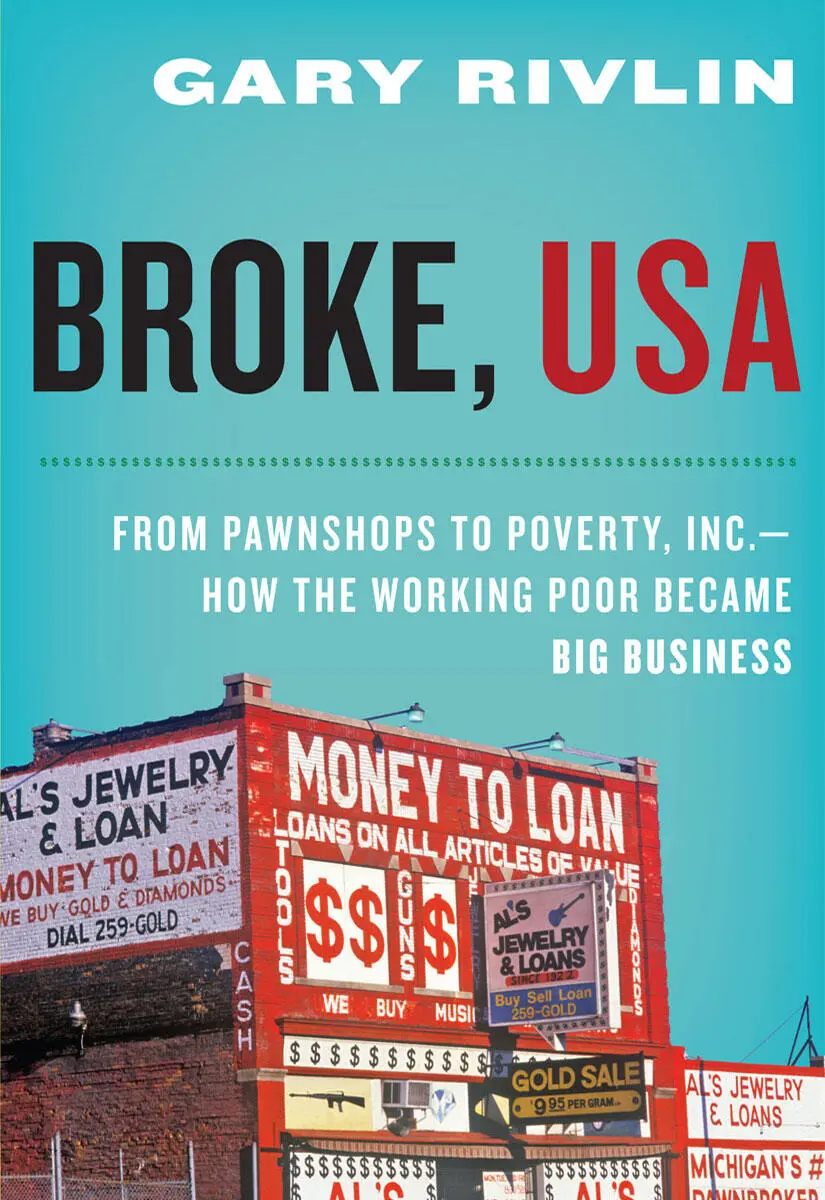
- Название:Broke, USA
- Автор:
- Издательство:HarperCollins Publishers Inc.
- Жанр:
- Год:2010
- Город:New York
- ISBN:978-0-06-199794-5
- Рейтинг книги:3 / 5. Голосов: 1
-
Избранное:Добавить в избранное
- Отзывы:
-
Ваша оценка:
Broke, USA: краткое содержание, описание и аннотация
Предлагаем к чтению аннотацию, описание, краткое содержание или предисловие (зависит от того, что написал сам автор книги «Broke, USA»). Если вы не нашли необходимую информацию о книге — напишите в комментариях, мы постараемся отыскать её.
Broke, USA — читать онлайн бесплатно полную книгу (весь текст) целиком
Ниже представлен текст книги, разбитый по страницам. Система сохранения места последней прочитанной страницы, позволяет с удобством читать онлайн бесплатно книгу «Broke, USA», без необходимости каждый раз заново искать на чём Вы остановились. Поставьте закладку, и сможете в любой момент перейти на страницу, на которой закончили чтение.
Интервал:
Закладка:
The CRL’s first big media triumph came in the spring of 2005, when CBS correspondent Scott Pelley traveled to North Carolina to report on the state’s efforts to evict the payday lenders from within its borders. Sandra Harris told her story, as did John Kucan. Listeners also heard from a woman named Ginny McCauley, who ran an Advance America store in Illinois for six years. McCauley estimated that 60 to 70 percent of her customers were rollovers during that time. Pelley asked Jim Blaine, the CEO of the State Employees’ Credit Union of North Carolina, what he would tell someone who was planning on taking out a payday loan. “I’d say go get a loan shark,” Blaine said. “They’re cheaper.” A typical loan shark, he explained, only charges an APR of around 150 percent.
The only payday lender willing to talk on camera was Willie Green, a former NFL wide receiver who opened his first payday store as his playing days were ending in the mid-1990s; he ultimately opened ten stores. Pelley asked Green, who was from a poor background, what he would say to a Sandra Harris, who had lost a car and almost a home. “How about, ‘Thank You, Mr. Green or Mr. Check Casher or Mr. Payday Advance Store for helping me out when I was in a time of need?’” Later in the segment, when Pelley brought up the prospect of Green’s wife taking out a payday advance, he essentially confessed that she was too smart for that. “She has a master’s degree in accounting,” he said.
The next year brought another body blow to the industry. This time it wasn’t the CRL leading the charge (though Eakes’s group would provide critical behind-the-scenes lobbying help) but the commanding officers at military bases around the country, unhappy that the payday operators had opened so many shops outside their gates—“like bears on a trout stream,” a pair of academics concluded in a 2005 study of the geography of payday lending. Was it any wonder, given that the country’s military bases were thick with young, financially inexperienced people getting by on modest salaries? In the mid-2000s, the typical army private first class started at an annual salary of $17,000 a year and nearly three-quarters of active-duty military personnel never made more than $30,000 a year. There were reports of soldiers discharged because they defaulted on a loan and many others were stuck stateside because of a military rule that stated that anyone owing more than 30 percent of his or her salary could not be dispatched overseas. “I have guys guarding my gate here when they should be deployed in Iraq,” the commanding officer at a naval base in San Diego told the Associated Press. The CRL waded into the fight with a study concluding that one in five active-duty military personnel had taken out a payday loan in the previous year versus one in every sixteen adult Americans. At Fort Bragg, North Carolina, credit counselors said they were seeing an average of two to three soldiers a week who owed money to a payday lender, according to a report cited by Bloomberg Markets .
To the extent that the payday industry has clout on Capitol Hill, it’s in the Senate Financial Services Committee, but this fight was waged instead in the Armed Services Committee. In the summer of 2006, Senator Jim Talent, a Missouri Republican, and Senator Bill Nelson, a Florida Democrat, added an amendment to the annual defense authorization bill that capped the rate military families would have to pay for a payday loan at 36 percent. It passed, and when the defense authorization bill became law that fall, payday lenders could charge active-duty personnel no more than $1.38 on every $100 they borrowed. With a stroke of the pen, the country’s payday lenders were essentially banned from doing business with the military. It didn’t elude the industry that it wouldn’t take much of a logical leap for a legislative body to conclude that if payday loans were so destructive to the emotional and financial well-being of America’s fighting men and women, they might also be harmful to some of their other constituents.
At the start of 2006, people inside Self-Help and the CRL started to notice a spike in the number of subprime home loans. Even as late as 2003, subprime accounted for only 8 percent of the overall residential mortgage market, but by 2006, subprime loans accounted for more than one in every four home loans written—28.7 percent of the mortgage market, according to the Fed. Worried that this would spell doom for the home ownership dreams of a great many low- and moderate-income people, a research team was created inside the CRL to predict what might happen. Ellen Schloemer, the CRL’s research director, told me that their conclusion, that this trend would lead to 2 million subprime foreclosures, was so incredible that they rewrote a report they called “Losing Ground” six times before releasing it at the end of 2006. The Mortgage Bankers Association denounced the study as wildly pessimistic but in time it would become clear this was one of the few early warnings of the economic carnage to come. “That study really put us on the map in Washington,” Mike Calhoun said. At the start of 2008, the publication Politico declared that the CRL was “the main intellectual engine driving the Democratic response to the housing crisis” in no small part because “the Center has been more right than wrong.” That same year the Federal Reserve Board would single out the CRL for its research when appointing Mike Calhoun to a three-year term on its Consumer Advisory Council.
Steven Schlein, though, has not been nearly as impressed with CRL’s research capabilities. “They do not do scholarship,” Schlein said. “It’s a joke what they call a study. They’re done by a bunch of twenty-four-year-old kids sitting in some office in North Carolina, plucking numbers from out of the air.”
In fact, some of CRL’s payday reports have tended to overreach. Its first big industry study, for instance, released in 2006 and called “Financial Quicksand,” asserted that 90 percent of the revenues payday lenders collect in any given year are “stripped from trapped borrowers.” Under the CRL’s definition, though, a trapped borrower was anyone taking out as few as five payday loans a year. The study also alleged that the “typical” payday borrower ended up spending nearly $800 to repay a single $325 loan, or more than $450 of accumulated fees. That’s because the average payday customer, the CRL found after examining data from eight states, took out nine loans per year. Inside the CRL, they assumed that meant a person took out a single loan and then flipped it eight times before paying it back, but it seemed just as reasonable to conclude that the typical borrower took out a new loan every few months but needed an extra couple of payments to wipe out the debt.
But one could also ask what difference it made. Maybe five loans a year didn’t call to mind a “trapped” borrower but it also didn’t conjure up the customer needing a bailout because (as Willie Green had told Scott Pelley) “God forbid, an emergency comes up where the refrigerator goes out or the child needs to go to the doctor.” And did it make much difference whether a person flipped a single loan eight consecutive times or took out multiple loans in a given year? The bottom line was the same: nearly $500 in payments to a payday lender rather than money that might otherwise go into a savings account.
The industry would again find fault in some of the more sweeping assertions made within the CRL’s next big study, “Springing the Debt Trap,” released in 2007. But the power of that report wasn’t in its conclusions; it was in the data the CRL collected from states that tracked and published customer usage statistics. In Colorado, for instance, one in seven payday borrowers in 2005 remained in debt for at least six months before paying back a loan. Regulators there also found that customers taking out twelve or more loans in a year generated 65 percent of the industry’s revenues in the state. Other states reported similar findings when singling out those taking out twelve or more loans in a year: Oklahoma (64 percent of their revenues from this group), Florida (58 percent), Washington state (56 percent). At least one in five borrowers in each of those four states had taken out twenty-one or more loans in a year. In this regard, the APR no longer seemed an imprecise measurement of what was in fact a fee but a close approximation of the interest a good portion of the industry’s customer base was paying for its short-term cash needs.
Читать дальшеИнтервал:
Закладка:
Похожие книги на «Broke, USA»
Представляем Вашему вниманию похожие книги на «Broke, USA» списком для выбора. Мы отобрали схожую по названию и смыслу литературу в надежде предоставить читателям больше вариантов отыскать новые, интересные, ещё непрочитанные произведения.









Обсуждение, отзывы о книге «Broke, USA» и просто собственные мнения читателей. Оставьте ваши комментарии, напишите, что Вы думаете о произведении, его смысле или главных героях. Укажите что конкретно понравилось, а что нет, и почему Вы так считаете.