Gary Rivlin - Broke, USA
Здесь есть возможность читать онлайн «Gary Rivlin - Broke, USA» весь текст электронной книги совершенно бесплатно (целиком полную версию без сокращений). В некоторых случаях можно слушать аудио, скачать через торрент в формате fb2 и присутствует краткое содержание. Город: New York, Год выпуска: 2010, ISBN: 2010, Издательство: HarperCollins Publishers Inc., Жанр: Старинная литература, на английском языке. Описание произведения, (предисловие) а так же отзывы посетителей доступны на портале библиотеки ЛибКат.
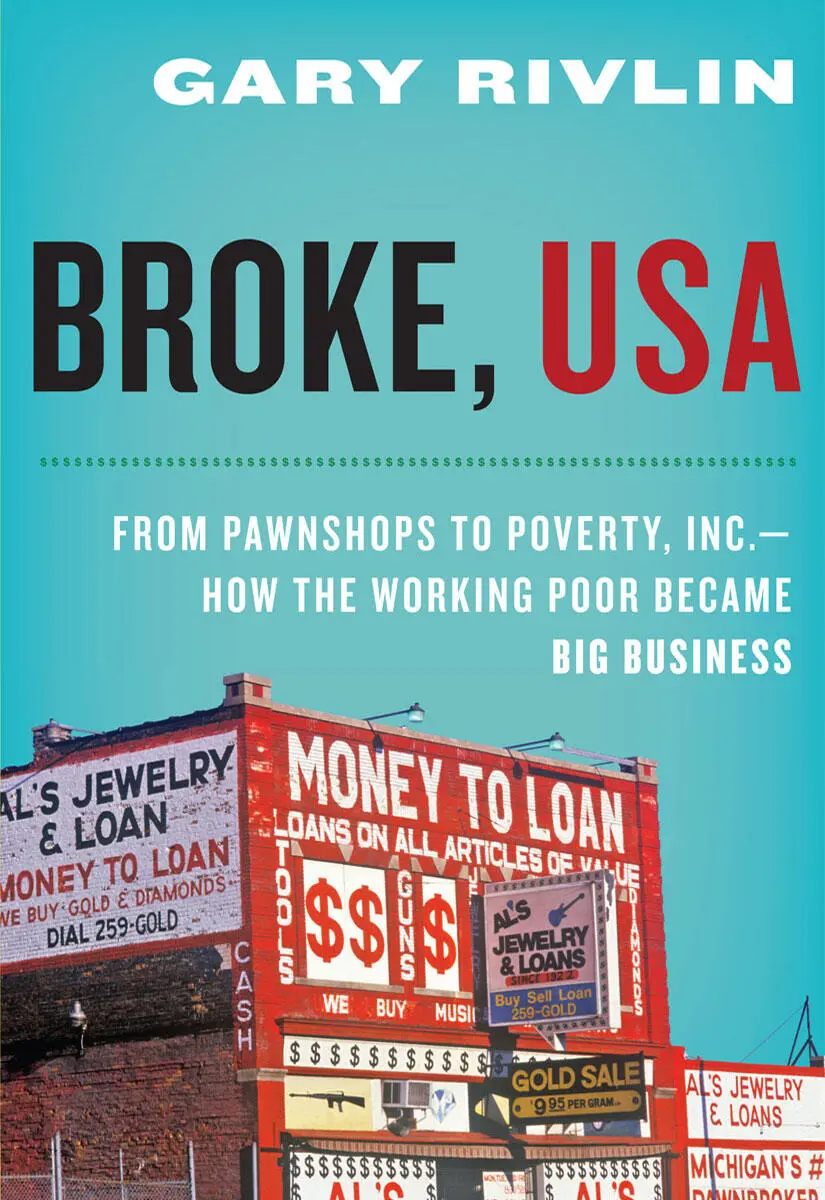
- Название:Broke, USA
- Автор:
- Издательство:HarperCollins Publishers Inc.
- Жанр:
- Год:2010
- Город:New York
- ISBN:978-0-06-199794-5
- Рейтинг книги:3 / 5. Голосов: 1
-
Избранное:Добавить в избранное
- Отзывы:
-
Ваша оценка:
Broke, USA: краткое содержание, описание и аннотация
Предлагаем к чтению аннотацию, описание, краткое содержание или предисловие (зависит от того, что написал сам автор книги «Broke, USA»). Если вы не нашли необходимую информацию о книге — напишите в комментариях, мы постараемся отыскать её.
Broke, USA — читать онлайн бесплатно полную книгу (весь текст) целиком
Ниже представлен текст книги, разбитый по страницам. Система сохранения места последней прочитанной страницы, позволяет с удобством читать онлайн бесплатно книгу «Broke, USA», без необходимости каждый раз заново искать на чём Вы остановились. Поставьте закладку, и сможете в любой момент перейти на страницу, на которой закончили чтение.
Интервал:
Закладка:
Schlein is a trim man, around fifty years old, with close-shorn gray hair. Those in the public relations trade tend toward the bubbly, or at least upbeat, but Schlein by disposition is far more dour, more life-weary and rough-hewn. He’s also more than a little obsessed with money. Over breakfast he told me about his grandfather, who had moved to this country from an Eastern European shtetl with next to nothing. He left a pair of successful jewelry stores to his heirs but Schlein wishes his grandfather had been a pawnbroker. “It was totally random, him getting into the jewelry business,” Schlein explained. And pawn sales, he went on to point out, are “going gangbusters right now.” At that same breakfast, he asked me to explain how a person could work as a business reporter at a place like the New York Times or Wall Street Journal . Some barely earn six-figure salaries. He can’t imagine working that hard, he told me, for so little money.
Schlein clearly is well paid. He wears expensive suits and a pair of fashionable rectangular steel glasses. Dezenhall’s offices are sleek, modern, prosperous looking. Yet one might ask Schlein why he does what he does for a living. His job hasn’t been much fun, he confessed, at least since taking over the payday account. He’ll work on a friendly reporter he knows, hoping to persuade him or her to see beyond the 391 percent APR, but then 60 Minutes Wednesday runs a segment on payday that begins, “It may sound like loan-sharking, but in most of America, it’s perfectly legal.” That particular story was set in North Carolina, of course. Look behind every effort to ban payday lending, Schlein said, and you’ll find “Martin Eakes and his little empire.”
It galls Schlein that people, especially reporters, hold up Eakes as some kind of white knight. To him, Eakes is a competitor who first opposed payday lending in North Carolina “because he runs a credit union and he had an economic stake in seeing us gone.” With no payday loans to help bail people out, the credit unions, like banks, earn a lot more in bounced-check fees and overdraft protection products. And once Eakes defeated them in North Carolina, he said, “he became enthralled with his power.”
“Just listen to the guy speak,” Schlein said. “He oozes elitism out of every pore. He’s the only one who knows what’s best for everyone else. He really thinks he’s the last honest man.”
Martin being Martin. That’s how Mark Pearce, the Self-Help executive Eakes chose to serve as the first president of the Center for Responsible Lending, described the decision to spend $23 million to buy the eleven-story office building that has pretty much destroyed Steven Schlein’s peace of mind. The building is located in Farragut Square, three blocks from the White House. “It was Martin’s way of saying we’re here and we’re not going anywhere,” Pearce said. It was also an aggressive business decision by an advocacy group that feels entirely at home playing the real estate game. The CRL, founded in 2002, occupies one floor and leases out the other ten, providing the organization with a steady income that more than covers the mortgage. Plus, Eakes said, the building is already worth more than $30 million.
Mike Calhoun admitted he was shocked to discover how rich and big the CRL was relative to other advocacy outfits. “We looked at groups like the Consumer Federation, PIRG, and the Consumer Law Center and we realized we were huge, relatively speaking, compared to these other groups,” said Calhoun, who took over as president of the CRL in 2006, when Pearce took a top regulatory posting with the state of North Carolina. “And these were organizations which had much wider mandates than us, with utilities and health care on top of consumer finance and mortgages.” To CRL’s great relief, these other groups were “gracious and welcoming,” Calhoun said, to this new giant in their midst (the group has a staff of sixty spread across three offices) and invited them to take the lead on predatory lending issues. The challenge, then, was figuring out what they would do in their newfound roles at the vanguard of the consumer rights movement.
The CRL would focus mainly on businesses that catered to the poor and working poor, but even then that left them with an impossibly broad terrain to cover. Subprime credit cards, rent-to-own, used car finance, refund anticipation loans, even the humble corner pawnbroker: There seemed no shortage of ways entrepreneurs had devised for getting rich working the easy-credit landscape. There was even a fledgling industry devoted to helping hospitals and doctors collect the money owed to them by the uninsured and underinsured. These companies, part of what BusinessWeek would dub the “medical debt revolution,” normally don’t charge the hospital or physician anything for its services but instead earn their profits from the fees and interest rates (typically between 14 and 25 percent) they tack onto the bills they have been assigned.
The CRL would naturally focus on exploitative subprime mortgages. The problem had grown only more acute since they had sided with Freddie Rogers in his fight with Associates and there was no doubting their authority in this realm. Kathleen Day remembered when she was covering the banking industry for the Washington Post and for the first time saw Eakes testify before Congress. Most striking, said Day, who now runs the CRL’s public information office, was how differently Eakes came across compared to the other consumer advocates speaking that day. “He starts off telling people he’s been in this business for twenty-five years,” Day remembered. “And he tells the committee, ‘You can’t tell me it can’t be done because I’m doing it, and I’m doing it right without screwing people.’” The banking lobbyists Day happened to share a cab with after the hearing were all in a huff about Eakes, she said. They didn’t say he was wrong: They didn’t say he didn’t know what he was talking about. “All they could say,” Day recalled, “is that they thought he was sanctimonious.”
The payday lending industry would be CRL’s second priority. Martin Eakes and Self-Help were too invested in that fight to consider dropping it, especially once they had the money to build a national organization. Their third and final priority would be the more predatory side of the credit card industry, including practices the consumer activists called “fee harvesting.” The insidious part of fee harvesting is that the consumer, her credit damaged and her funds tight, starts off feeling grateful that a lender is willing to trust her with a credit card. But then she receives the first bill. There are card activation fees and origination fees (commonly $100 or more) billed as a cash advance and also an “account maintenance fee” (maybe $10 a month). The fees eat up a goodly share of the available credit, typically between $300 and $500, and therein lies another huge moneymaking opportunity for the card issuer: the fine for going over your available limit. In time, the CRL would also add banks to their list of targets and specifically the overdraft fees they charged. “These fees are becoming the main profit center for these banks,” Eakes said, “which means they’re making the bulk of their profits off their poorest customers.” Still, the CRL would devote a lot more time to fighting the mortgage lenders and the payday advance industry than to battling the banks that were issuing subprime credit cards.
The payday lenders lost in North Carolina in 2001 and then again a few years later in Georgia and Arkansas. Even so, they were slow to recognize that they were in an existential fight for their livelihood. “These were three very different situations,” Billy Webster said. North Carolina was Martin Eakes, Georgia boiled down to the political clout of the industrial loan stores that Roy Barnes had battled, and Arkansas was a quirk: A legal battle they lost because Arkansas is the only state in the union with a usury cap (17 percent) written into the state constitution. Still, the same year that they lost in Georgia, the big chains hired Dezenhall. We need to be more aggressive, Webster explained in an American Banker article about the payday lenders “going on the offensive.” We need to explain to people that a payday advance is cheaper than missing a credit card payment or a series of bounced checks. Steven Schlein had just been hired but he was not wasting time. The Center for Responsible Lending might sound as if it has the best interest of consumers at heart, Schlein said, but he shared with American Banker a report he had put together dismissing the CRL as nothing but a front group for a Durham-based credit union.
Читать дальшеИнтервал:
Закладка:
Похожие книги на «Broke, USA»
Представляем Вашему вниманию похожие книги на «Broke, USA» списком для выбора. Мы отобрали схожую по названию и смыслу литературу в надежде предоставить читателям больше вариантов отыскать новые, интересные, ещё непрочитанные произведения.








Обсуждение, отзывы о книге «Broke, USA» и просто собственные мнения читателей. Оставьте ваши комментарии, напишите, что Вы думаете о произведении, его смысле или главных героях. Укажите что конкретно понравилось, а что нет, и почему Вы так считаете.