Gary Rivlin - Broke, USA
Здесь есть возможность читать онлайн «Gary Rivlin - Broke, USA» весь текст электронной книги совершенно бесплатно (целиком полную версию без сокращений). В некоторых случаях можно слушать аудио, скачать через торрент в формате fb2 и присутствует краткое содержание. Город: New York, Год выпуска: 2010, ISBN: 2010, Издательство: HarperCollins Publishers Inc., Жанр: Старинная литература, на английском языке. Описание произведения, (предисловие) а так же отзывы посетителей доступны на портале библиотеки ЛибКат.
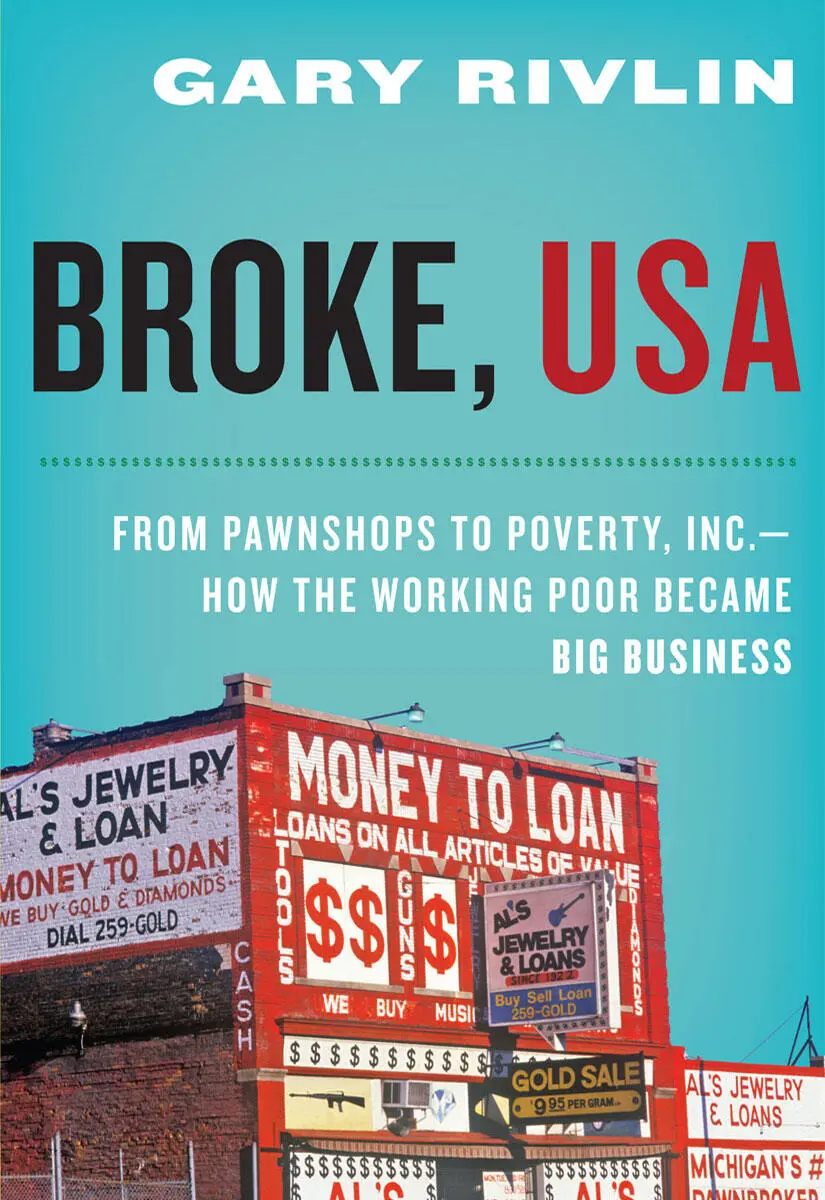
- Название:Broke, USA
- Автор:
- Издательство:HarperCollins Publishers Inc.
- Жанр:
- Год:2010
- Город:New York
- ISBN:978-0-06-199794-5
- Рейтинг книги:3 / 5. Голосов: 1
-
Избранное:Добавить в избранное
- Отзывы:
-
Ваша оценка:
Broke, USA: краткое содержание, описание и аннотация
Предлагаем к чтению аннотацию, описание, краткое содержание или предисловие (зависит от того, что написал сам автор книги «Broke, USA»). Если вы не нашли необходимую информацию о книге — напишите в комментариях, мы постараемся отыскать её.
Broke, USA — читать онлайн бесплатно полную книгу (весь текст) целиком
Ниже представлен текст книги, разбитый по страницам. Система сохранения места последней прочитанной страницы, позволяет с удобством читать онлайн бесплатно книгу «Broke, USA», без необходимости каждый раз заново искать на чём Вы остановились. Поставьте закладку, и сможете в любой момент перейти на страницу, на которой закончили чтение.
Интервал:
Закладка:
The other side, of course, was offering much the same complaint: A fractured system meant fighting the same battle in town after town and in state after state. At the end of 2001, the Federal Reserve, which Congress had deputized to monitor the field, modified its definition of a “high cost” loan to include any loan carrying an interest rate eight percentage points higher than a Treasury bill, putting it in line with the North Carolina law and Georgia’s proposal, and declared that any lender making a “high cost” loan needed to take into account a borrower’s ability to repay the loan. Yet both sides had their powerful stalwarts in Congress, and neither could muster enough support to change the system. So despite the wishes of either side, the fight played out in states and cities around the country, creating a complex and multilevel battlefield (if not also a lucrative one) for Andrews and other lobbyists.
Martin Eakes had proven that a lender could make loans to subprime borrowers at rates around one percentage point above the going rate for prime borrowers and at least break even. Self-Help was a nonprofit, but even if charging only two or three percentage points above the conventional rate, a lender could still make double-digit profits. Georgia’s proposed law only applied to mortgages that charged rates eight percentage points above conventional rates, yet Andrews and his colleagues deemed the proposed new rules unduly excessive. It will hurt first-time homebuyers. It will chase away the legitimate lenders, not just the crooked ones. “I had one bank CEO in my office telling me that Georgia is going to become an island; no one is going to make a loan here,” Barnes scoffed. “We were the third or fourth fastest-growing state in the nation, at least at the time. I just couldn’t believe no one was going to loan us money when we were growing that fast.” In one meeting, a contingent of out-of-town lenders argued that if Georgia insisted on imposing its own rules on mortgages, then it would be difficult to sell them in the secondary market. Mortgages are the latest commodity sold on the global market, they explained, but Barnes was thinking these guys weren’t thinking beyond next quarter’s bonuses.
“I’m telling ’em, ‘You’re in for a crash here, this isn’t going to end well,’” Barnes said. “But they’re looking at me like I’m the one who doesn’t understand.”
Barnes was confident he could outmaneuver the out-of-town lenders. He knew he could best the mortgage brokers, but the state’s biggest banks, even those not making high-cost loans, were also aligned against him and that had him worried. So he called them into his office to threaten them en masse. “I have this vacancy on the banking commission,” Barnes recalled telling them, “and if y’all don’t back off this bill, I’m going to do a nationwide search to find me the most sandal-wearing, long-haired, liberal consumer activist I can find to regulate every last one of you.’” Whether that was a bluff was not something they were willing to find out. “I finally backed them off,” Barnes said.
Even many of his fellow Democrats were opposing him. “You’d’ve thought I was proposing the repeal of the Plan of Salvation, that’s how much they were fightin’ me on this,” Barnes said. Some told him that they were worried his measure would make them appear antibusiness. “This ain’t about business,” he’d tell them, “this is about taking advantage of folks.” And when reason wouldn’t work, he reminded them that he was governor and could make life miserable for them if he set his mind to it. “They were mostly mad because they were enjoying those thick steaks and the cold liquor they were getting from the lobbyists,” he said.
Fort confessed to experiencing a few pinch-me moments during those weeks of arm-twisting and uncertainty. He would be sitting in a hearing room overstuffed with lobbyists and activists and feel something like shock. “The whole focus nationally was on stopping us in Georgia so it wouldn’t spread to other places,” he said. “It was almost surreal to think what we had started in 2000 had gotten to this level.” Fort had staked out the conference room next to his legislative office, where every Friday a small coterie of strategists would gather. He had Bill Brennan on hand to help him monitor small changes in the bill, along with Self-Help’s Mike Calhoun, who had helped Fort write the original bill. Another regular, Kathy Floyd, a lobbyist for AARP, arranged for tens of thousands of its members to phone legislators in support of the Barnes-Fort bill.
“As this process moved along, my job was to make a lot of noise,” Fort said. “It was to our benefit for them to think I was militant or racial or whatever. The crazier they saw me, the more dealing with Roy didn’t seem so bad.”
Despite everything they were doing, Fort thought they were a goner when Fannie Mae waded into their fight. In a letter addressed to Barnes, the government-backed mortgage giant warned that the measure “could unintentionally shrink the availability of responsible credit for the most vulnerable consumers.” Fannie Mae asked to be exempted from the bill. But rather than respond directly to Fannie Mae, one of the governor’s people enlisted Fort. “So I blast Fannie Mae and hint at the crowds we’ll mobilize to protest their actions,” Fort said. And the next thing he knew, Fannie Mae had rescinded its statement and issued one in support of the bill. The agency blamed the whole thing on a low-ranking staffer.
Barnes probably compromised more than Fort would have had he been the chief negotiator. The biggest concession was giving up on judicial foreclosures. In many states, foreclosures are overseen by the courts but not in Georgia. There are strict rules governing the procedure, but a lender can auction off a property without ever going before a judge. The Barnes-Fort bill sought to change that but Barnes dropped that proposal to win the support of the Speaker of the House, a Democrat. But the bill passed mainly intact, including the provision that would allow a borrower to sue anyone who takes possession of his or her mortgage. “There’s a compassion issue here,” state senator Bill Stephens, a Republican, told the Atlanta Journal-Constitution , explaining why he and so many other members of the GOP voted for Barnes’s bill. “You can’t hear the stories without having it tug at your heart.”
Barnes signed the bill into law in April 2002. He held a signing ceremony in Atlanta and similar events in Savannah, Augusta, and Macon. Before the week was out, he would hold no less than seven public ceremonies to sign a bill that advocates and critics alike were describing as the toughest anti–abusive lending law in the land.
Barnes had generously singled out Bill Brennan and his staff during that first signing in Atlanta. This would never have happened, the governor said, without them. What passage of this bill meant to Brennan nearly a dozen years after he first came across that first flurry of Fleet cases became clear to Fort a few weeks later, at a celebration sponsored by Atlanta Legal Aid. No one expected them to win, Fort said from the podium. Not the good ol’ boys who were still stunned that they had lost—and not even those pushing for the bill. While he was speaking, Fort recalled, he spotted Brennan standing off to the side, overcome with emotion. “Bill doesn’t know that I noticed,” he said, “but I saw tears coming down his cheeks.”
On election night, Roy Barnes saw the early returns from the rural white counties and knew he was in trouble. He might have won a John F. Kennedy Profile in Courage award for changing the Georgia state flag but apparently not everyone was so impressed with his convictions. In the end, the 2002 race wasn’t even close; GOP challenger Sonny Perdue beat Barnes by five percentage points and, for the first time in 130 years, a Republican was seated as the governor of Georgia. “Bill, you know it’s over,” Fort said when he called Bill Brennan the next day. And even Brennan, ever the optimist, had to confess that his friend was probably right.
Читать дальшеИнтервал:
Закладка:
Похожие книги на «Broke, USA»
Представляем Вашему вниманию похожие книги на «Broke, USA» списком для выбора. Мы отобрали схожую по названию и смыслу литературу в надежде предоставить читателям больше вариантов отыскать новые, интересные, ещё непрочитанные произведения.









Обсуждение, отзывы о книге «Broke, USA» и просто собственные мнения читателей. Оставьте ваши комментарии, напишите, что Вы думаете о произведении, его смысле или главных героях. Укажите что конкретно понравилось, а что нет, и почему Вы так считаете.