Gary Rivlin - Broke, USA
Здесь есть возможность читать онлайн «Gary Rivlin - Broke, USA» весь текст электронной книги совершенно бесплатно (целиком полную версию без сокращений). В некоторых случаях можно слушать аудио, скачать через торрент в формате fb2 и присутствует краткое содержание. Город: New York, Год выпуска: 2010, ISBN: 2010, Издательство: HarperCollins Publishers Inc., Жанр: Старинная литература, на английском языке. Описание произведения, (предисловие) а так же отзывы посетителей доступны на портале библиотеки ЛибКат.
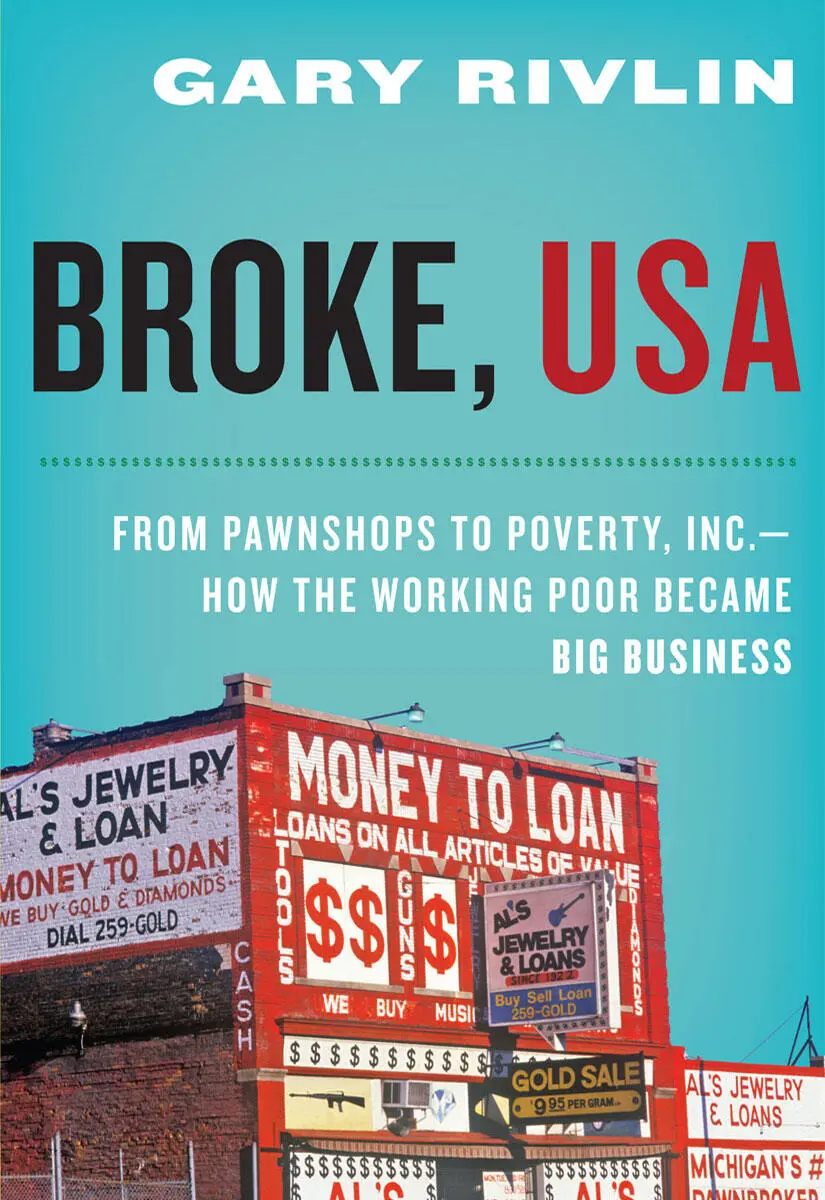
- Название:Broke, USA
- Автор:
- Издательство:HarperCollins Publishers Inc.
- Жанр:
- Год:2010
- Город:New York
- ISBN:978-0-06-199794-5
- Рейтинг книги:3 / 5. Голосов: 1
-
Избранное:Добавить в избранное
- Отзывы:
-
Ваша оценка:
Broke, USA: краткое содержание, описание и аннотация
Предлагаем к чтению аннотацию, описание, краткое содержание или предисловие (зависит от того, что написал сам автор книги «Broke, USA»). Если вы не нашли необходимую информацию о книге — напишите в комментариях, мы постараемся отыскать её.
Broke, USA — читать онлайн бесплатно полную книгу (весь текст) целиком
Ниже представлен текст книги, разбитый по страницам. Система сохранения места последней прочитанной страницы, позволяет с удобством читать онлайн бесплатно книгу «Broke, USA», без необходимости каждый раз заново искать на чём Вы остановились. Поставьте закладку, и сможете в любой момент перейти на страницу, на которой закончили чтение.
Интервал:
Закладка:
“Under normal circumstances, I’d say sixty percent is usurious,” Barnes said. “But compared to what the title pawn and payday lenders are charging, they’re low-cost.” When he was younger Barnes backed a law that would have capped the fees tax preparers could charge for an instant refund and he worked with the consumer groups to rein in rent-to-own. But now, Barnes said, “in the rank ordering of things, these things don’t seem so bad. We’ve become immune.” The biggest shock—and the most distressing to him personally—has been all those old-line institutions that succumbed to temptation. “Some of the most recognizable names are the biggest predatory lenders,” he said. He mentions Wells Fargo, a bank with roots dating back to 1852 and a bank he had long respected. “Wells Fargo! Wells Fargo funds these predatory lenders,” Barnes said. “Wells Fargo made all these predatory loans. Banks have a responsibility to serve the community. It’s outrageous.”
Barnes is a bulky man with blue eyes, a thick mane of gray hair, and the breezy, aw-shucks style of a country lawyer. A successful legal practice and those banks he owns with his brother gave him a net worth estimated at more than $10 million but the day we met he dressed like an English Lit professor in a brown corduroy sport coat and seemed to greet every person we passed on the street with a “Hi, how y’all doin’?” He was twenty-six years old when he was first elected to the Georgia Senate and practically grew up there, cutting deals and learning the nuances of cloakroom politics. It was no wonder that Fort, the former black studies professor, saw Roy Barnes as the perfect partner. The case against Fleet Finance had been one of the biggest of Barnes’s legal career, and Barnes wasn’t just the sitting governor but also a master at twisting arms and counting noses.
Another elected official would have sought a meeting with Barnes or at least one of his top people. Instead Fort took to the airways. If nothing else, Roy Barnes was a politician who read the polls, especially then as he geared up for a tough reelection. Getting Barnes to embrace predatory lending as a priority, Fort figured, required him to move the public opinion dial. And so Fort was all over the local media as 2001 turned into 2002, doing what he could to call attention to the problem of predatory lending in Atlanta.
Mainly that meant borrowing from the Bill Brennan playbook and offering the media the stories of elderly Georgians facing the street because of a deal they had done with a subprime lender—people like Ralph and Ethel Ivey. They had been making do since Ralph, eighty, a retired construction worker, had been incapacitated by a series of strokes, but then they needed a few thousand dollars’ worth of home repairs on the small turquoise-colored bungalow they had paid off years earlier. So they turned to Household Finance for help. “Atlanta is under siege by predatory lenders,” a consumer reporter told listeners on the town’s ABC affiliate. “These lenders were your friend so long as you owned equity in your home,” said Fort in an interview with Creative Loafing , the local alternative weekly. “They’d get as much out of you as they could and then…they took your house.” Where once the polls had shown only nominal interest in the problem of abusive mortgage lending, by 2002 between 70 and 80 percent of the electorate was in favor of predatory lending legislation.
“I’d hear the stories and get mad,” Barnes said. “They were loaning money to people who couldn’t afford it. They were churning people through loans to collect more fees. They were not using any underwriting criteria because they were just going to sell the thing on Wall Street through securitization. So I had my administration take over Senator Fort’s bill.”
The governor’s people fiddled with the language but otherwise left the key provisions in place. As in previous legislative efforts, the bill created a special category for “high cost” loans. The bill defined that as any home loan carrying fees exceeding 5 percent of the loan amount (versus 8 percent under the federal HOEPA law) or an annual interest rate more than eight percentage points higher than the corresponding Treasury bill (Fort had initially proposed six percentage points). The proposed law would ban balloon payments and prepayment penalties on any high-cost loan and required a borrower to receive counseling from a nonprofit organization before a deal could be consummated. The bill also capped the financial reward a lender could give a mortgage broker for putting a borrower into a more expensive loan (in the trade, a “yield spread premium”) and stipulated that there must be a clear tangible financial benefit to a refinancing on a loan less than five years old. And, as Fort’s original bill had done, the proposed legislation also gave any borrower burdened by a high-cost home loan the right to sue not only the original lender but anyone taking possession of that loan.
“I saw that as the key,” Barnes said. “Wall Street had legitimized subprime lending and predatory lending by allowing for the securitizing of mortgages. We had to get at that if we were gonna get a handle on all the abuses.”
The bills might have been virtually the same but the result wasn’t. Again the legislation came before the Senate Banking and Financial Institutions Committee but this time it passed unanimously and cleared the full Senate by a vote of 52–2. It was in the Georgia House that the lenders would make their stand.
Wright Andrews, Jr., ran the National Home Equity Mortgage Association out of his offices in Washington, D.C. From those same offices he ran a group he called the Coalition for Fair and Affordable Lending and also a third that went by the name of the Responsible Mortgage Lending Coalition. Andrews was a top lobbyist for the subprime mortgage industry so Bill Brennan was understandably surprised to hear Andrews inviting him to a conference in Palm Beach, Florida. They were having a panel discussion on regulation and would Brennan participate? Seeing this as a perfect chance for some choice reconnaissance work, Brennan readily said yes.
The trip wouldn’t disappoint, but only because Brennan, being Brennan, stayed through to the end for some final remarks from Andrews. “He tells everyone that the next battlefield is Georgia,” Brennan recalled. “He tells the group, ‘We’re going to Georgia to stop Roy Barnes from passing this anti-lending ordinance.’”
Barnes took to calling his bill the Lobbyist Relief Act of 2002. Between the mortgage brokers, the local banks, the out-of-state banks, and nonbank lenders such as Countrywide and Ameriquest, Barnes said, “they hired every lobbyist in town.” And then there were troops who had been flown in from out of the state. Fort remembers in particular a pair of female lobbyists for Ameriquest ubiquitous in those weeks when the two sides were vying for support in the House. “One was black and one was white and they’re both in their mid-twenties,” Fort said. “And I’ll tell you what, they were both really attractive.” In a series of articles that ran at the end of 2007, once the subprime market was already showing deep cracks, the Wall Street Journal reported that one of Wright Andrews’s groups, the Coalition for Fair and Affordable Lending, spent $6.3 million to blunt state laws like Georgia’s, and that Ameriquest, then the country’s seventh-largest subprime lender, by itself made more than $20 million in political contributions.
Andrews offered something of a mea culpa in the Journal series: “I certainly was not aware of the degree to which many in the industry clearly failed to follow proper underwriting standards—the standards which they represented they were following to us who were lobbying.” But in 2002 Andrews was describing the proposed Georgia law as “so bad” it might even prove a good thing. Georgia should “wake up and truly unite” the mortgage industry, Andrews told American Banker , to the need for federal legislation that would “pre-empt” those state and municipal governments trying to impose limits on subprime lenders and in the process creating a balkanized and confusing regulatory system.
Читать дальшеИнтервал:
Закладка:
Похожие книги на «Broke, USA»
Представляем Вашему вниманию похожие книги на «Broke, USA» списком для выбора. Мы отобрали схожую по названию и смыслу литературу в надежде предоставить читателям больше вариантов отыскать новые, интересные, ещё непрочитанные произведения.





Обсуждение, отзывы о книге «Broke, USA» и просто собственные мнения читателей. Оставьте ваши комментарии, напишите, что Вы думаете о произведении, его смысле или главных героях. Укажите что конкретно понравилось, а что нет, и почему Вы так считаете.