Gary Rivlin - Broke, USA
Здесь есть возможность читать онлайн «Gary Rivlin - Broke, USA» весь текст электронной книги совершенно бесплатно (целиком полную версию без сокращений). В некоторых случаях можно слушать аудио, скачать через торрент в формате fb2 и присутствует краткое содержание. Город: New York, Год выпуска: 2010, ISBN: 2010, Издательство: HarperCollins Publishers Inc., Жанр: Старинная литература, на английском языке. Описание произведения, (предисловие) а так же отзывы посетителей доступны на портале библиотеки ЛибКат.
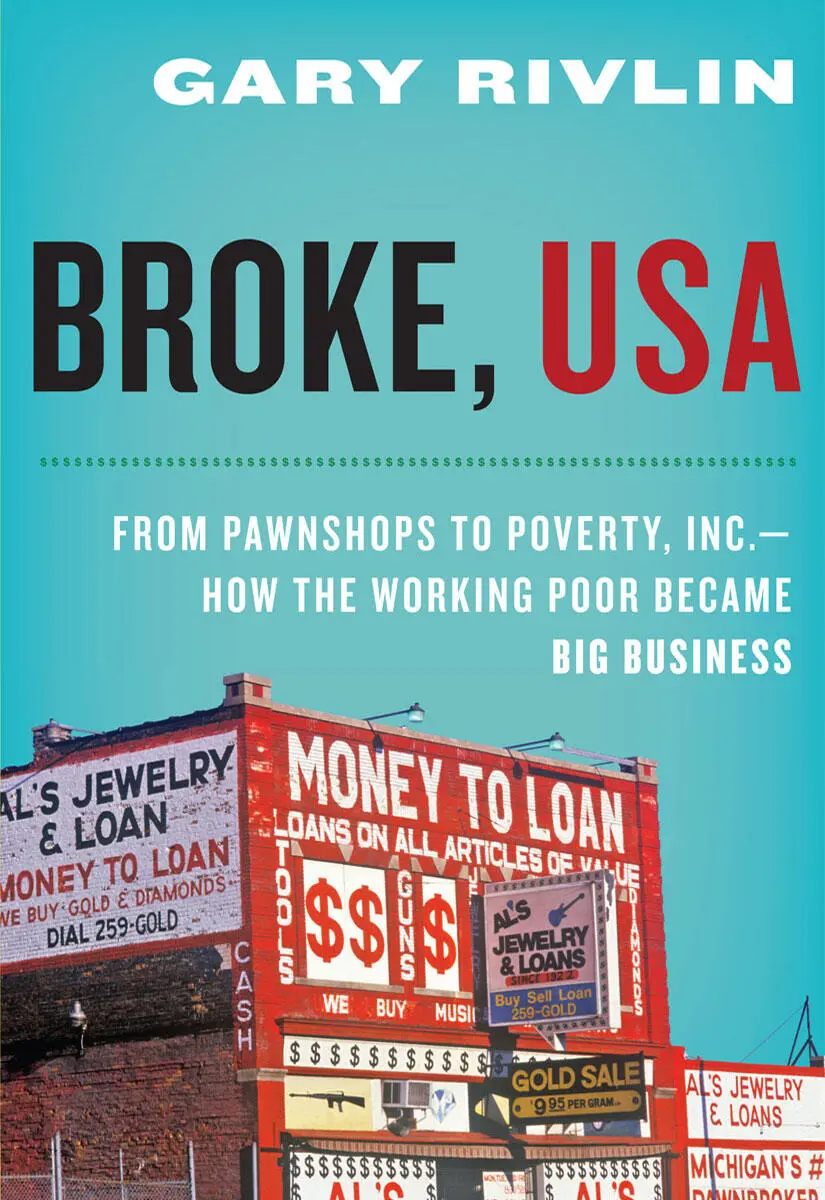
- Название:Broke, USA
- Автор:
- Издательство:HarperCollins Publishers Inc.
- Жанр:
- Год:2010
- Город:New York
- ISBN:978-0-06-199794-5
- Рейтинг книги:3 / 5. Голосов: 1
-
Избранное:Добавить в избранное
- Отзывы:
-
Ваша оценка:
Broke, USA: краткое содержание, описание и аннотация
Предлагаем к чтению аннотацию, описание, краткое содержание или предисловие (зависит от того, что написал сам автор книги «Broke, USA»). Если вы не нашли необходимую информацию о книге — напишите в комментариях, мы постараемся отыскать её.
Broke, USA — читать онлайн бесплатно полную книгу (весь текст) целиком
Ниже представлен текст книги, разбитый по страницам. Система сохранения места последней прочитанной страницы, позволяет с удобством читать онлайн бесплатно книгу «Broke, USA», без необходимости каждый раз заново искать на чём Вы остановились. Поставьте закладку, и сможете в любой момент перейти на страницу, на которой закончили чтение.
Интервал:
Закладка:
Check ’n Go printed cards offering regulars a $20 discount for every new customer they brought in. The other big chains did the same. “Now, remember,” Browning said in a deep voice, in imitation of one of her manager’s, “give two referral cards every time you make a loan.” She reverted to her own voice: “The idea was that we could get you to convince your mother, your cousin, your next-door neighbor, your best friend to come to our place.” To extend their reach, the home office instructed that they leave brochures in factory break rooms and in the mailrooms of apartment complexes around town. The company had brochures printed in Spanish. “Grow your fan base by using the Hispanic marketing materials,” read one missive from corporate. Another encouraged store managers to treat even phone calls from people asking for an address or the store’s hours as an opportunity to sell. “Don’t simply answer these questions,” a memo advised. “Find a way to make them your customer!”
But of course new customers wouldn’t do the company much good unless they were converted into semi-regulars. So Check ’n Go programmed its computers to spit out lists of customers who had gone sixty days without taking out a new loan. “We got one of those reports every single morning,” Browning said. “We were supposed to call every person on that list and then also send them a letter. And that person kept showing up on your reports until they came back in.” Management taught her little tricks. “You were supposed to say, ‘I notice you haven’t been here in two months; why don’t you stop by later, we’ll update your information. I’m sure you can use some extra money right now.’” And to keep Browning and her cohorts motivated, corporate offered both a carrot and a stick. Store managers would receive an extra bonus if enough of their sixty-day borrowers returned each quarter—or would get grief if their “customer reactivation rate” was too low. Mainly Browning got grief.
“As far as I was personally concerned, we were being told to harass these people until they walked back in the door,” she said.
Another order that she found even more noxious was the practice of up-selling a loan. Check ’n Go, like most payday lenders, allows people to borrow up to one week’s salary. Up-selling was aimed at a customer who earned enough to borrow $500 at a time but borrowed less than that. “I was to repeat, no less than three times, ‘Now, are you sure you don’t want to borrow $500 before I print this contract?’” Browning said. While she was printing the contract, she might say, “You know I can void this out; are you sure you don’t want that extra money?” Reviewing the contract offered one more opportunity to make her pitch. On the final page of the agreement it laid it out in black and white: We have offered you $500 but you are taking a lesser amount. And Browning would say, “Now you see, you qualify for $500; are you sure this $200 is going to be enough money?”
Collections was its own torture. “If a customer was late paying us back, we were to contact that customer a minimum of three times a day,” Browning said. People give three references when taking out a loan and she was instructed to phone them as well. If they were still late in paying off the loan, she was to phone their place of work. “It was no holds barred,” she said. “You were supposed to do whatever you need to do to get the company’s money back.”
At least the home office didn’t force her to make what some of her rivals referred to as “field calls”—visiting people at home. “If they weren’t there,” Browning said, “they’d have to put on a door hanger that says, ‘You owe us $575, you need to contact our office immediately,’ or whatever, and then it’s there for everybody who comes to the door to see. I had customers tell me they even had people knock on their next-door neighbor’s door to ask what time they’d be home. The idea was to embarrass them into paying any way they could.”
Through her large plate-glass window, Browning could see the Advance America outpost that had opened directly across the street in 2006. Cashland had leased a storefront a few doors down from her own in 2003 and a fourth store called Quik Cash opened in 2005. And so Browning would amuse herself during idle moments watching people play a kind of human pinball between shops.
Her store could boast the biggest parking lot so generally people made her shop their first stop. “They’d borrow money from me and walk straight from my door across the street to the Advance America,” she said. “I don’t know what they did in there, whether they were paying back or borrowing more, but then I’d watch them walk to the next store and then finish up by walking across the street to Cashland. Then they’d walk back up to my place to get their car.” The whole sequence usually played itself out in forty-five minutes or less.
Browning would see the occasional new face inside her store, but she spent most of each day loaning money to the same core of customers. Browning is a talker and inevitably many of these people became friends. They would bring her leftover slices of birthday cake; they would surprise her with cupcakes they had baked. One couple popped in one day for no other reason than to drop off a few apples from the bushel they had bought at a roadside stand out on the highway. Is it any wonder, Browning asked, that with time she saw her job as less about earning quarterly bonuses and more about getting a good night’s sleep so she could survive another day?
“The whole thing came to be about money and greed,” she said.
Maybe a bartender has the same feeling when the glum-faced man who every once in a while used to sneak in for a mid-afternoon snort starts showing up at 11 A.M. for his first nip and eventually is stopping by every day before work. After a time Browning took to applying a kind of shock therapy to her regulars. She would lecture them about the high cost of a payday loan. Stop buying that six-pack of beer, she would order them. Stop going out to eat. And then to punctuate her point she would swivel her computer monitor around. On the screen there was a tally of all the fees they had paid the company over the years.
Browning tried the gambit on a woman named Susan and it worked exactly as she had hoped it would. Susan, an administrator at the local hospital, had been borrowing the same $500 every two or three weeks for almost two years. That $500 was costing around $1,500 a year in fees. “I thought I was going to have to pick her up off the floor,” Browning said. Worse, the woman was borrowing money from other stores. At Browning’s suggestion she borrowed $450 instead of the usual $500, and tried to borrow $50 less each successive time. The last time Browning ever saw her was when she came in to pay back the $150 she owed plus the $22.50 fee.
But far more common were customers like David, a GM pensioner who was as reliable as the morning mail. Each month began the same way, Browning said, with David standing outside her door, two cups of coffee in hand. “If it was the first of the month,” Browning said, “I knew I could count on a McDonald’s coffee.” David, she said, received a monthly pension of around $2,600 plus another $1,800 or so from Social Security—more than $50,000 a year. His house was paid for. But he was an inveterate gambler and always broke. Every month he would borrow the $500 maximum—and then $800 starting in 2005, after the legislature increased the ceiling on a payday loan. It had been costing him $900 a year in fees to borrow $500 a month and then $1,400 a year once he was able to borrow $800.
Browning would plead with him to borrow less. “We really need to get you out of this,” she would tell him. It was too late, though. He owed money to stores all around town. When Browning ran into him at the local Walmart in the fall of 2007, a few months after she was fired, he confessed to her that he was juggling loans at seven stores. She figured that in the ten years and three months she served as a manager with Check ’n Go, David had paid $9,150 in fees on 115 loans. That, of course, didn’t count the tens of thousands of dollars he was paying to other stores. And he was hardly alone. Browning said she did the math. In the final two years she ran her store, six in every ten people she would see in a given week were customers she saw at least once a month.
Читать дальшеИнтервал:
Закладка:
Похожие книги на «Broke, USA»
Представляем Вашему вниманию похожие книги на «Broke, USA» списком для выбора. Мы отобрали схожую по названию и смыслу литературу в надежде предоставить читателям больше вариантов отыскать новые, интересные, ещё непрочитанные произведения.








Обсуждение, отзывы о книге «Broke, USA» и просто собственные мнения читателей. Оставьте ваши комментарии, напишите, что Вы думаете о произведении, его смысле или главных героях. Укажите что конкретно понравилось, а что нет, и почему Вы так считаете.